 |
| Hong Shui calls on his audience to rise up and fi ght the Japanese during a speech in 1938. [Photo provided to China Daily] |
A common cause
"Hard on the heels of the Russians came the Japanese and the Germans. This was not entirely surprising because many Kuomintang leaders, including Chiang, had studied at a military academy in Japan," said Chen Yu, who has written extensively about Whampoa's history.
However, the Japanese presence caused unease from the start, mainly because of the growing tensions between the two countries, which culminated in Japan's invasion of China in September 1931. "The leaders at Whampoa then looked to Europe for the world's most advanced military theories and weaponry. They bought heavily from Germany, the technological giant of Europe, and along with the German tanks and machine guns came the German instructors," he said.
But it didn't last. By the late 1930s, Germany had become increasingly preoccupied with its own ambitions, which would soon drag the world into war. As the German instructors headed home, China headed toward its inevitable conflict with the Japanese. The Communists and Nationalists joined forces, and former classmates from Whampoa, who had previously fought on different sides, discovered a common goal: to expel the invaders.
The Soviets returned briefly, but never in the same numbers as before, according to Chen Yu. "From 1937 to 1941, the Chinese basically fought the Japanese without outside assistance. It was a really hard time. Then came the Japanese attack on Pearl Harbor on Dec 7, 1941, which brought the US into the war and turned the tables," he said. "The Americans began to assist China in its battle against Japan. The Flying Tigers (a mixed squadron of pilots from China and the US) may be the best-known unit, but military instructors were actually appearing at many Whampoa campuses - the academy had set up more than 20 branches in the unoccupied areas."
In the past decade, Wang Yi, a high school teacher turned Whampoa history enthusiast, has spoken with hundreds of World War II veterans. "The American instructors surfaced in the conversations, albeit briefly. A man who'd studied at the Whampoa branch in Xi'an recalled his first class with an American instructor. Instead of diving directly into a discussion about the war, the teacher spoke about George Washington and Abraham Lincoln, and the support the American public showed for the Chinese cause," the 55-year-old said.
"It's worth noting that most of the students at Whampoa's Xi'an branch had come from northeastern China, which was overrun by the Japanese in 1932. Bereaved and homeless, they needed a big injection of hope and confidence to carry on during the most critical moment of the prolonged conflict. It seems to me that the American instructor understood that."
Although interpreters were needed to get the message through, some of the students were gifted linguists, especially those from neighboring Asian countries, many of whom, including Hong Shui, had traveled widely before entering Whampoa.
According to Chen Hanfeng, his late father was following the footsteps of Ho Chi Minh, the founder of the Democratic Republic of Vietnam. Fluent in Russian, English, French and Chinese, Ho Chi Minh came to China in 1924 to act as an interpreter for the Russian instructors, but also occasionally delivered lectures on socialism to his fellow Vietnamese at Whampoa.
"He later opened a class to train Vietnamese officers at Whampoa's Nanning branch, not far from the Sino-Vietnamese border," Chen Hanfeng said.
"Then there were the Koreans, who had set up a provisional government on Chinese soil before starting to cultivate their own revolutionary forces, with 'Koreans-only' classes at several branches of the academy. The atrocities those countries endured at the hands of fascist Japan formed a tight bond between the young students," he added.
An 'excruciating' decision
Fluent in Chinese, with an unmistakable northern accent, Hong Shui's foreign background was never suspected, not even by his future wife. "When my mother first saw him in about 1937, my father was making an anti-Japanese speech, in Chinese, to a group of avid listeners. My mother later told me that she was deeply impressed, and that the last thing in her mind was that my father might be a foreigner," Chen Hanfeng said.
In January 1938, Hong Shui, who had joined the Chinese Communist Party in 1927, married Chen Jiange, who was also a committed communist. Chen Hanfeng was born in 1944.
A year later in November, 1945, while Chen's mother was pregnant with her second son, Hong Shui received an invitation from Ho Chi Minh, who had become the president of Vietnam. The Japanese had been defeated, but the French, who first colonized Vietnam in the late 19th century, had returned.
"My father answered the call and was made a general in the Vietnamese army. During his stay in Vietnam, news reached him that my mother, my younger brother and I had all died in the Chinese Civil War (1946-49) between the Communists and the Nationalists," he said.
The return
Although inconsolable, at Ho Chi Minh's request Hong Shui married a Vietnamese woman and returned to China in 1950, only to discover that his family was still alive.
"It was excruciating for them both, but my mother made the decision to end the marriage. Looking back, it was so obvious that she spent her whole life loving and protecting my father. She made sure he had a peaceful life during his final five years in China with his Vietnamese wife and children," said Chen Hanfeng. "And she made an effort to get my brother and me to believe that our father was always with us, wherever he might be.
"When she came to my school and told me the truth, it was, as she later told me, because my teacher had called to say I had been naughty," he said. "But I only got to know the whole story in the mid-1960s, during the Vietnam War, when we were invited to meet visiting Vietnamese officials.
In 1956, a year after he'd been made a major general by the Chinese government, Hong Shui was diagnosed with lung cancer. He insisted on returning to Vietnam, and passed away in October of that year. Chen Jiange died in 2012 at the age of 99.
Reflecting on the significance of his father's time at Whampoa, Chen Hanfeng said: "My father's Chinese name means 'flood'. He once likened himself to a torrent of water, charging irresistibly through life's rugged landscape, against all the odds. In the same way, Whampoa really was the place where all these different 'rivers' met and formed a strong torrent that changed the world once and for all."
Contact the author at zhaoxu@chinadaily.com.cn
|
 |
|
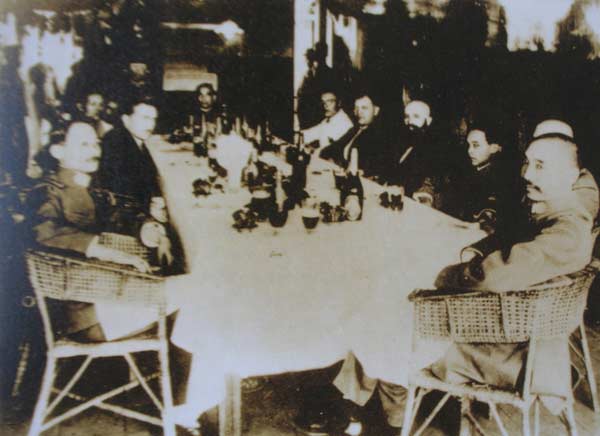
Sun Yat-sen, renowned revolutionary and founder of the Whampoa Military Academy, dines with military advisers from the former Soviet Union, many of whom taught at Whampoa between 1924 and 1926. [Photo provided to China Daily] |


Copyright 1995 - . All rights reserved. The content (including but not limited to text, photo, multimedia information, etc) published in this site belongs to China Daily Information Co (CDIC). Without written authorization from CDIC, such content shall not be republished or used in any form. Note: Browsers with 1024*768 or higher resolution are suggested for this site.
License for publishing multimedia online 0108263 Registration Number: 130349 



