|
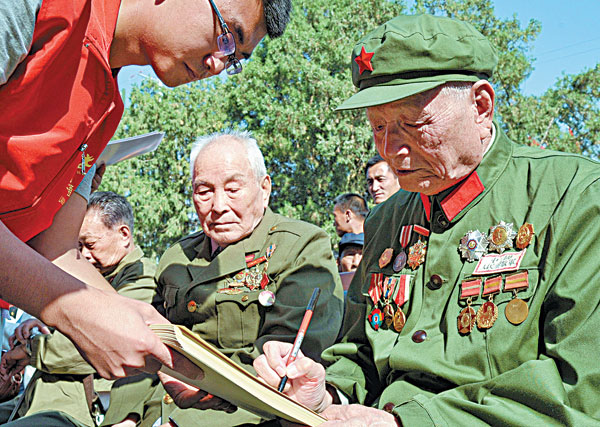
A veteran signs his name in a book for a volunteer on Sept 3, marking the 69th anniversary of China's victory in the War of Resistance against Japanese Aggression. Guo Gang / Xinhua |
Xia Xiaobo cannot wipe from her mind the memory of her first trip to Tengchong, Yunnan province, in much the same way she failed to wipe the accumulating rainwater from the gravestones in Tengchong Guoshang Cemetery nearly a decade ago.
|
History of the heart Every time he is asked whether political concerns influenced his decision to invite former Kuomintang soldiers to give lectures on campus, 58 years old Sun Meitang replies the truths of history should be respected by all. Last October, Sun, the former vice-president of the School of Marxism at China University of Political Science and Law, invited six soldiers to share their stories with about 400 students in the university. He says the lecture was originally supported by the University's Youth League Committee, but they withdrew from the activity due to some concerns. "But personally speaking, I think there should be no Party perspective when we are facing the facts of history. Historical truths should be recognized by everyone." For most young college students, their views of this period of history are based on biased information or even just movies or TV dramas, Sun says. "Patriotism is just a concept floating on the surface of their minds," he says. However, the lectures made a big impression on them from the moment that the six soldiers walked slowly into the lecture hall as a bugle sounded. "Tears were running down the faces of students when the veterans, who were all in their 90s, talked about the deaths of their comrades-in-arms," he said. "That is the moment people can understand the devotion of these old soldiers and their deep love towards our motherland." Such efforts from Sun and other scholars, as well as the efforts of volunteers, have influenced an increasing number of young people. Lin Yaoqian, 23, a postgraduate from the School of Foreign Languages at Peking University, said knowing the details of the history is a journey of understanding. She used to post articles and pictures of old soldiers on the Internet, to attract attention to the stories of people she says "contributed to the country's prosperity". "But now, I'd like to hold such respect in my heart, as part of me," Lin said. By Yang Wanli and Zhao Xu |
"There they were, scattered across the mountain slope under a leaden sky," recalls Xia, who is now 21. "The rain was persistent and cast a misty gauze over the surroundings, while streaming down the grey stone slabs. Even to a little girl, they were a sad and lonely sight. When I looked closely, some didn't even have names."
More than 3,000 soldiers of China's Expeditionary Force are buried in the 13-acre plot of land. They were among the 9,168 who died in 1944, during the four-month battle to retake the county of Tengchong from the Japanese.
Xia says she knew nothing about what had happened 70 years ago until her mother, who is a big history buff, took her to the cemetery on a detour from their usual sightseeing.
What her mother probably never imagined back then was her daughter would return 10 years later, not as an impressionable youngster, but as a seasoned volunteer dedicated to unearthing the truth of history and making sure that those who had fought in war and are still alive can live out their final days with love and respect.
"I went with dad in July last year to talk to some surviving veterans, most of whom are in their 90s," said Xia. "With all the historical material I'd read in between the two visits, I felt I was finally able to engage myself in the dialogue, and to say a heartfelt 'Thank you'."
Xia belongs to a fast growing number of young Chinese volunteers who have made it their mission to rediscover the country's wartime history and honor some of its long-forgotten heroes.
Other half of the story
"The war against fascist Japan was fought by both the Nationalists under Chiang Kai-shek, leader of the Chinese Nationalist Party, or Kuomintang, and the Communists. But with the ensuing civil war (1945-48) and the ultimate triumph of the Communist Party of China, half of that resistance story passed into oblivion," said Wang Guan, the 27-year-old founder of the Nanjing-based non-governmental organization 1213 Volunteers Association. The number stands for Dec 13, the day the occupying Japanese troops embarked on the Rape of Nanking.
"Also passing into oblivion were the Kuomintang soldiers who were part of that story, veterans who had long learned to bury their precious memories in the back of their minds," she said. "But things really started to change in the early 2000s."
Wang was referring to the landmark speech made in 2005 by then-president Hu Jintao. In the speech, delivered on the 60th anniversary of the end of the World War II, Hu paid full tribute to "the battlefield at the front", where the Kuomintang army collided with the Japanese, at a huge human cost. This year, President Xi Jinping invited both Communist and Kuomintang veterans to a ceremony on July 7 at the site of the Marco Polo Bridge in Beijing where the Chinese army fired the first bullet against the Japanese invaders on that day 77 years ago.
"The leadership has sent a clear signal. But for us young volunteers who were born in the 1980s and 1990s and who grew up learning very little about the Nationalist participation in the war, getting to know the story in its entirety is a deeply personal undertaking," Wang said. "By digging into history, I have reconnected myself with the spirit of my country."
In 2007, she accompanied an 88-year-old veteran to the bridge. He stood silently on the bridgehead for a long time, then before turning to leave, the old man bowed and said just one thing: "I'm sorry, Captain. My job was to protect you, but you died, and I'm still alive."
"I saw tears running down his face and knew for the first time in my life what loyalty means," Wang says.
Although young volunteers are invariably impressed by the stories that surface during their talks with the veterans, it is these men's grinding poverty that causes the biggest initial shock, said Wang Yi, a high school Chinese language teacher. Over the past few years, Wang has been taking her students, mostly between 13 to 15 years old, to regularly visit Nationalist veterans from the war, in her native Jilin Province.
"The majority of my students, at a local private school, come from well-off families. For them, the sight of an old, frail man enduring loneliness in a humble shack is upsetting enough. Many of them burst into tears before anything is said," recalls Wang Yi. "And if the pitiful condition of these men in their twilight years arouses sympathy in their hearts, then the knowledge that these men had once fought the invaders totally confused, if not outraged, them."
Wu Hanzhong is a former Nationalist soldier from those days. When Wang Guan found him, on the outskirts of Nanjing, he was literally living in the junk.


Copyright 1995 - . All rights reserved. The content (including but not limited to text, photo, multimedia information, etc) published in this site belongs to China Daily Information Co (CDIC). Without written authorization from CDIC, such content shall not be republished or used in any form. Note: Browsers with 1024*768 or higher resolution are suggested for this site.
License for publishing multimedia online 0108263 Registration Number: 130349