A nationwide problem
 |
|
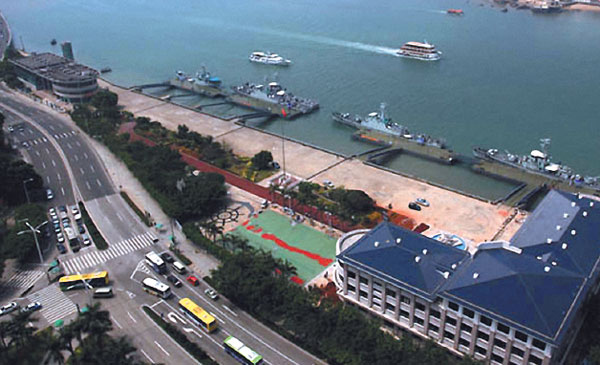
A file photo of a military port in Xiamen, Fujian province. Operations at some PLA bases have been disrupted by the encroachment of residential buildings and the daily activities of local residents. Provided to China Daily. |
Fu's division is just one of many threatened by the rise of tall buildings and architectural encirclement. Numerous PLA establishments are being disturbed by civilian or business sprawl, said Ma Yifei, a senior officer at the PLA General Staff HQ who is in charge of planning and overseeing military infrastructure.
He mentioned an important naval port in Dalian, Liaoning province, that had to spend more than 10 million yuan ($1.6 million) to erect a wall 800 meters long and 22 m high to conceal its facilities and ships from the residents of a nearby array of European-style villas, and residents of several high-rise buildings near the base that provide a clear view of operations inside the perimeter fence.
The issue isn't confined to specific regions, either. The PLA Daily cited an inspection report that showed that in the southern province of Hainan Island, a local government near an unidentified naval base continued to allow the construction of foreign-invested villas in a restricted military area, even though the provincial authorities had spent a huge amount of money on acquiring, and then demolishing, many of the houses.
The PLA navy has also been affected, according to the report. Several military ports have been disrupted by fishermen laying their nets in the middle of waterways used by military vessels, and some have even attempted to force warships to deviate from their allotted courses.
"Some of these ports are in remote places that used to be sparsely populated. However, with China's economic development, they are now homes to tourist attractions or commercial properties," Ma said. "Some profit-centered entrepreneurs simply ignore our regulations, and GDP-oriented officials turn a blind eye."
In Beijing, business premises, orchards, and vegetable gardens are encroaching on the antenna area of a communications facility, according to a report in Oriental Outlook magazine. Meanwhile, tall buildings that block radio signals have seriously compromised the use of radars at a PLA installation in the Guangxi Zhuang autonomous region, and a surface-to-air missile unit in Shanghai.
Legal moves
In an attempt to rectify the situation, China's top legislative body, the National People's Congress, passed the Law on the Protection of Military Installations in 1990. Since then, a number of notices and rules on the implementation of the law have released to better protect military facilities.
Despite these efforts, the law has been poorly applied in many regions, according to Ma.
"There are about 4,800 committees within local governments and military authorities that are dedicated to protecting military facilities, but only a few of them meet regularly. That's because of a number of reasons, including a shortage of members, and frequent changes of personnel - the committees are usually composed of military officers and civil servants who have been assigned on short-term postings".
Zhang Junshe, a senior researcher at the PLA Naval Military Studies Research Institute, said many local officials are convinced that no country is likely to start a war with China so the use of land and other items for military construction is a waste of resources.
Conversely, some PLA units have failed to understand the risks, and haven't taken appropriate measures to protect their facilities, he added.
In addition, the military has no jurisdiction over civilian properties, so infringements have to be reported to local authorities, which then take action as and when they see fit.
"It's not unusual for local governments to be reluctant to curb commercial activities, or hesitate to establish restricted areas around a military unit," Zhang said. "Once a restricted area is established, local governments are not allowed build new structures at will."
Song Xinfei, a staff officer under Ma's command, said the intelligence agencies of some foreign powers also use security loopholes to obtain information about PLA facilities. They establish companies near bases or use sightseeing tours around military installations to gain access and gather information, he said. "Many soldiers have told me that a number of foreign-invested enterprises always seem to establish a presence wherever we relocate our facilities."
Strict enforcement urged
To resolve the potential threat, in June the NPC approved a number of amendments to the Law on the Protection of Military Installations.
The revised law expanded the definition of military facilities to include border controls, the coast guard, and temporary facilities for combat needs. Governments at county level and above are obliged to consult the PLA about developments, urban planning, and construction projects that are likely to affect military facilities. Activities that may hinder radio communications have also been banned in the immediate vicinity of military installations.
The amendments included detailed definitions of the measures guards are allowed to use against intruders at facilities, including forcible expulsion, detention, and handing serious offenders over to the police or the national security department. Guards are also authorized to confiscate devices, tools, and other articles carried by intruders, and remove any barriers that threaten security.
In addition, the law requires the PLA to consider the economic and social needs of local communities when drafting plans. The military must also consult local governments before installing facilities, and all programs must be subjected to environmental impact evaluations. The PLA has been told it must not site installations in crowded civilian areas, while civil officials have been told to refuse permission for commercial developments near military bases.
"Although the central government has formulated a range of new measures and improved the law to address the problem, many local authorities have failed to realize the importance of ensuring the security and operations of military units," Zhang said.
"The military should work with central government departments to launch a nationwide inspection to ascertain if law is being enforced correctly, and to punish those who break the law. That will ensure national security"


Copyright 1995 - . All rights reserved. The content (including but not limited to text, photo, multimedia information, etc) published in this site belongs to China Daily Information Co (CDIC). Without written authorization from CDIC, such content shall not be republished or used in any form. Note: Browsers with 1024*768 or higher resolution are suggested for this site.
License for publishing multimedia online 0108263 Registration Number: 130349 



