The trade game that everyone must win









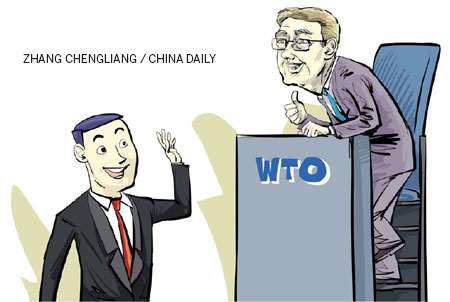
Attempts to reach agreement on global trade are particularly important for china
While the European Union announced this month that it will seek to impose duties as high as 47.6 percent on European imports of Chinese solar panels, the 159 members of the World Trade Organization were voting to replace the outgoing French Director-General Pascal Lamy with a Brazilian, Roberto Azevido.
China has a lot to gain from a new global trade agreement. It is very much in China's interest to play as active a role as possible in enforcing the WTO's existing rules while supporting a successful conclusion to the difficult negotiations to establish an improved global trade regime.
Global trade accounts for more than a quarter of global economic activity. In a world still suffering from the deep wounds of the 2008 financial crisis, it is vital that trade continues to grow. But the current set of negotiations to replace the last global trade agreement reached in 1993 have yet to succeed. In frustration, the major trading countries, including China and the United States, have turned to arranging bilateral or regional trade agreements. Yet regional trade agreements are no substitute for the huge economic benefits brought by a worldwide agreement.
Some commentators have hailed a Brazilian's appointment to one of the key global institutions as a victory in the battle by the world's emerging countries to wrest control over global governance away from the developed nations. But it is more important than that, because a new global trade agreement would provide a vital spur to global growth. Failure would help to bring on the new economic dark age that many fear.
Why does unencumbered trade between countries make such a big contribution to global prosperity? To the English speculator and writer David Ricardo (1772-1823) we owe the key insight that a country will always be able to improve its economic position by trading with another country, because foreign trade enables a country to allocate its own productive resources more efficiently.
Until Ricardo it was widely believed that a country benefited from trade by limiting imports and maximizing exports. After Ricardo, economists began to understand that foreign trade - both imports as well as exports in goods and services - plays a vital role in improving a country's economic efficiency, and hence its productivity and wealth.
But Ricardo's insight is not immediately obvious when imports displace products made by the importing country's own enterprises and workers. That is when countries start to erect barriers to trade and market entry, reducing the benefits from free trade. To keep trade free and fair, countries need to agree and follow a system of rules.
It was not until 1948 that the main trading countries, still under the influence of post-war cooperation, were able to set aside local concerns in favor of the prospect of shared prosperity. The General Agreement on Tariffs and Trade (later the WTO) was born.
Trade as a proportion of global economic output has grown from 8 percent in 1948 to more than 25 percent today, and is the main reason for the reduction in poverty in Asia and South America. China's entry to the WTO, finalized in 2002, has been the largest single event in this story, unleashing a fresh wave of prosperity not just in China, but around the world, as every country has been able to benefit from the entry of such a large economic player into a greatly enlarged global system.
The development of international trade depends on each participant being able to see its own self-interest as part of a rules-based global economic system. For trade to advance, countries must be prepared to yield apparently precious domestic interests for the large, but intangible future gains that follow from greater economic openness.
Tariffs that raise the price of imported goods to protect domestic producers limit the process of economic improvement that trade brings, while making many everyday products, including food, more expensive. Among the world's major economies, India, with more than 10,000 items subject to import tariffs at an average of 14 percent, leads the way in trade protection, while China maintains tariffs on more than 7,000 items, at an average of 11 percent. Even the US, with 5,600 dutiable imports and the European Union, with more than 6,100, still have great scope to benefit from freer trade.
The US, as the world's largest economy and second-largest trader, remains the key component of the global economy, but US leadership of the Trans Pacific Partnership and the Atlantic Trade and Investment Partnership, neither of which includes China as a participant, suggests that the US is now focused on regional trade agreements aimed at excluding China.
Although the economic benefits from China's emergence have benefited everybody, the country's rapid emergence as a major economic power has ruffled more than a few feathers in the developed world. But for China, trade has been the key that has unlocked its economic potential. Even if China's future development may depend more on the evolution of its domestic market, the country's openness to foreign goods and investment will continue to play an essential role in improving its productivity and increasing its wealth.
China should see itself as one of the main beneficiaries of a new world trade agreement, and should be a principal supporter of the WTO as the forum for bringing about freer trade. Conversely, China will be a big loser from the failure of a new WTO agreement, as the world's major trade players continue to arrange their own bilateral and regional trade deals.
The appointment of Azevido as head of the WTO is extremely important to the global economy at a point when world growth seems to be faltering once again. Even though Brazil is itself hardly a model of free trade, maintaining an average import duty of 12 percent on more than 9,000 imported items, it is a member in the increasingly influential BRICS grouping and has strong traditional ties with the US that can enable it to operate as an effective broker.
The next meeting of the WTO members in December will determine, to a large extent, whether global prosperity can go on growing, and global poverty can go on diminishing at the rate of the last 50 years. Can the world's major economies, led by the US and China, afford to let it fail?
The author is a visiting professor at Guanghua School of Management, Peking University. The views do not necessarily reflect those of China Daily.
(China Daily 05/17/2013 page11)


Today's Top News
- Report reveals US blunders in Afghanistan
- President of Uruguay begins visit to China
- The logic behind China's internal impetus
- AI push moves innovation into everyday life
- APEC must turn turbulence into traction
- Manufacturing resilient despite lower PMI figure