Talks should give boost to cooperation amid differences









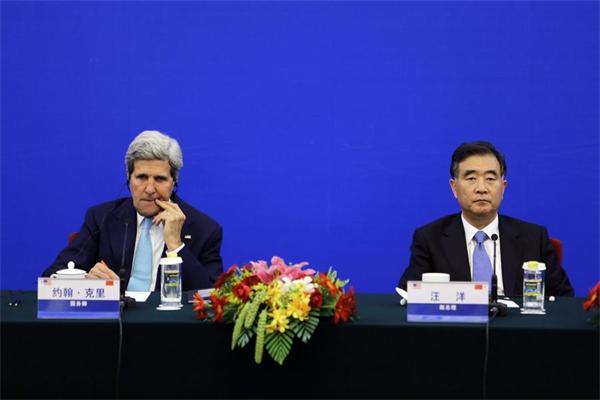 |
| U.S. Secretary of State John Kerry (L) and China's Vice Premier Wang Yang attend a news conference after the 6th round of the U.S.-China Strategic and Economic Dialogue at the Great Hall of the People in Beijing, July 10, 2014. [Photo/Agencies] |
China and the United States will convene next week for the 7th Strategic and Economic Dialogue, their most important and wide-ranging bilateral talks.
Some critics of the event have complained about the low productivity of the talks, but given the misunderstanding and mistrust that exist between the two countries, the talks which involve several hundred people from the two governments are extremely important. In fact, there are actually far more people involved, as teams from the two governments prepare for the S&ED throughout the year. Their frequent interaction itself allows them to better communicate with and understand each other.
High-level engagement has been the key to positive momentum in relations between China and the US since President Richard Nixon's icebreaking trip to China in 1972. In the past two years, we have seen a boost to the relationship after President Xi Jinping and President Barack Obama met for their "shirt-sleeves summit" at the Sunnylands estate in Ranch Mirage, California in June 2013 and agreed to build a new type of major country relationship. Though the US has not been using the term much since then, there is no doubt that such a concept signals the intention for cooperation, not confrontation.
The summit in Beijing last November between Xi and Obama was equally fruitful and far-reaching, when the two countries struck landmark deals on extending business, tourist and student visas, and fighting climate change, among other things.
The same is true with the S&ED. In the past two years, the two countries agreed to start substantive dialogue on the negative list for a Bilateral Investment Treaty, which they exchanged last week in Beijing, and talk on confidence building to avoid dangerous military encounters on the high seas and later in the air.
Some people might think that the South China Sea and cyber security should dominate the agenda this time. The two sides should indeed have a candid talk on such issues, as did last week when visiting Central Military Commission Vice-Chairman Fan Changlong met with US Defense Secretary Ash Carter and other senior US officials.
But at the S&ED, although the two sides should still engage with each other on such complex issues that may not be solved for years in order to prevent them increasing tensions, they should not let such difficult issues eat up the precious time that can be better used talking about ways to increase their cooperation.
The S&ED was established as a major platform to identify new opportunities and manage differences in the bilateral relationship, yet the potential of such opportunities has not been explored as much as they should have been due to the excessive fixation on differences.
Compared with the US, China is still a developing country and it will take a long while for China to catch up. Expecting China to change overnight is just unrealistic. It's just like New Yorkers going to Tennessee or Texas insisting that everything should be as it is in New York. That is not going to happen. Yet that does not mean that New Yorkers and Texans cannot work together to achieve win-win results.
The same is true for China and the US and it has been proved over and over again over the past decades. For example, if the two countries can reach an agreement on the BIT negative list and the air-to-air annex to the code of conduct for military encounters this time, it will inject huge confidence and momentum in the bilateral relationship.
The S&ED is vital for managing differences, but that should not come at the expense of greater efforts to expand cooperation.
The author is deputy editor of China Daily USA. chenweihua@chinadailyusa.com