Asia should build internal trade as US steps aside









Region's economic power can serve to rescue enterprises in the face of looming protectionism
Asia will have to face it - the collapse of the Trans-Pacific Partnership, or TPP.
What Donald Trump's rise to the US presidency means is a "new normal" for the region.
He openly said he doesn't like multilateral trade deals. His campaign adviser, Wilbur Ross, the nominated commerce secretary, wrote in the press listing the three most disastrous trade deals ever made by the United States. He identified them as the North American Free Trade Agrement, or NAFTA, in 1993; allowing of China's entry into the WTO in 2001; and the bilateral free trade agreement with South Korea in 2012.

As for Trump's economic goals, he said he would create up to 25 million jobs for the US. One has to understand what it means. That would be almost five times the number of manufacturing jobs lost (5.2 million) in the country in the 16 years from 2000 to 2016, due to international competition and the wide adoption of automation.
Economists haven't come up with a scenario explaining how 25 million jobs would be created. Inevitably, as people may imagine, it would require a higher level of self-sufficiency, based on marked tariff increases on many daily goods.
The same would be true for the world. There are warnings that global trade volume will not see significant growth for at least the next few years.
This would post a major challenge to Asian economies, which typically have a higher level of export dependence than other economies. Just how serious the challenge would be is hard to measure at this point. But soon enough, in just a couple of months, once Trumponomics begin to be put into action, Asian governments will each need to respond with their contingency plans.
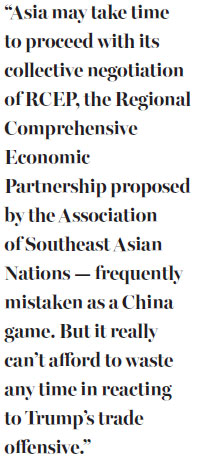
Asia may take time to proceed with its collective negotiation of RCEP, the Regional Comprehensive Economic Partnership proposed by the Association of Southeast Asian Nations - frequently mistaken as a China game. But it really can't afford to waste any time in reacting to Trump's trade offensive.
As to how Trump's economic strategy is to be implemented, by raising government debt or slashing overseas expenditure, is not Asia's business. By the same token, how Asia should react to the sudden contraction in export opportunities should not be Trump's.
International observers say the recent turn of events may allow China to play a leadership role in Asia's intraregional trade relations. This is partly inevitable, since China is one of the largest trading powers in the world, with or without Trump's abandoning of the TPP, which China tends to see as a poorly designed political alliance more than anything else.
China is already the largest trading and investment partner with ASEAN - twice as much as the US in value.
At the same time, China is but one country in Asia. It can't do much to help the whole region, even less "organize world trade", as the Financial Times suggested. Realistically, China will have to work with other countries, and in this matter, most importantly, the 10-nation club of ASEAN.
Some ASEAN member nations are just at the threshold of their industrialization, with a per capita GDP level no higher than $3,000 (2,800 euros; 2,400) per year. It is only recently that they have taken over some manufacturing operations from China. Their potential for supplying a growing middle-class in the region is equally great. China should seek to expand trade with ASEAN and particularly to import more from its poorer members.
In fact, despite their traditional modesty, people in Asia really should not look down on themselves in their newly acquired trading power. The latest IMF data show that Asia's share of global imports is around 35 percent, including those from China, Japan and other advanced and developing areas in Asia.
This is an important share, only around 5 percentage points smaller than the combined US and European Union.
It is also quite a feat, considering the fact that most of these countries have only recently transformed from agricultural societies (some still are) and most are poor in resources except for their abundant labor.
Globalization is not just a "leadership game". During setbacks, it is also a rescue mission. If the several big players in the region, such as China, ASEAN, Japan and India, can sit down and build some temporary framework for boosting intraregional trade, it will be a great service to the millions of small enterprises now facing looming protectionism from across the Pacific.
The author is an editor-at-large of China Daily. Contact the writer at edzhang@chinadaily.com.cn
(China Daily European Weekly 12/02/2016 page9)




Today's Top News
- High-speed rail mirror of China's modernization
- China will deliver humanitarian aid to Cambodia
- The US 2025: a year of deep division
- China to expand fiscal spending in 2026: finance minister
- China's finance minister pledges expanding fiscal spending in 2026
- CPC leadership meeting urges steadfast implementation of eight-point decision on improving conduct