



What can stop Japan from continuing to deny the truth









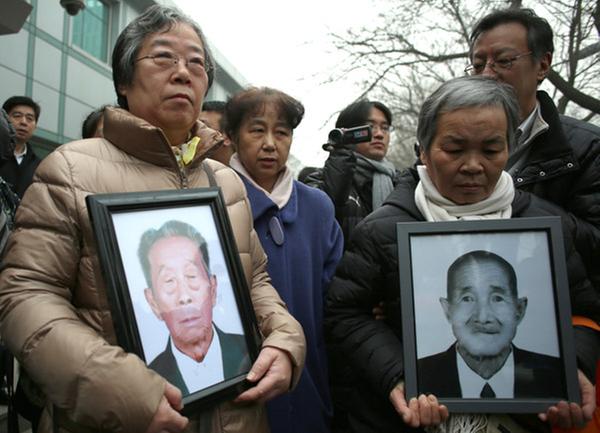 |
| Relatives of deceased Chinese forced laborers, accompanied by lawyer Kang Jian (center, in blue coat), attend Beijing No 1 Intermediate People's Court on Feb 26, 2014, to sue two Japanese companies over forced labor during World War II. The lawsuit seeks printed apologies to be carried in Chinese and Japanese newspapers as well as compensation from the Japanese companies. WANG JING / CHINA DAILY |
Then, why should the Japanese government apologize?
On Feb 17, the National Archives of Japan submitted copies of 19 documents of "comfort women" to the country's Cabinet. The records are a collection of the minutes of the Tokyo War Crimes Tribunal and the trials of Japan's Class-B and Class-C war criminals. The files include the testimony of an Indonesia-based police officer who said he was ordered by the Japanese army to "take" about 200 women to Bali to serve as "comfort women".
Some Japanese scholars and newspapers believe the documents re-emphasize the fact that "comfort women" were forcibly mobilized. But Japan's Deputy Chief Cabinet Secretary Koichi Hagiuda said on Wednesday there is no "direct" proof of forced mobilization of such women.
In 1993, then Japanese Chief Cabinet Secretary Yohei Kono released a statement based on a government study on the issue that began in 1991, acknowledging that women, primarily Koreans, were "recruited against their will, through coaxing (and) coercion". Kono said in his statement:
"We shall face squarely the historical facts as described above instead of evading them, and take them to heart as lessons of history. We hereby reiterate our firm determination never to repeat the same mistake by forever engraving such issues in our memories through the study and teaching of history." And he expressed his "sincere apologies and remorse".
When Abe was prime minister between 2006 and 2007, his administration said it had not found any descriptions by the Japanese military or state agencies to prove the forced mobilization of "comfort women". The denial of historical facts has continued during Abe's second stint as prime minister, which began in December 2012.
In 2014, a government panel reviewed how the Kono statement was issued, calling it a product of diplomatic negotiations between Tokyo and Seoul. The panelists argued that the then Japanese government did not make further inquiries or check more facts to back up the testimonies of the 16 former "comfort women" from the ROK the 1991 study's authors interviewed.
Asked in 2016 to provide written answers to questions put forward by the Geneva-based United Nations Committee on the Elimination of Discrimination against Women, Tokyo said forceful movement of "comfort women" by the Japanese military and government authorities could not be confirmed in any of the documents.
The issue of "comfort women" is so sensitive to the Abe administration that it has attempted to play it down. It argues that "comfort women" should not be described as "sex slaves", which many Western media outlets, including The New York Times, The Washington Post, The Guardian and CNN, use. In Japanese officials' words, "the term 'sex slaves' doesn't match the facts".
But the rest of the world has not forgotten those women. On March 27, the US Supreme Court refused to hear a case calling for the removal of a "comfort woman" statue in California, putting an end to a three-year legal challenge initiated by US plaintiffs supported by the Japanese government.
"By remembering the past, including the women who suffered immensely, we help ensure these atrocities are never committed again," said Ed Royce, Republican chairman of the House Foreign Affairs Committee. "Now that the highest court in the land has spoken, I hope those who've wasted years trying to rewrite history will finally move on."
People cannot help but ask what "direct" evidence can stop the Abe administration from continuing to deny the truth.
The author is China Daily Tokyo bureau chief. caihong@chinadaily.com.cn





