How trustworthy are REITs?









Low rental yields, high taxation are stalling listing of real estate trusts on the mainland
Over almost a decade, the world's second-largest economy has been considering giving developers the green light to package properties into listed trusts to raise funds, while offering investors an extremely liquid stake in the traditionally illiquid pools of real-estate assets.
The much-hyped investment vehicles, however, are still out of reach today for property enterprises and investors alike on the Chinese mainland. Analysts believe the take-off for real estate investment trusts (REITs) will very much have to depend on how and when the long-awaited tax and regulatory reforms come into being.
Back in December 2008, an ambitious "Nine Articles" published by former premier Wen Jiabao on asset securitization and capital-market reform made it clear that the REITs issue was already on the table. Yet, only a handful of "quasi-REIT" investment products have found their way into the mainland market since.
In April 2014, Citic Securities - the largest mainland brokerage house by sales - listed the country's so-called first REIT, backed by two office buildings worth a combined 5 billion yuan ($725 million) in Beijing and Shenzhen, on the Shenzhen Stock Exchange.

Two years on, the mainland REIT market remains negligibly small. In the first nine months of 2016, Japan, Singapore and Hong Kong formed the centerpiece of Asia's REIT business, accounting for 102 of 141 REIT products and 95 percent of the total market capitalization of $209.6 billion, says a report by property consultancy DTZ.
A few available "quasi-REITs" investment products still come in the form of asset management projects, with the bar setting too high for investors to join in the fray. It also highlights regulators' belief that the domestic REIT market is too immature for institutional investors to take part, said Fielding Chen Shiyuan, Asia economist at Bloomberg Intelligence in Hong Kong.
"Basically, I can see an insatiable appetite for REIT products from the Chinese mainland market," said Vincent Cheung Kiu-cho, Hong Kong-based deputy managing director of Asia valuation and advisory services at Colliers International.
"But, investor returns remain a real issue today as the underlying property assets that developers tend to bundle into the investment vehicles are largely low-yielding ones, and whose rental yields are far from being adequate for developers to offer attractive returns," he said.
Cheung noted a years-long practice by mainland commercial real-estate developers to put a whole range of property types, including offices, service apartments, hotels and shopping malls, together into a single development project.
This reflects a trend of REIT products being backed by a complex array of real-estate assets, whose yawning rental yields may put the trusts' returns in question, he added.
"It's the relatively low-yielding hotels and shopping malls, rather than the highest-yielding office buildings, that most Chinese mainland developers are looking to finance through REITs," Cheung reckoned.
Yet, mainland hotels, struggling to maintain occupancy levels that have plunged from 60-70 percent in past years to 30-50 percent, could hardly see a glimmer of hope for higher yields. And shopping malls, whose biggest tenants have long become developers themselves, could not fare any better, he said.
Cheung believed that local financing costs have much to do with defining an "attractive" annual return for REITs.
"The 2-percent financing costs make 3-4 percent returns in Hong Kong rather reasonable, while similarly low financing costs in Singapore make the city state's 6-7 percent returns more than lucrative," he said. "With overly 5 percent financing costs on the Chinese mainland, what level of returns investors would target and what corresponding level of rental yields that developers must receive to support it?"
What's going on in the mainland REITs market is that investment vehicles neither offer a promising investment option nor act as an efficient financing channel, noted Chen.
"The sticking point is a long-awaited tax and regulatory reform," said Andrew Yao Cho-fai, chairman of Hong Kong Shanghai Alliance Holdings Ltd.
"So far, the country's REITs market has dithered in the face of double taxation and duties. Otherwise, it could have played a bigger part in reducing bad debts for banks and helping absorb overcapacity for some developers," he said.
In many major developed markets, REITs are typically required by law to maintain dividend payout ratios of at least 90 percent, making them a favorite for income-seeking investors. Such a requirement also comes as a prerequisite for REITs being exempted from taxation at the trust level, Yao said.
"Without changing the tax system and regulatory regime, any take-off for the REIT market could go nowhere on the Chinese mainland," Yao, who's also a Hong Kong deputy to the National People's Congress (NPC), told China Daily during this year's NPC gathering in Beijing.
Yet, as mainland companies rush to chase fat profits in a property boom, Chen said the timing may be tricky to expect any bold move from the country's REIT market.
Developers in first-tier cities - home to a wealth of high-quality and high-yielding property assets - simply have no problems with financing in a high-flying real-estate market, so much so they don't relish the idea of REIT products, he said.
"Typically, in jurisdictions where real estate stands as the mainstay of local economies, the REIT business may have difficulties in finding its place," Chen said. "Hong Kong is the case. Compared with what's going on in other major Asian economies, you can hardly say the city's REIT business is flourishing."
In only a handful of second- and third-tier mainland cities, where there's no dramatic run-up in local housing prices for the time being, with a cluster of high-quality property assets yet to catch the attention of investors, REIT products may be given full play, he said.
But, this cannot go without tax and regulatory reforms to unleash the earning potentials of local real-estate markets and the REIT business.
What REITs mean for the latest property boom is that they may act as a means to pull the red-hot homes market back into the trajectory of rationality, Chen observed.
"The property bubble is essentially the product of market irrationality," he said. "Very often, market irrationality derives from a lack of transparency and information asymmetry."
The disclosure requirements that come with the launch of REIT products will get investors to reach out to the fundamentals of traditionally opaque and illiquid property companies. With more information, there'll be less room left for panic and speculative buying, Chen added.
sophia@chinadailyhk.com
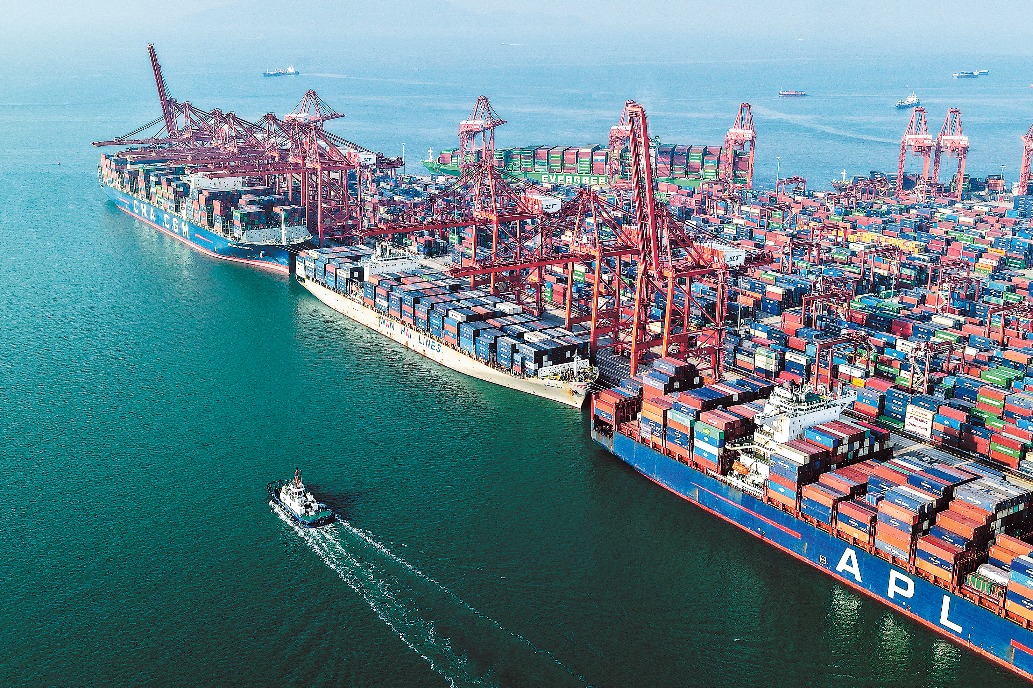
| Citic Securities - the mainland's largest brokerage by sales - set the REITs (real estate investment trusts) market rolling in 2014 by listing the nation's first REIT on the Shenzhen Stock Exchange. Experts, however, have reservations on when the REIT market can really take off, saying investor returns are a real issue and it would be an uphill battle without reforms in the tax and regulatory system. Qilai Shen / Bloomberg |

(HK Edition 05/05/2017 page8)




Today's Top News
- China launches steps against US defense firms, individuals
- Militarism revival efforts criticized
- Leadership highlights Party conduct
- Forging a human-centered future in era of smart machines
- Land-sea trade corridor key to regional progress
- Local rules to be reviewed to help disabled