Chinese media's influence growing in 21st century









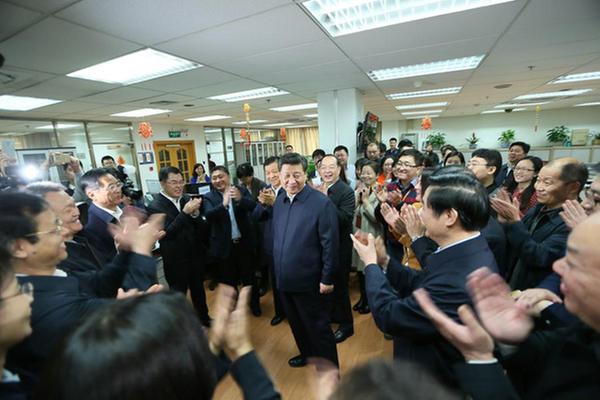 |
| President Xi Jinping meets with the editors and other staff in the newsroom at the headquarters of People's Daily newspaper. [Photo/Xinhua] |
The public address system calls on passengers to board flights to Chengdu and Guangzhou. Outside shops selling duty-free Chunghwa brand cigarettes, a group of workmen are squatting to eat noodles during their lunch break. In the queue for security check, a businessman is giving instructions on his mobile in accented Putonghua. But he is from Burundi, and this is Addis Ababa airport in 2017.
Ethiopia is one of the most pronounced examples of where the Chinese century is already upon us. It will have an impact on everything; not least the media. To understand the media in the 21st century, we will all, at least figuratively, need to learn Chinese.
Traditional media are already feeling the shift. The international re-launch of CGTN-China Global Television Network-marks a turning point in international broadcast journalism. The network, still known within China as CCTV (China Central Television), is expanding its international presence. With journalists in more than 70 countries, production centers in Beijing and Washington will be joined by new studios in London and Nairobi later this year.
President Xi Jinping has urged the network to "tell China's story well, spread China's voice well, let the world know a three-dimensional, colorful China, and showcase China's role as a builder of world peace".
Chinese media remains constrained. Yet the tendency to dismiss it as purely a publicity tool underestimates its sophistication. The State Administration of Press, Publication, Radio, Film and Television, is tasked with the supervision of China's television, radio and film industries. It promotes themes within the world's largest media system, such as the Chinese Dream and the "peaceful rise" of China.
From the exposé of the AIDS "epidemic" in Central China's Henan province to the mass corruption case in Chenzhou, Central China's Hunan province, some of China's largest scandals in recent years have been uncovered as a result of ferocious investigative journalism. In contrast to the adversarial Western "muckraking" model, this so-called "watchdog journalism" works closely with the government.
As China continues its expansion across the international media landscape, some of the principles of Chinese journalism are also being reflected in the Western media.
The SAPPRFT has long encouraged what it calls "constructive journalism". Better known in the West as "solutions-focused journalism", it is the idea that journalists should move beyond the distorted world view presented by breaking news, and focus on what is working in the world. The BBC explicitly endorsed this positive approach in 2016. New BBC World Service programs, such as My Perfect Country, are aiming to solve common problems in countries around the world.
Despite progress, some Western coverage of China itself is still two-dimensional, at best. For example, much of the reporting on the recent Belt and Road Forum for International Cooperation in Beijing recycled decade-old arguments on Chinese neo-colonialism in Africa.
Some in the West have tried harder than others to get to grips with this evolving landscape. In 2014, Mark Zuckerberg conducted a 30-minute question-and-answer session at Tsinghua University in fluent Mandarin, much to the delight of China's engaged netizens.
Many of the disruptive ideas emerging in China's "new media" are world leading. Zuckerberg is not only picking up vocabulary on his visits to Beijing-some of new features of Facebook and WhatsApp are also lessons from ubiquitous Chinese social media platforms such as WeChat and Weibo.
This transformational shift is only just getting started. Last year, China moved up two places in Portland's SoftPower 30-a ranking of countries' soft power, based on a composite index measuring engagement, culture, government, education digital and enterprise.
As China continues to invest in its soft power assets, we can expect it to rise further up the ranks. Its media will be a key part of this. As the driver of a new era of globalization, international norms in media and reporting will continue to flow from West to East. Businesses and governments will need to learn Chinese. And learn fast.
The author is a consultant at Portland Communications.