



It's time Japan stopped dreaming TPP









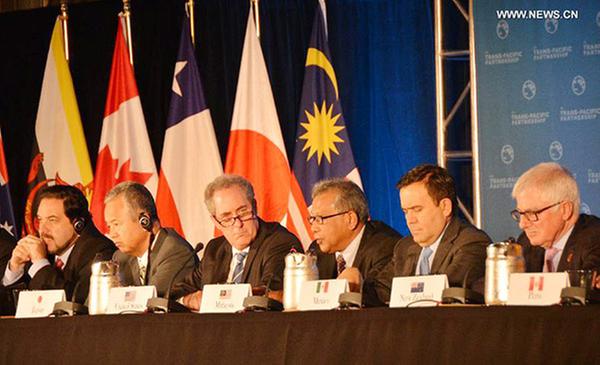 |
| Trade ministers of the United States and 11 other Pacific Rim countries attend a press conference after negotiating the Trans-Pacific Partnership (TPP) trade agreement in Atlanta, the United States, on Oct 5, 2015. [Photo/Xinhua] |
Negotiators from the 11 remaining members of the Trans-Pacific Partnership agreement held a meeting in Japan's hot-spring resort town of Hakone last week where they decided to push ahead with the agreement without any significant changes.
The two-day meeting shows some countries, especially Japan, are desperate to revive the TPP after US President Donald Trump pulled out of it in January. But, sooner or later, Japan will realize it has set out on mission impossible because without major revisions, the pact may remain good only on paper.
In its present state, the TPP agreement can come into force only after being ratified by at least six countries which together account for at least 85 percent of the bloc's GDP. Given that among the original members, the US alone accounts for more than 60 percent of the GDP, enforcing the TPP agreement without modifications is impossible.
But last week's meeting and the one among chief negotiators in Toronto, Canada, in May both stopped short of proposing major changes. Perhaps Japan believes that by effecting only minor changes it can still lure the US back into the TPP.
But since Trump still prefers bilateral trade deals and sticks to his "America First" credo, there is no reason to believe the US will make another U-turn.
Unlike Trump, however, Japanese Prime Minister Shinzo Abe has developed a penchant for multilateral trade arrangements. On July 6, Japan and the European Union announced they had reached consensus on a Japan-EU Economic Partnership Agreement. Abe called it "a model for 21st century economic order".
Considering that Japan has vowed to increase its exports under free trade deals to account for 70 percent of its overall export volume in 2018, Abe is also looking to the TPP and Regional Comprehensive Economic Partnership, along with the outline free trade deal with the EU, to fulfill his economic goal.
However, compared with economic factors, political concerns play a larger role in Japan's endeavor to revive the TPP. In fact, political calculations in the TPP have far outweighed its economic objectives, as major economies such as China and India were deliberately kept out of it to enable the US to regain its waning global influence. And ever since China overtook Japan to become the world's second-largest economy in 2011, Tokyo's ambition to play a bigger role on regional and global platforms has grown by the day.
Given these facts, it is no surprise that Japan is desperate to use the TPP to widen its influence in the region, because once the TPP agreement comes into effect, Japan would be one step closer to achieving its goal of writing the global economic rules. Besides, considering the icy Beijing-Tokyo relations in recent years, Japan could also use the TPP card to contain China's economic influence in the region.
This also explains why Japan has been insisting the TPP agreement be used as a model for the RCEP, in total disregard of the huge differences in the economic levels of participating countries and the fact that the RCEP is a broader free trade arrangement covering more economies in the Asia-Pacific than the TPP.
Needless to say, Japan's stance has markedly slowed down the RCEP process. China has always supported inclusive and open multilateral economic arrangements, because the exclusiveness and overlapping nature of some existing multilateral trade mechanisms are to blame for imbalanced globalization.
As an advocate of balanced globalization, China has actively pushed for negotiations on the RCEP, which involves 16 countries including Japan. And as the world's third-largest economy, Japan needs to make the right choice and follow the trend of the times.
By refusing to change its confrontational mindset, Japan will lose (as well as make other countries lose) the opportunities presented by more inclusive regional economic arrangements such as the RCEP. It's time Japan woke up from its TPP dream.
The author is a senior writer with China Daily. wanghui@chinadaily.com.cn





