Turning deserts into opportunities









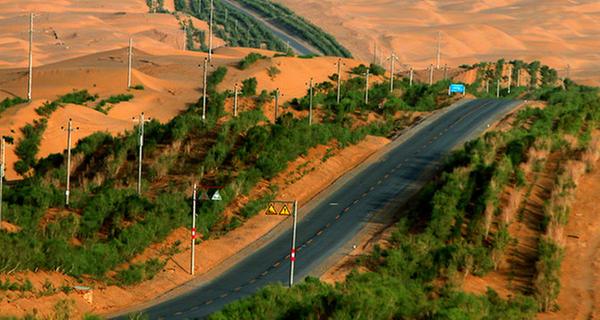 |
| The 562-kilometer road connecting Urumqi and Hotan, which once was plagued by problems caused by the sand, now has desert plants as protection. [Photo/Provided to China Daily] |
Both places were covered by forests and grasslands until about 400 years ago when the Qing Dynasty (1644-1911) opened them for lumber. Following decades of deforestation, grazing forest fires, the two places turned into deserts toward the end of the Qing Dynasty.
However, desertification has been controlled by more than one-third in the 180,000-square-kilometer Kubuqi Desert, the seventh-largest in China, and the 750-sq-km Saihanba Desert thanks to the anti-desertification campaign launched in the 1960s. In fact, the two places are now national parks.
Some common factors have played important roles in helping fight desertification in Kubuqi and Saihanba. Anti-desertification projects the world over take nature's laws into consideration, for which multidisciplinary expertise and modern technologies are needed. And by involving botanists, arborists, geologists, environmental engineers, and hydrologists in the two projects, the authorities have ensured their success.
Important decisions such as what trees and shrubs to plant, so as to make maximum use of the limited water resource are made after seeking the opinions of the experts and in consultation with the local people.
China has learned some lessons in its fight against desertification. For instance, after planting saplings and shrubs that absorbed the underground water in arid areas and then died a few years later for the lack of enough water, the authorities realized not all trees and shrubs can help fight desertification.
The authorities pay special attention to the Kubuqi and Saihanba national forest parks because they are the sources of sandstorms afflicting North China, including Beijing. If the greenery in the two places is not maintained, the sandstorms can get worse and extract huge economic and environmental costs.
To effectively fight desertification, however, the participation of enterprises and local residents is also necessary, because such environmental projects require huge amounts of energy and capital.
While working on a report on the desertification-control station in Hexi Corridor in Northwest China's Gansu province a couple of years ago, I interviewed a farmer in his late 70s, who told me that dozens of villagers have spent their entire life in preventing the nearby desert from engulfing the village. But despite their best efforts, after the elderly farmers die the village will turn into desert as the young people of the village have migrated to cities to earn a better living.
The Elion Group, a green technology and finance company, has been part of the Kubuqi desertification-control project since 1988, and played a crucial role in introducing capital and technologies, and employing local residents. Advanced agricultural technologies used in anti-desertification projects can help create business opportunities in the long run, by, for example, planting herbs that can be used in medicines. In fact, such herbs have been planted under the solar power panels in Kubuqi, generating revenues for local inhabitants.
Such endeavors can also help change people's concept about environmental projects and prompt them to take advantage of the "desert economy". In Saihanba, for instance, many of those born after the anti-desertification project was implemented share a common first namelin (meaning forest)-reflecting local residents' respect for the vegetation that protects their homes.
Besides, the government should also take measures to provide better public services for local residents and raise their environmental awareness. Since desertification-control projects yield results only in the long term, they should be continued once started.
China has about 2.6 million sq km of deserts, and another 1.7 million sq km of desertified land, which together is about one-tenth of the world total. Thanks to the authorities' desertification-control efforts, desert and desertified areas in China have on average reduced by about 4,000 sq km a year in recent years. China's success in the fight against desertification, as such, is a contribution to global efforts to control the spread of deserts.
The author is a writer with China Daily. liyang@chinadaily.com.cn