



US' trade policy shows it seeks to be both player and referee









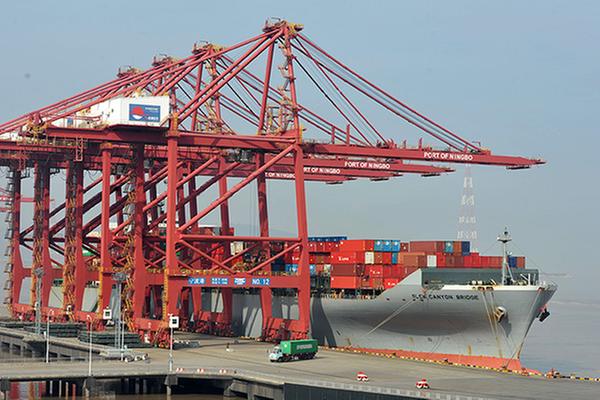 |
| A container ship docks at the Port of Ningbo, East China's Zhejiang province. [Photo/Xinhua] |
The United States launched a Section 301 investigation into China's technology transfer and intellectual property policies and practices last week, raising more concerns about the trade policy of the Donald Trump administration, which is increasingly unilateral, protectionist and rules-breaking.
While the action may reflect the views of some trade hawks in the Trump administration, many US economists have opposed reviving the outdated Section 301 of the US Trade Act of 1974.
The reason is clear. With its Section 301 investigation the US is trying to be a player and the referee at the same time. The dispute settlement mechanism of the World Trade Organization, set up in 1995, is the right place to address such issues.
The US is violating its WTO commitment with its Section 301 investigation. The implication of this is serious. If the US takes the lead in breaking WTO rules, it would set a bad precedent for others to follow suit.
Although the investigation, which might take a year, does not equate to a declaration of a trade war, it is moving in that direction. A trade war between the world's two largest economies, or just tit-for-tat retaliation between them, would be calamitous to not only themselves, but also the global economy, especially those in the Asia-Pacific supply chains.
And the unilateral action, whatever its purpose, is a setback to the progress made between China and the US over the past seven months.
During the presidential race, Trump threatened to impose tariffs of up to 45 percent on imports from China and label China a currency manipulator. Those threats faded away after he became president, and he and President Xi Jinping had a successful faceto-face meeting in Florida in early April. During the meeting the two leaders agreed on a 100-Day Action Plan for economic cooperation that, having proved fruitful, has now been transformed into a one-year action plan. And a week after the summit, the US Treasury Department determined that China was not manipulating its currency.
The Section 301 investigation has again cast a shadow over the bilateral economic relationship, especially over those industries that will be at the forefront of any retaliation should the worst-case scenario of tit-for-tat actions materialize.
The move is one of the many actions by the Trump administration challenging the US' global and multilateral commitments, which Trump hailed as a good thing in a speech in Phoenix, Arizona, on Tuesday.
In the speech, Trump praised himself for withdrawing the US from the "disastrous Trans-Pacific Partnership" and "job-killing Paris Climate Accord". And he said if the US cannot make a deal, it will probably terminate the North American Free Trade Agreement.
People such as IMF Managing Director Christine Lagarde have repeatedly voiced concern over the surging protectionism in the US. It was the US that refused to renew a longstanding pledge to free trade and rejection of protectionism in the G20 finance ministers' meeting in Germany in March.
When taking protectionist moves, the US likes to blame its economic woes on other nations, painting itself as a victim. However, a recent report by Gary Hufbauer and Lucy Lu of the Peterson Institute for International Economics showed that the payoff to the US from trade expansion is and will be significant, while the 156,250 manufacturing sector jobs lost annually over the past 13 years represents less than 1 percent of the number of people involuntarily separated from their jobs each year.
The 21st century is totally different from Cold War days of 1974 when Section 301 was enacted. The Trump administration should heed the warning of many economists and drop the Section 301 action.
The author is deputy editor of China Daily USA. chenweihua@chinadailyusa.com





