



Investment protectionism a new US weapon









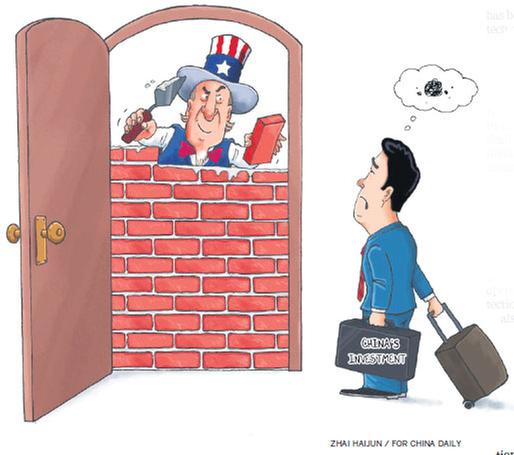
The United States recently changed its trade policy toward China, straining bilateral ties, and intensified its protectionist measures against Chinese investments. And if the bill four US senators submitted a few days ago to Congress seeking a review of foreign investment is accepted, it will have a negative impact on global overseas direct investment.
The US' protectionist measures against foreign investment increased as well as strengthened after the global financial crisis. Over the past few years, Chinese investments in the US have frequently faced national security review by the Committee on Foreign Investment in the US.
CFIUS reviews of Chinese investments have increased sharply, from 1.56 percent in 2005 to 21.6 percent in 2013. From 2010 to 2013, cases involving Chinese investments made up 14.5 percent of the foreign investment cases subjected to security review (60 out of 415 cases). And last year, CFIUS reviews of foreign investments hit a record high of 170, with Chinese investments the most scrutinized, as they have been for the past three years.
In November, the US-China Economic and Security Review Commission suggested in its 2016 report that Congress authorize the CFIUS to ban Chinese State-owned enterprises from gaining effective control of US companies, including through mergers, because the companies could use the mergers to obtain US technology and intellectual property rights, which would compromise US national security. And the latest CFIUS report shows US national security reviews of foreign investments are not only more stringent but also at an all-time high.
A crucial part of the US national security review system, the CFIUS, an interdepartmental reviewing agency led by the US Treasury Department, is responsible for evaluating cross-border transactions to determine the potential impact of foreign investments on national security.
In fact, the definition of "national security" has expanded to include areas such as energy, crucial technology and services. which means it can be used as a tool to restrain or stop the inflow of foreign capital to the US. In particular, investments targeting companies handling apparently sensitive technology or which are in supposedly sensitive industries can be the reason for refusal.
Those investments that were refused involved mergers and acquisitions mainly in the fields of telecommunications, aviation, integrated circuits, artificial intelligence and advanced materials. The US deems the chances of data and user information falling into Chinese hands a security risk, which is the same excuse it has been using for years to restrict high-tech exports to China.
A few days ago, the Donald Trump administration said it is considering expanding the CFIUS' power and strengthen the national security review. And the latest US Defense Department report says China evades CFIUS scrutiny by using seemingly ordinary business deals, such as joint ventures, small shareholdings and investments in startups, to obtain sensitive technology.
In fact, it has become more common for the US to refuse or delay the approval of mergers involving Chinese enterprises on the grounds of mutual openness. For instance, China Telecom's application for a license was not approved even after more than five years, because the US believes China's telecom market is not open. This suggests that like trade protectionism, investment protectionism also seems to be part of Trump's "America First" policy.
In the final analysis, economic and industrial structures determine Sino-US commercial ties. Rhodium Group, a research organization, says the US became China's biggest investment destination last year, with investments in completed acquisitions and startups totaling $45.6 billion. China and the US also enjoy complementary economic advantages which should outweigh competitiveness. So any conflict between the two countries will harm both. And after suffering the effects from trade protectionism, the world might also have to suffer investment protectionism and barriers to the movement of resources.
The author is a researcher at China Int'l Economic Exchanges Center. Source: chinausfocus.com





