Work begins to clean up Beijing's 'dirty streets'









|
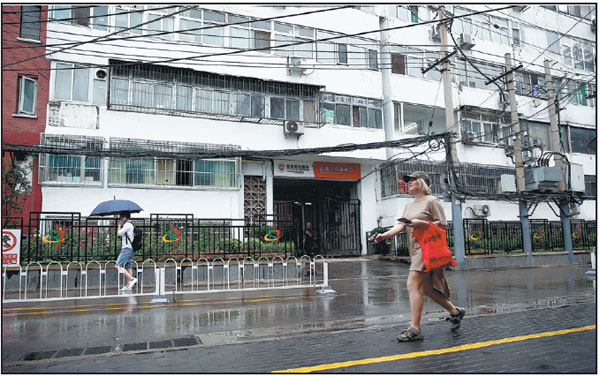
The street after renovation work was carried out in April. Photos By Feng Yongbin and Zou Hong / China Daily |
Zero tolerance
By the end of July, more than 23,390 sites with unauthorized openings had been dealt with around the city, and the municipal government has stated that new unauthorized constructions will not be tolerated.
In addition to removing safety hazards, the citywide campaign is also expected to make central Beijing less crowded and provide room for improvements, such as the construction of parks and facilities to make people's lives more comfortable.
The goal is to develop Beijing into world-class capital city and improve the general standard of living, according to a draft of the Beijing Overall Urban Development Plan, which was published in March. The process, which began last year, will continue until 2030.
In February, President Xi Jinping said the urban planners must think deeply about how the city should look and devise ways to strengthen its function as the capital.
According to the draft, Beijing will further restore the traditional appearance of neighborhoods during the campaign. In August, the revised plan was approved by the central government, the Beijing Municipal Commission of Development and Reform said.
Xisibeitoutiao, a 600m-long hutong in Xicheng district, has existed since the Yuan Dynasty (1271-1368), when Beijing became the capital. As one of the best-preserved hutong neighborhoods in the city, it was also among the first to launch the campaign.
"Some stores selling electronic accessories near the entrances to Xisibeitoutiao had doors that opened into the hutong. Trucks would block the alleyway for hours every time new stock was unloaded," said Zhang Xiaozhen, who has lived in the area for 15 years.
Improvements
Since 14 wall openings in the hutong were blocked at the end of last year, the 63-yearold has noticed obvious changes.
"The alleyway is much cleaner and quieter than before. The blocked walls looked quite ugly at the beginning, but now workers have started to repaint and decorate them to restore the traditional courtyard appearance," she said.
"I don't mind people running businesses from the hutong as long as they treat it as their home and take care of it. They shouldn't pour dirty water everywhere and change the structure of the houses just to make more money."
The process hasn't won universal approval, though, and some residents have complained that they have to travel further afield for grocery shopping and for breakfast because some small businesses, such as greengrocers and restaurants, have relocated.
"The inconvenience is only temporary. The planning of new supermarkets and convenience stores started even before the campaign was launched. Our goal is to ensure that hutong residents can find a supermarket or convenience store within 15 minutes' walking distance," said Wei Jiuhong, deputy director of Xinjiekou subdistrict, which administers the hutong located on Xisibei street.
To accommodate people's needs, more than 3,000 greengrocers, convenience stores and restaurants that offer breakfast had been built or upgraded by the end of July, according to the city's development and reform commission.
The new convenience stores will also reserve spaces for former street traders who provide bike and shoe repairs, Wei said. "People need their skills, so we want to encourage them to continue their businesses in regulated areas."
Thomas Angotti, a professor of urban affairs and planning at Hunter College in New York, believes that the campaign in Beijing has many parallels with the development of the "Big Apple".
"The campaign in Beijing seems to be a response to interests by national and international capital to locate in central areas where land values and business potential are higher. Building regulations and zoning, when strictly applied, can be the mechanism (for that)," he said.
Zoning
New York is now divided into three basic zones - residential, commercial and manufacturing - and construction application forms and permitted uses are strictly applied in all of them. Residents can use the city's urban planning website to discover their neighborhood's zonal code and work out if they are allowed to operate businesses there.
Angotti suggested that before it takes action the Beijing government should make greater efforts to work with small businesses to improve their compliance with local laws. In many places, governments provide incentives, grants and assistance, he said.
Back in Beijing, "Dirty street" is no longer dirty, according to Tian: "The city is changing so quickly. I can't imagine what it will look like in 10 years' time. All I know is that it is my home, whatever changes are made."
Zhang Ruinan in New York contributed to this story.






- China to foster new quality productive forces in water conservancy sector
- China sees 66.86 billion cross-regional trips in 2025
- China braces for four cold waves in February
- Scientists design flexible patch for precision drug delivery to complex organs
- China reports rising investment in science popularization in 2024
- Chinese scientists build first quantum network to hunt for dark matter