



Smart help









China's approach to foreign assistance is grounded in practical benefits, political neutrality and friendship
As it becomes more prosperous, China is stepping up its efforts to support development around the world, taking a new and often more effective approach to foreign assistance.
"China must improve management over foreign aid funds and projects, reform the foreign aid administration system and improve the overall results of foreign aid," said President Xi Jinping during a Beijing meeting on deepening reform in February.
Since China adopted opening-up reforms in the late 1970s, it has experienced phenomenal economic growth that has allowed it to expand the scope of its foreign assistance and play a bigger role in improving livelihoods worldwide.

In 2016, China provided about 35 billion yuan ($5.2 billion; 4.4 billion euros; £3.8 billion) in foreign assistance, up from around 30 billion yuan in 2011. That is growth of more than 3 percent per year, according to Neil Wang, greater China president of consulting firm Frost& Sullivan.
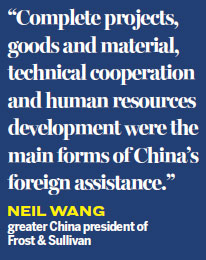
"Complete projects, goods and material, technical cooperation and human resources development were the main forms of China's foreign assistance," Wang says.
The difference between "aid" and "assistance" can be subtle but it is profound. Criticism of the traditional, Western-led approach to aid is common. Aid often comes with philosophical or political strings or creates dependency among developing nations that come to rely on it as part of their national economy.
China's approach has been different. The country's goal is not to give developing countries metaphorical fish, but to provide the financial and technical assistance so that countries can learn to fish and, in turn, build stronger flourishing economies.
A 2014 white paper published by the State Council, China's cabinet, said that "teaching one to fish rather than giving one fish" is important to build capacity in developing economies.
The result is a focus on foreign assistance that prioritizes agricultural development, education, health services, manufacturing, infrastructure, trade, public welfare, environmental protection and humanitarian aid when needed.
Since 1949, China has provided around 600 billion yuan in foreign aid and has regularly expanded the scope of its efforts.
In January 2016, the official launch of the China-led Asian Infrastructure Investment Bank was another big step that highlighted China's approach to shoring up international development. The development bank offers financing for projects that are part of China's Belt and Road Initiative, a plan to improve connectivity in countries along the historical Silk Road routes.
The AIIB is expected to lend between $10 billion and $15 billion a year in the first five years, according to its president, Jin Liqun.
In its first year, the bank approved $1.7 billion in loans, exceeding its target by $500 million. These included $165 million for power distribution in Bangladesh, $216.5 million to improve a slum in Indonesia and $300 million for a hydropower project in Pakistan.
Out of a total $100 billion in capital, China had an initial subscription of almost $30 billion.
China's push to lead the AIIB is part of a multipronged approach to foreign assistance that is defying long-held conventions and focusing on direct funding of projects.
China is now taking steps to optimize its strategy on foreign aid, particularly as the country's global influence and role in helping shore up struggling economies grows.
Rapid economic growth has substantially increased the amount of resources China can devote to foreign aid. And since China deepened its financial engagement with the world through its Go Global strategy, which was launched in 2005, its foreign assistance has grown at an average rate of almost 22 percent annually.
In 2013, Chinese foreign assistance accounted for about 3.9 percent of development assistance globally and was equivalent to more than one-fourth of total foreign aid from the United States. Much of China's foreign assistance goes to Africa - about half the total between 2010 and 2012, according to the 2014 white paper.
According to the Export-Import Bank of China, by 2025, the country will have provided Africa with $1 trillion in direct investment, soft loans and commercial loans, all of which contribute to the country's efforts to provide development assistance.
In 2015, President Xi upped the ante, announcing that over the next three years China would send $60 billion to Africa in assistance and loans to help with the continent's development. The financial aid includes interest-free loans and focuses on 10 areas, including industrialization, agriculture, financial services, green development and security.
In addition to ongoing measures to strengthen the economies, trade and infrastructure of developing countries, China has also increased efforts to help in the aftermath of natural and humanitarian disasters.
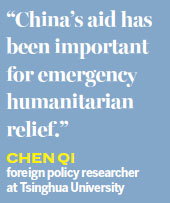
"China's aid has been important for emergency humanitarian relief. For example, in May China provided $5 million to support relief efforts by the United Nations World Food Program in northeastern Nigeria," says Chen Qi, a foreign policy researcher at Tsinghua University.
The contribution from China is to help purchase 4,305 metric tons of rice to support 410,000 internally displaced people - those who have been forced to leave their homes but who remain in Nigeria. According to official data, as of May a total of 184,500 men and 225,500 women had been affected by food shortages in the northeastern states of Borno and Yobe.
During a meeting with China's Ambassador to Nigeria Zhou Pingjian, Borno State Governor Kashim Shettima praised the Chinese government for the assistance and called it "invaluable support".
"Sometimes China provides cash or materials for emergency relief or sends people to help in countries that are affected by disasters," says Tsinghua's Chen. "These operations are crucial in saving lives, and China is taking an increasingly active role in such efforts."
China has also deployed hundreds of thousands of aid workers overseas.
In December 2004, it launched its largest emergency relief operation, providing 700 million yuan in aid to countries hit by an Indian Ocean tsunami. Indonesia, the most seriously affected country, received the first batch of aid. China also dispatched medical teams, international rescue teams, DNA testing groups and divers to seriously affected countries.
In 2006, China advocated a multilateral aid fund following the World Health Organization's framework for the control and prevention of bird flu, and it donated $10 million to the fund, according to China's Foreign Aid: 60 Years in Retrospect, a book by researchers Zhou Hong and Xiong Hou.
Last year, China sent four plane loads of aid worth more than $9 million to help Ecuador after a catastrophic earthquake left tens of thousands homeless. The aid included 10,000 foldable beds, 5,400 tents and other supplies.
"Some people are skeptical about the intentions behind China's foreign aid, but when you really see the necessity of the aid and how it has directly improved people's lives, I think you would find most criticisms unjustified," Chen says.
"Of course, when you are kind and generous to those who need help, they will be grateful and you will develop good relations with them. Some people criticize China for that, but it's just a natural result of giving foreign aid."
And then there is debt relief, another form of foreign assistance. China has written off the government debts of struggling countries several times, helping to shore up their finances.
According to Chen, the Chinese government hardly ever chases struggling countries to pay back their debts. When indebted countries have difficulty in repaying interest-free loans, China usually adopts flexible repayment methods and extends the repayment period.
As of the end of 2009, China had signed debt relief measures with 50 countries from Africa, Asia, Latin America, the Caribbean and Oceania and canceled 380 mature debts worth 25.58 billion yuan.
Last year, China canceled about $60 million in debt from African countries, a move Xi announced during the Forum on China-Africa Cooperation in 2015.
China has also emerged as an active participant in aid programs initiated by multilateral organizations. For example, to strengthen communication with other aid providers, Chinese delegations have participated in conferences on international development and cooperation, such as high-level United Nations meetings and the WTO Global Review of Aid for Trade.
"These efforts have helped China to establish good relations with other developing countries, improving trade and the economy. Foreign aid has positive effects that extend beyond immediate relief," Chen says. "It promotes common development, cooperation and improvement across the world."
For China Daily
| Shafiq Bilal, an Afghan boy, kisses nurse Li Yanmei on Sept 13 after he was treated for congenital heart disease at the First Affiliated Hospital of Xinjiang Medical University. A group of Chinese doctors conducted free examinations in August for children from birth to 7 years old in Kabul, Afghanistan. More than 20 children diagnosed with the disease got free surgery in China. The organizer, the Chinese Red Cross Foundation, said it will provide technical and financial support for the project in the future. Wang Jing / For China Daily |

(China Daily European Weekly 09/22/2017 page1)


Today's Top News
- AI helping to redefine entrepreneurship
- China's judges enhancing global role
- FM calls for joint efforts to de-escalate Mideast tensions
- Bridging the last mile so that farm technology reaches field and table
- Opening-up remains key to nation's growth
- Reform unlocks China's silver dividend





