Seasonal delights to savor this autumn









Every traditional holiday in China is centered around food. For the Mid-Autumn Festival, a day of family reunion, the festive delicacies are unusually humble and homey, made from some of the most common seasonal specialties in a simplistic way.
Taro and duck
If mashed potatoes and turkey are the signature pairing in the American Thanksgiving meal, then taro and duck can be said to best represent the Mid-Autumn meal in Shanghai.
Duck and taro are common enough ingredients all over China, and in the professional and private kitchens, there have been countless recipes developed with these.
The soup-loving Cantonese stew them together for a slow-cooked broth, which, according to the principles of traditional Chinese medicine, will moisten the dryness of the body in autumn.
In east China's Yangtze River Del-ta region, this dish becomes much simpler.
The taro is skinned, cut and stir-fried with scallion and salt before it is cooked with duck. The most popular type is the Nanjing salted duck, whose tender white meat is fatty but not greasy.
The salted duck's fame has gone far beyond the capital city of Jiangsu province and made it to the tables of neighboring cities like Shanghai and Hangzhou.
Duck is considered the best choice of meat because connoisseurs believe that they are naturally scented with the sweet aroma of osmanthus flowers during autumn.
Shops selling ducks perpetuate this belief by seasoning their ducks with osmanthus as well.
In northern China, taro is often boiled, peeled, dipped into sugar and eaten as a staple in place of rice or noodles. Here, the famous roasted duck reigns supreme on the dining table.
The most complicated pairing can be said to be crispy duck wrapped in mashed taro, a century-old recipe from Chaoshan cuisine, an offshoot of Cantonese cooking which is famous for its deceptively meat-like vegetarian dishes.
The best taro is believed to come from the district of Lipu in Guangxi Zhuang autonomous region where the climate and soil produce an especially firm but smooth textured taro. It is often paired with the short-necked rice duck from Guangdong province, a bird that has plenty of meat but relatively less fat.
The secret in the pairing of these two ingredients lies in the temperature of the oil used to fry the taro. If the cook is skilled, the result is a crispy coat of mashed taro enveloping juicy duck meat.
Lotus root
The Chinese poet Han Yu (768-824) once sang praises of the lotus root and described it to be "sweet as honey, icy as frost, a slice in the mouth heals all sickness". The Qing emperor Qianlong (1711-1799) compared it to "the snowy white, slender curved arm of a beautiful woman".
Indeed, the humble lotus root has often been used as an example for morality because of how it rises "above the mud it grows in, untainted and white".
It is most abundantly harvested in autumn, and has naturally become part of the feast for the Mid-Autumn Festival.
One of the reasons it is widely used in cooking of autumn dishes is because of the Chinese culinary tradition of "eating local, eating seasonal" which was born out of the belief that food in season is the best gift from nature. In the case of the lotus root, traditional Chinese medicine practitioners claim that the aquatic root vegetable is best for relieving summer heat and autumn dryness.
While the lotus root is widely used in soups, cooked with pork ribs and stir-fried sweet and sour style, it is usually presented as an appetizer, or cold dish, during autumn. Candied lotus root stuffed with slow-cooked glutinous rice and topped with osmanthus jam is one of the most common starters.
This dish was once native to the east China region where diners liked having something sweet to start the meal. These days, the dish is popular all over the country, attracting loyal followings with the shiny luster of the osmanthus syrup, its appealing fragrance, and above all, the soft and sticky lotus root, cooked to a melt-in-the-mouth mealy texture.
Contact the writers at xujunqian@chinadaily.com.cn
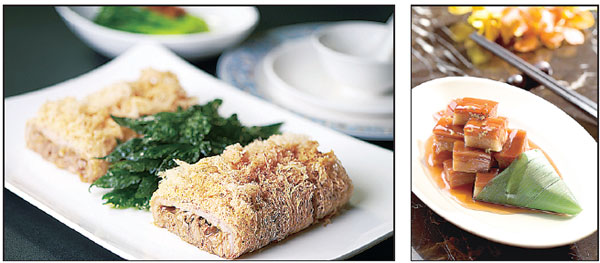
| Sweet scented lotus roots with glutinous rice from Xindalu, Hyatt on the Bund (right), and taro and duck (left).Photos provided to China Daily |
(China Daily 09/30/2017 page16)