Millennials' yen for a room of fine furniture









New homeowners eschew traditional aesthetics to go for more simplistic, lighter, western designs and brands from Japan
The preference of Chinese millennials for fine furniture has brought opportunities for interior designers and premium furniture brands, especially those coming from northern Europe.
As those born in the 1980s and 1990s get their hands on their first houses, the market has seen a seminal shift in taste. It has gone from predominantly traditional Chinese aesthetics - featuring heavy wooden furniture and dark-red floors made of expensive, sometime rare woods - to simplistic western styles.
Sugar Lee, a 29 Shanghai-based home design magazine editor, spent about nine months decorating her home with her partner. It cost the young couple about 270,000 yuan ($41,189) to do up their 46-square-meter pad.
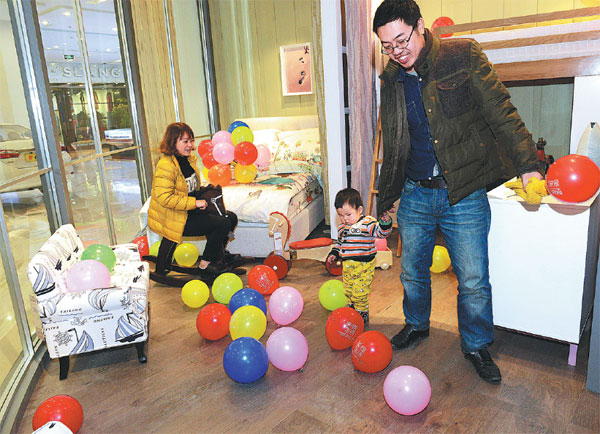
| A father plays with his child in a sample room of a furniture design company in Rizhao, Shandong province. Chen Weifeng / For China Daily |
Defining her home as a fusion of French and northern Europe styles, most of their furniture was bought in design shops in Shanghai, like Design Republic, Casa Casa and BoConcept. Cheaper pieces from Ikea can also be found in her home.
"The younger generation has undoubtedly developed different tastes," Lee said, "We are more international, influenced by all kinds of ideas from around the world."
Neil Wang, president of consultancy Frost and Sullivan Greater China, pointed out that such shift in taste was due to the different concepts and lives being pursued by Chinese youngsters compared to their parents.
"Simplistic interior designs from Japan and North Europe are more budget friendly. With the ever climbing prices of houses, youngsters don't have much money left for the luxury Chinese wooden furniture their elders preferred," Wang said.
"Take Ikea for example. Its prices and designs meet the needs of the younger generation, "Wang added.
He said their demographics meant they were always open to new experiences, which meant changing their furniture more often.
"Many young people rent homes and they are constantly on the move, so they want furniture which is more affordable and can be thrown away," Wang said.
"Also, their fast-paced work and lives places mental stress on the young and it also explains why they want to live in places with light, simple and clean designs," Wang added.
"It provides a sense of comfort, compared to the heavy and serious Chinese furniture."
The latest trend in interior designs has opened a gate for international premium brands and for young designers.
Early in September, the East Design Show was successfully held at the China International Furniture Fair in Shanghai. The show attracted foreign retailers and designers.
Swedish Wood, a unit of the Swedish Forest Industries Federation, which promotes the use of pine in sustainable designs, attended the event.
"The popularity of northern European designs has encouraged the use of pine and timber product imports, designers and companies," said Swedish Wood representative Jiang Yincheng.
"But to fully meet the tastes of Chinese youngsters, the industry still needs to study the demographics more."
Jiang said he thought younger Chinese consumers were more rational in their purchasing decisions, as they valued design highly.

"Materials should not be the only criteria when deciding whether a piece of furniture is good or bad," Jiang said.
"Changing concepts about what makes a good piece of furniture have made creative design and various materials possible and profitable."
Many young and ambitious designers are on the same wavelength. Li Xiaoying, a 28-year-old interior design graduate based in Shanghai, said although she currently works on hotel room designs, she would like to apply for a housing design job in few years.
"There is joke among designers," Li said.
"When you walk into a well-furnished design studio, you may start to assess the wall paper by the color density, the pattern, the brightness, the tone, the underlining essence and how well it goes with the rest of the room.
"But your parent may ask: 'It's just a piece of paper so why does it cost so much?'"
Li said although it was still hard to force people pay for the ideas and design work behind a product, and moves to prevent copyright violations were still taking time to be fully effective, younger people were slowly changing their mindsets and starting to appreciate intellectual property.
Consultant Wang said the preference for premium and design furniture indicated that younger consumers understand and recognize the efforts and the values in design.
"The younger generation is more willing to pay and pay more for intellectual property."
He said designers, especially younger ones, had similar concepts and life pursuits as their peers in different lines of work, and they understand each other's needs better.
"They may not have decades of work experience, but they have the empathy to make up for it," he said.
"Such recognition is boosting demand for creative designers and companies, creating growth opportunity and promising career paths for them."
Alongside the success of foreign brands - both mainstream retailers like Ikea and premium ones like BoConcept - the pursuit of quality of life and appreciation of design has fertilized many indie designer shops.
Hidden in the flourishing Guozijian Road in the central hutong area of Beijing are Fnji cafe and Lost and Found. The two indie furniture shops never lack admirers who appreciate their simple but quality furniture.
Starting out on the Guozijian Road in 2008, Lost and Found focuses on vintage furniture and homeware and has a young design team whose average age is below 30.
"Our products are simple but classic. We cut out all the unnecessary decorative details and focus on how practical it should be," said Yuan Yue, public relation manager of Lost and Found.
"For example, we use solid wood for chairs because then they won't easily wear out. We want to remind people to respect the material and craftsmanship."
With their spoons that can cost hundreds of yuan, industrial analysts don't think such companies - with their passion for design and craftsmanship rather than revenue - will ever grow into large businesses. But they may well become icons for the design industry.
"Flagship design shops like Fnji and Lost and Found appeal to very specific demographics, to people who like high quality and unique designs, unlike retail chains," Wang said.
"The nature of such marketing means that they will not become the industry leaders, but for designers, they have significant symbolic meaning."
Contact the writer at renxiaojin@chinadaily.com.cn

(China Daily 10/04/2017 page9)