



Belt and Road building cultural bridges









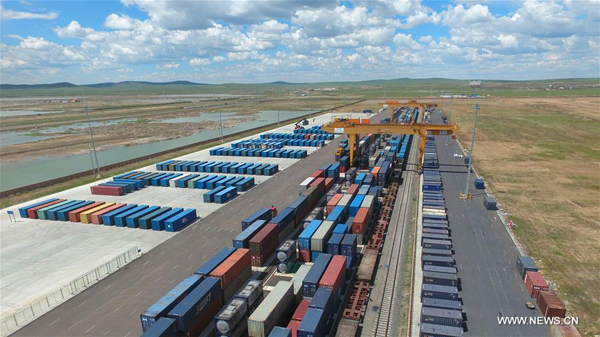 |
| Photo taken on June 23, 2016 shows a container yard at the port of Manzhouli, Inner Mongolia autonomous region. [Photo/Xinhua] |
One of China's biggest contributions to global governance in the past five years may be the China-proposed Belt and Road Initiative.
President Xi Jinping was right when he said that we are living in an age of major development, changes and adjustments. Calculated according to purchasing power parity, emerging markets account for over half the global GDP, while Western economies account for 42 percent this year, down from 64 percent in 1980. And with many countries struggling to recover from the 2008 global financial crisis, widening wealth gaps have led to rise of populism and political extremism in Western countries.
The Belt and Road Initiative, which was first proposed by Xi in 2013, has actually pointed the way out of the present impasse, and its success in sustaining growth, stabilizing politics and improving social justice can serve as a source of inspiration especially to countries aspiring to reform their governance.
Progress has been made in bonding people across the world, an integral part of the initiative, through intensified cultural exchanges between China and the other participants involved in the initiative. By the end of last year, China had signed some 318 official cooperative deals and action plans on cultural exchanges with participating nations and established Chinese culture centers in 11 countries. At least 491 Chinese cities had become sister cities with foreign counterparts in 63 countries by the end of May.
Interaction on such a scale bodes well for future cooperation, from archaeological studies to submitting shared relics to the UNESCO World Heritage Committee. It can also help lay the cultural foundation for settling geopolitical disagreements, territorial disputes and trade frictions by reducing misunderstandings between peoples. That is why the leaders of the BRICS nations enshrined cultural exchanges as the third pillar of the bloc after political security and economic cooperation during the BRICS Summit in Xiamen, Fujian province, in September.
Failures of governance have a lot to do with insufficient communication and integration between different cultures, as shown in the Western culture that features self-proclaimed supremacy, the refugee crisis emanating from the Middle East and the widening wealth gap between developed and developing economies. The West, in many cases, tends to consider other cultures and institutions inferior and tries to promote the Western model elsewhere, intensifying conflicts.
Enhancing cultural exchanges with the participants of the Belt and Road Initiative could help create a safer, more reciprocal world. Although, while emerging economies such as China are striving to build a partnership-based alternative open to wider participation and consultation, the US and its military alliances still dominate the global security system.
However, there are challenges facing the cultural exchanges between China and the other Belt and Road participants, from complex geopolitical situations and lack of strategic trust to different levels of economic development. For countries in the thick of economic transformation or struggling with energy shortages and natural disasters, there is little incentive to put much effort into cultural cooperation. Some regions on the Belt and Road routes are even subject to sectarian clashes and other nontraditional security threats.
Besides, cultural differences could stand in the way, not least when some Western media outlets keep hyping up a "China threat" to audience in countries involved in the Belt and Road Initiative. These problems need to be addressed to lay the foundation for future cross-culture exchanges.
The author is former Chinese vice-foreign minister and co-chairman of the Center for China and Globalization.





