



Developing a collaborative approach to groundbreaking scientific research









 |
| Philipp Khaitovich, director of the Max Planck Society Partner Institute for Computational Biology in Shanghai / CHINA DAILY |
"It may sound like a cliche but I would say it's undoubtedly the most impressive China-related story for me," said Khaitovich, director of the Max Planck Society Partner Institute for Computational Biology in Shanghai.
The 43-year-old, who has pushed boundaries to discover why humans are smarter than other species and how the aging process happens, attended meetings for foreign experts with Xi three times-first at the Great Hall of the People in Beijing, then in Shanghai, and finally in Moscow.
The first meeting he attended was in 2013, and he said it was completely unexpected.
"There were 24 of us from different industries, and none of us expected to meet Xi because he had only just been elected as the top leader of the country a few weeks before. It was a complete surprise," said Khaitovich, who has worked for the Shanghai Institutes for Biological Sciences, which includes his institute, since 2006.
He said his impression of Xi is that he takes his time and makes an effort to ensure expatriates working in China see the country as their second homeland.
"There are few expats in China compared with the number of citizens, and I don't think we're that important for China. The country can deal with problems without foreigners. But he really made it a point," Khaitovich said.
He has been awarded the Friendship Award, the nation's highest honor for foreigners who make a significant contribution to economic and social development. "Xi is a sophisticated leader who really looks far into the future," he said.
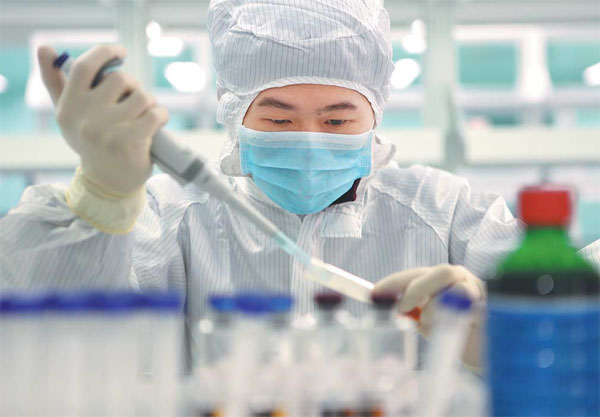 |
| A technician performs an experiment at a biomedicine company in Zhangjiang. Photos provided to China Daily |
Back then, he said, foreigners did not know China that well and some were afraid of it. But as a scientist, he wanted firsthand experience. "In science, something that people believe for centuries can turn out to be wrong."
When he came to find out what China was actually like, he felt it was true that China is a truly different country. "China is special, and it's not the same as Russia, Europe or the US. But it's good that countries have their differences. I strongly believe China needs to keep its unique identity."
He turned down job offers from first-class scientific research institutes in Germany, Israel and Spain and instead chose China out of a desire to find out what a joint institute between CAS and Max Planck could be.
"The decision was also motivated by my belief that I can work with the most talented and motivated researchers here," he said.
After all these years, he said, he feels his only real contribution to the institute is to train young scientists and see them develop and start independent careers.
However, he is involved in valuable research.
His team is working on a new project to show the importance of feeding babies breast milk rather than infant formula for early brain development because the composition of fat, a major constituent in brains, is unique to humans.
"It is widely believed that fat in brains is probably the same in all species. But that's not true, as seen from our recent findings. For each species, it's different, and for humans it's particularly so," Khaitovich said.
He said evolution had resulted in cow's milk being optimized for calves' brains and goat's milk being optimized for kids' brains, but that their brains were composed of different materials.
"It's like building houses out of wood or stone. If you need to build a house out of wood but you have a lot of stones, it does not help you," he said.
Khaitovich enjoys a modest life in Shanghai where he lives with his wife, who is also a scientist, and two children.





