Protectionism with US characteristics









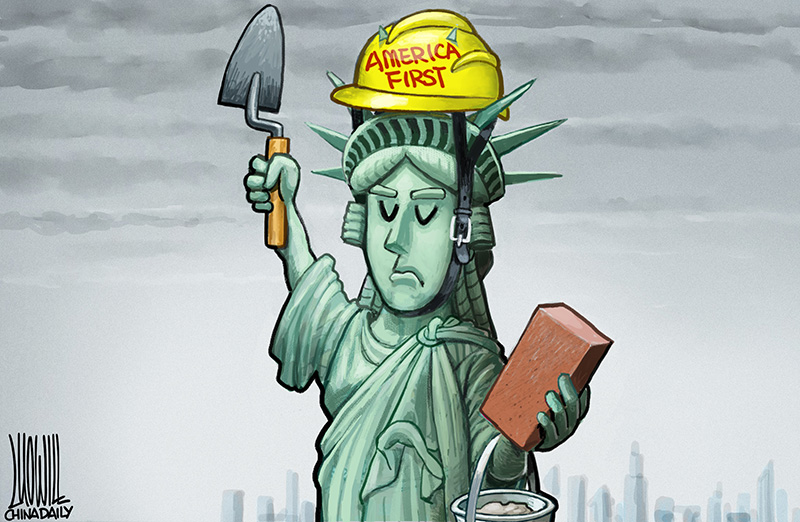
The most consistent thing about US President Donald Trump is his inconsistency. With consistency, he has reneged on most campaign promises, with a few flagrant exceptions, such as withdrawing from the Paris climate change agreement, building up trade barriers, forcing American companies to divest internationally, and effectively seeking to isolate the United States from globalization. Not a good record for a country that has for years claimed to be the beacon of globalization, free trade and investment.
Speaking at the World Economic Forum in Davos, Switzerland, in January, President Xi Jinping emphasized that no one will emerge as a winner in a trade war.
However, the Trump-led US administration fired the opening shots of a trade war on Nov 30 by opposing China's bid for recognition as a "market economy" in the World Trade Organization. The move reflects Trump-era protectionism via the manipulation of a global multilateral trading mechanism.
Under WTO principles, there are no specific requirements for a member country to get the market economy status, a concept that harks back to the Cold War principles espoused by the US to isolate and sanction socialist economies.
Cold War rhetoric has become popular in Washington again, without anybody acknowledging that most of those socialist economies enjoy high growth as market economies today. Of course, they developed in their own way, based on their own actual conditions, and without following imported theories.
China led this process of gradual transition from planned to market economy, and joined the WTO in 2001. According to WTO rules, China should have been automatically recognized as a market economy on Dec 11, 2016, that is, 15 years after joining the world body.
A market economy is an economy that operates by voluntary exchange in a free market and is not planned by a central authority, and where decisions on investment, production and distribution are made based on supply and demand, which in turn determines the prices of goods and services.
Addressing the 19th National Congress of the Communist Party of China, Xi, who is also general secretary of the CPC Central Committee, unequivocally said that it is important to improve the property rights system and ensure the market-based allocation of factors of production.
Western media attention is often focused on China's State-owned enterprises, but the fact is that they function within the framework of a market economy. Besides, Western media rarely acknowledge that private companies are estimated to account for 75 percent of China's $11 trillion economy.
By not acknowledging China as a market economy, the US will be able to adopt protectionist measures against Chinese imports, including high tariffs, taxes and investigations into China's production and marketing methods, comparing them with those followed by Japan and the Republic of Korea in order to accuse China of dumping and deny it the market economy status.
This concept does not take into consideration factors such as the cost of investment in efficient infrastructure, labor cost, costs of raw materials, and the cost of living, which should necessarily be factored in before deciding on a country's market economy status.
The Economist recently said China will catch up with the US as the largest global economy soon. Is Washington afraid of Beijing's "Made in China 2025"marketing strategy, because it has realized that in less than a decade China will lead in many industries, particularly technology? China is already the leading investor in artificial intelligence, renewable energy technologies, and quantum research. In 2020, China will launch 5G, moving a step closer to being a global technology leader. Could this be the underlying reason for the Trump administration to not grant China market economy status?
The author is a senior fellow at the Center for China and Globalization.