Changes improve efficiency of family planning services









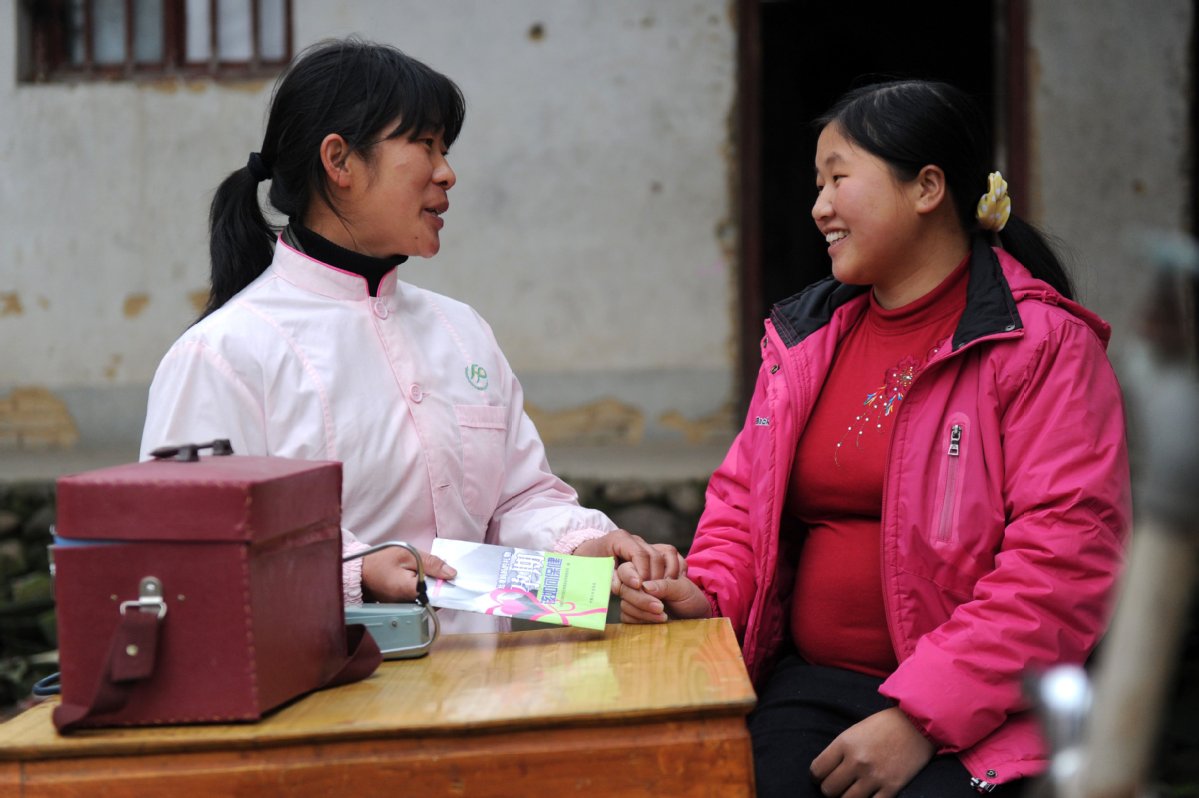
Departmental mergers help officials to redefine their roles
For most of her 13 years as a grassroots family planning officer, Wang Wanhui's main task has been to discourage her fellow villagers from having more children than the law allowed.
Now, her role is changing.
"Before the universal second-child policy was adopted in 2016, my job was to emphasize pregnancy management and population control," said Wang, who works in Longjing, a village in the township of Dongfeng in Guiyang, capital of Guizhou province.
"Women who had already given birth had to use contraceptive measures, such as intrauterine devices, and we asked them to have checkups every three months to make sure the devices were intact."
Wang's work priorities began to change several years ago in response to the gradual relaxation of the family planning policy. However, the biggest change came in early 2016.
"The adoption of the second-child policy saw the number of births rise markedly, so the major task of family planning workers in our town became the provision of healthcare services for pregnant women, especially in high-risk cases, to ensure their safety," she said.
Sixteen women in Longjing got pregnant in 2016, but last year the number was 26, including two high-risk cases: a 35-year-old, and a woman who had previously given birth via a cesarean section, making her vulnerable to complications such as a ruptured womb or premature birth.
"I spend most of my time keeping track of pregnant women who are close to giving birth, reminding them to visit the health center in Dongfeng for checkups and asking them to come to my office to pick up free doses of folic acid," Wang said. Folic acid can help prevent neural tube defects.
"I also help them to register online so they can get benefits such as free checkups and higher reimbursement for certain services during and after pregnancy. My workload is heavy because the village doctor and I are the only people available for the whole village, and we would face disciplinary proceedings if someone died during pregnancy or childbirth."
Wang is one of about 200 family planning officials in Guiyang's Wudang district whose roles have been transformed. They have started to focus more heavily on working with colleagues to provide maternal healthcare services to suit the universal second-child policy.
For more than three decades, the primary task of family planning officers was to prevent unauthorized births via the promotion and use of contraception, according to Qin Desheng, deputy director of Wudang's bureau of health and family planning.
However, that began to change a few years ago as the national family planning policy was gradually relaxed.
The merger of the district's family planning and health departments resulted in family planning officers being integrated with other health workers, especially those at the grassroots.
"The effect of the second-child policy in Wudang can be seen clearly, with nearly 4,000 births expected by the end of the year," Qin said, speaking in December.
"By comparison, in 2016, the total number of births in the district was about 2,000. Many couples who already had one child delayed having a second until the universal second-child policy was implemented," he added.
Qin noted that some rural couples, such as those whose only child was a girl, were allowed to have two children in the hope the second would be a boy, which would help to maintain the workforce.
As in many other parts of China, a large number of the women in Wudang who plan to have a second child are considered to be at high risk-for example, those ages 40 and older-so improving health management has become a key task for the district's health and family planning officials.
"While village doctors provide purely medical care, family planning officials have other functions," Qin said.
"They have close contact with villagers over many years, and as a result they establish a vast information network at the grassroots. For example, they can provide useful information about pregnant women, and also help those who plan to have a second child to have a pre-pregnancy checkup. When the universal second-child policy was implemented, many of our family planning workers were puzzled and did not know what their new jobs would entail. We believe they still have a role to play, and we have arranged training programs so they can provide a better service."





- China aligns green finance with global standards, boosting renewable leadership
- Xu Faqi sentenced to death with a two-year reprieve
- Shanghai researchers unveil promising clinical trial results in glioblastoma treatment
- CCG organizes 134 patrols around the Diaoyu Islands since 2021
- Yangtze finless porpoise population increases in China
- Trains undergo inspections ahead of Spring Festival travel rush