



Eating disorders weigh heavily on the world of figure skating









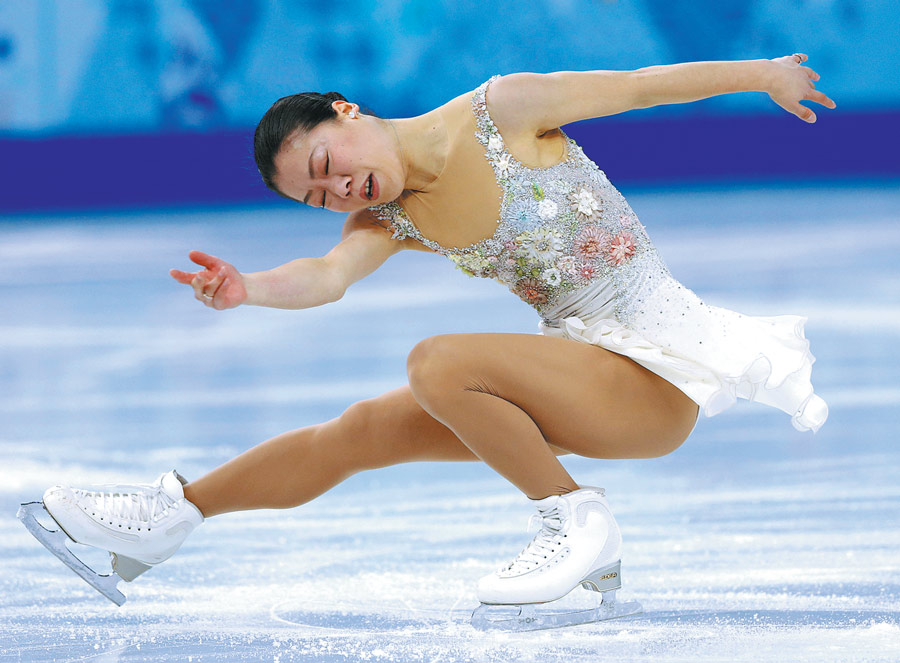
Growing number of athletes revealing struggles with debilitating psychological issues
TOKYO/MOSCOW - Japanese figure skater Akiko Suzuki was struggling with jumps when her coach said losing a kilogram could help. Instead, in two months she lost nearly a third of her body weight, putting her career - and her life - in danger.
Too weak to skate, she was diagnosed with the eating disorder anorexia nervosa. Her weight had fallen from 48 kg to 32 kg on her 160cm (5-foot-3) frame.
"There were all these younger skaters coming along with good proportions, and I started wishing for longer legs. I got a real complex," she told Japan's NTV network.
"But since there was no way I could grow, the only thing I could do something about was my weight."
Eating disorders have long been an issue in figure skating, where lighter weights make performing easier and aesthetics dominate. But this year the toll has been higher.
US skater Gracie Gold, citing psychological issues and an eating disorder, is taking a break for treatment and will almost certainly miss the Olympics, while Sochi Olympics team gold medalist Yulia Lipnitskaya, 19, shocked the skating world by quitting altogether after treatment for anorexia.
"Anorexia is a disease of the 21st century," Lipnitskaya said on the Russian Skating Federation website. "It is quite common. Unfortunately, not everyone is able to cope with it."
Even those who can cope feel pressure.
"I try to approach my relation to my body as responsibly as possible, because, yes, now I can't eat after 6 pm like I used to," Evgenia Medvedeva, a two-time world champion who will be favorite for gold if she is able to compete in Pyeongchang, told reporters in Moscow.
"Sport itself is discipline," she added. "You have to control yourself every day, and when you give in to weakness you hate yourself. I think everyone knows that feeling."
Hurtful slurs
That sort of drive, essential for sporting glory, can also lead to eating disorders. But what pushed some to success and others toward illness was complicated, said Aya Nishizono-Maher, a professor at Shiraume Gakuen University in Japan.
"Perfectionism, the inability to feel one's feelings or verbalize them to other people ... and maybe the parents are very competitive or pressurize the daughter - usually it's girls - to highly achieve," she said.
"In some clubs, the coaches weigh you before practice. And still some call the girls 'pig' or 'fat' when they gain."
Suzuki had always watched her weight. But when she became ill, she was under new pressure to advance at the senior level, and had also just left home for university in a distant city.
Successfully treated, she eventually made it to the 2006 and 2010 Olympics, but it took a year before she was strong enough to jump.
Two-time US Olympian Johnny Weir told Reuters that the world of high level sports, where the weight of one day and one competition can be huge, is "not the most mentally healthy place to live" and it can be easy to step over the line.
But he also warned about blowing the issue out of proportion since diet is so important for elite athletes in all sports - and there are real reasons for a skater to weigh less.
"When I was competing I knew I didn't get to have cake, or chicken fingers, or eat a big Thanksgiving dinner because if I ate too much I would pay for it for three days," he said.
"When you're coming down with 100 times the force of your body weight on landing a jump, it hurts," he added.
"When I go skate and it's been a little while and I've put on weight, you can feel every fiber of your knees and ankles reacting to this extra weight."
Weir thinks things may actually be getting better. In the past, there was more emphasis on specific body types - and nobody talked about the problem.
"I do think it's very brave for Yulia Lipnitskaya and Gracie Gold to be open about this," he said. "Their telling about it will keep parents on guard, will keep coaches on guard."
Reuters


Most Popular
- Nation's Winter Paralympics squad is its biggest ever
- China to send 70 athletes to Milan-Cortina Paralympic Winter Games
- China announces largest-ever delegation for 2026 Winter Paralympics in Italy
- Chinese men's basketball team beats Japan
- Grassroots soccer hits fever pitch in 'wild stadium'
- Team China excels on and off the field at 2026 Games