



How to reduce shortage of pediatricians









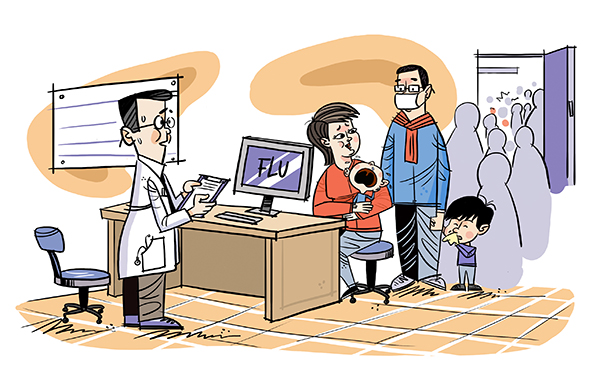
On a business trip to Beijing three weeks ago, I was astonished to read the headlines in many local newspapers highlighting the extraordinary pressure on pediatricians, especially during the seasonal influenza outbreak when many children are down with the flu. I couldn't help but speculate that if the capital, which is home to a great number of top hospitals and elite doctors, is overwhelmed, the situation in other parts of North China could be worse.
Such speculation proved right, as media outlets reported that the pediatrician department of a hospital in Tianjin had to suspend its service because its pediatricians were too exhausted to work.
The shortage of pediatricians and the stress under which they work should be a concern not only for the millions of parents who have to wait for hours for just a few minutes of consultation or medical treatment for their kids, but also for health policy researchers. Many factors are responsible for the situation, such as the unusually severe outbreak of flu and low public awareness about vaccination.
But the flu outbreak has revealed the vulnerability of pediatric departments. The children-pediatrician ratio in China is well below the international level. Despite the National Health and Family Planning Commission setting the benchmark number for pediatricians, about 100,000 pediatricians are still needed to fill the gap, as China's medical schools produce no more than 2,000 pediatricians every year-and many of them are tempted to opt for another specialization, because pediatrics is not a high-paying job.
Perhaps an "unwise" decision made 19 years ago is to blame for that. For some reasons, most medical schools-starting from 1999-ceased to offer bachelor's degrees in clinical pediatrics, downgrading this important specialization to merely one course in the curriculum for the soon-to-be doctors. This significantly reduced the number of pediatricians passing out of medical schools every year. That general physicians lack the specialized training necessary to provide professional pediatric service further complicates the matter. And despite the resumption of pediatrics programs in medical schools, it will take long to fill up this generational gap.
Worse, pediatrics is not the preferred choice of doctors in China. Because patients are children, specialists require more patience and relatively high communication skills. The profession is also associated with greater occupational risks, is prone to medical disputes, and comes with heavier workload and lower salary, compared with other specializations.
A critical factor often neglected is that China's primary care system doesn't have enough clinical capacity in pediatrics. Due to the low trust in community-level doctors, most Chinese patients, especially urban dwellers, tend to visit big hospitals for treatment of even a common cold or fever.
Such behaviors have inflated medical costs and exacerbated the heavy burden on major hospitals. The consequences are huge crowds, long queues, and high costs. Supposed to play the role of "gate-keepers", the primary care system is, however, rather weak, while two-way referrals are rare. And since very few community health centers are staffed with pediatricians, general practitioners usually have no choice but to refer the children to the major, over-crowded hospitals.
There is no panacea for this illness, but two caveats may be worth considering. First, while the training of professional pediatricians to fill up the gap is undoubtedly necessary, the creation of a more conducive environmental for pediatricians is probably more crucial. Higher income and more career opportunities will help attract and retain more talents in pediatrics.
Second, the training of primary care staff in pediatrics needs to be significantly improved, in order to reduce the unnecessary patient flow to referral hospitals. And in urban communities where the demand for pediatricians is very high, the local health administration should consider providing necessary incentives for pediatricians to practice more in primary care facilities, helping strengthen their capacity on the one hand and meeting local needs on the other.
The author is an associate professor and associate head of the Department of Asian and Policy Studies, The Education University of Hong Kong.





