



Connectivity is the cornerstone of inclusive growth in the Himalayan region









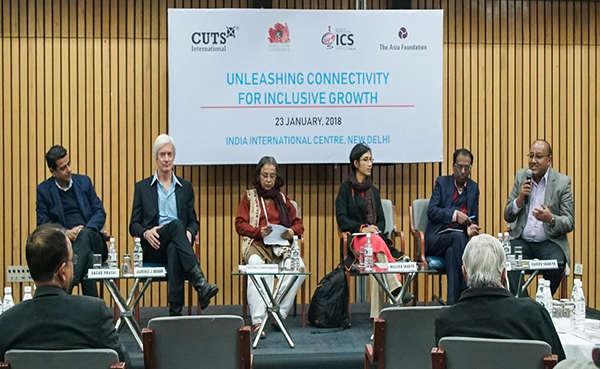
CUTS International, Himalayan Consensus Institute, Institute of Chinese Studies, and The Asia Foundation organised a panel discussion titled “Unleashing Connectivity for Inclusive Growth – Leveraging Himalayan Consensus” in New Delhi on Tuesday.
The discussion introduced the idea behind Himalayan Consensus process to the larger audience in Delhi and developed an initial framework on how this platform can be used to usher connectivity and people to people contact. In a moderated session, speakers reflected on the work of their institutions and shaped up the discourse especially in context of how this can shape the larger Act East discourse for India, together with China’s Belt and Road Initiative, in the interests of furthering connectivity.
Panelists included Bipul Chatterjee, Executive Director, CUTS International; Laurence Brahm, Chair, Himalayan Consensus Institute; Mallika Shakya, Assistant Professor, South Asian University; Sagar Prasai, Country Representative, The Asia Foundation; and Sreemati Chakrabarti, Vice-Chairperson and Honorary Fellow, Institute of Chinese Studies, New Delhi.
Bipul Chatterjee explained the concept of connectivity by looking through the tangible pillars of land-based transportation (road and railways) connectivity, waterways connectivity and energy connectivity. He stressed the importance of promoting infrastructural investments for increased connectivity in the BBIN region (Bangladesh, Bhutan, India, Nepal) sub-region and the greater
Bay of Bengal Region including Sri Lanka, Myanmar and Thailand. He also emphasised on integrating private sector participation in the connectivity development discourse.
Laurence Brahm explained how social entrepreneurs working in the Himalayas came together to form Himalayan Consensus while trying to protect their local culture and environment through local business models. It was these concepts that came together as Himalayan Consensus which promotes multilateral approach to development. HC believes that conflictis not driven by clash of culture and religion but through economic disempowerment and marginalisation of cultural identity.
He stressed on the importance of realising economic and people to people connectivity by mobilising shared resources and harnessing technological opportunities that are smart, green and blue.
Mallika Shakya underscored the importance of conceptualising the idea of the Himalayas,borders, regions – what really constitutes this huge geographical construct? To understand the present realities, she emphasised the importance of exploring the historical trajectory of human connectivity including movements of businessmen,traders,relatives,workers and soon across the region.
Sagar Prasai emphasised that connectivity is integral for development but geopolitics of the South Asian region inhibits regional cooperation in a constructive manner. In terms of waterways connectivity,he said that the new water management technologies are not reflected in geopolitical agenda and institution dealing with the prevailing educational system. He also argued that for any sort of connectivity China should be taken into consideration being another biggest economic and human resource provider in the region.
Sreemati Chakrabarti gave an overview about ICS’s integral role in informing India’s Ministryof External Affairs for key Track 1.5 or Track 2 initiatives such as the BCIM Regional Economic Forum and the Russia-India-China Trilateral Dialogue and the academic partner for Boao Forum for Asia. She stressed the need to build a common platform of think-tanks for working towards the connectivity discourses by working harder on the enhancement of regional connection, connecting research and business, and encouraging youth and women participation for thesame.
Sujeev Shakya moderator of the panel summarised on the need of using the platform of Himalayan Consensus to further the connectivity discourse across many areas. He emphasised on engaging youth in the discourse and informed on the Youth Forum at the upcoming Himalayan Consensus Summit in Kathmandu this March 2018, to will be held jointly with Himalayan University Consortium of International Centre for Integrated Mountain Development(ICIMOD).










