Still opportunities for China-US climate cooperation









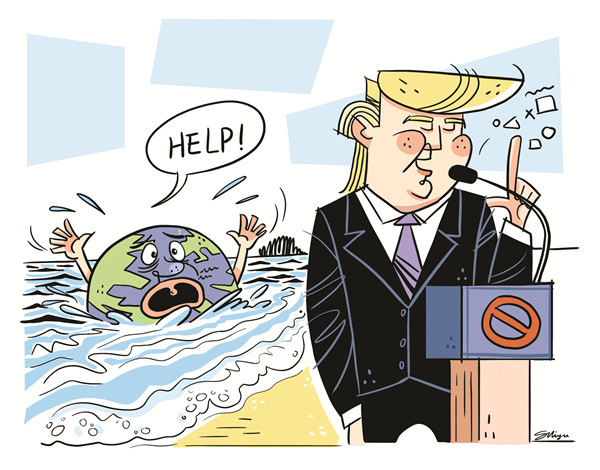
Despite the growing signs of changing climate in 2017, with massive storms, flooding and wildfires, US President Donald Trump did not mention "climate change" in last week's State of the Union speech. He did not refer to "renewable energy" either, breaking from nearly all recent presidential addresses. Trump did say that he had "ended the war on American Energy", the "war on clean coal".
So, what is happening in the United States?
Since Trump took office a year ago, the US Environmental Protection Agency has proposed repealing the Clean Power Plan-former president Barack Obama's landmark initiative to reduce emissions in the power sector-and is exploring options to replace it with a weaker policy. President Trump has consistently prioritized fossil fuels, including expanding the area of coastal waters available for oil drilling and opening more public lands for oil, gas and coal extraction. The controversial Keystone XL and Dakota Access pipelines were recently approved to bring oil sands from Canada to US refineries and markets. The Trump administration also launched a review of US auto efficiency standards, with again, a likely push to weaken them. Many of these actions will be subject to lengthy legal challenges, and some may ultimately be reversed, but the administration's direction is clear.
In June 2017, President Trump announced that he intends to withdraw the US from the Paris climate agreement. This decision leaves the US administration as an outlier, as it fails to appreciate one of the great diplomatic achievements in recent times. Although what is less well-understood is that the US cannot technically leave the Agreement until after the next US presidential election in November 2020.
However, despite his announcement, US states, cities and businesses are forging ahead, many of them with an even stronger sense of conviction. Even after President Trump announced he would withdraw the United States from the Paris agreement more than 2,500 governors, mayors and CEOs pledged to stick with the goals of the Paris Agreement.
The World Resources Institute (where I work) contributed to a report for America's Pledge, which was presented at the international climate talks in Bonn, Germany last November. Our analysis found that the states, cities and businesses committed to the Paris climate goals represent more than half of the US economy and population. If this coalition were its own country, its economy would be the third-largest in the world.
Many compelling examples of US subnational action exist. New Jersey and Virginia just announced they would rejoin a group of states that have a cap-and-trade system, called the Regional Greenhouse Gas Initiative (RGGI). Governor Jerry Brown of California recently committed to deploy at least 5 million zero-emission vehicles by 2030. The governor of Washington is expected to advance a carbon tax in the state. The city of Pittsburgh has targets to reduce its transportation emissions by 50 percent and switch to all-renewable electricity sources for municipal operations by 2030. Nearly 350 multinational companies, including brands like General Mills, Pfizer and Walmart, have adopted science-based targets to reduce emissions in line with the goal of keeping global warming under 2 degrees Celsius. Such subnational moves can drive down US emissions, but clearly more efforts, including by the US federal government, will be needed in the years ahead.
The surge in subnational actions creates several opportunities for cooperation between the US and China on climate and clean energy. For example, US states can continue some of the ongoing initiatives with China's national government, such as the joint Clean Energy Research Centers. China's launch of its national emissions trading system can also open up more dialogue with US states that have carbon trading systems, such as California and the states in the RGGI network. Finally, Chinese provinces and US states, as well as cities in both countries, can cooperate on low-carbon development. Exchanges of lessons, business investment and even people between both countries at the subnational level can be mutually enriching.
Collaboration between the US and China was essential to create the Paris Agreement. This collaboration is much less visible today during the Trump administration. Next September, California will host a major climate summit to highlight subnational action. China can use this opportunity to demonstrate its continued leadership on climate change and to encourage greater ambition from the US. Despite the current political challenges, deeper cooperation between the two countries is possible and can help raise global ambitions around climate change.
The author is executive vice president & managing director, World Resources Institute.