US' DPRK policy at odds with its stated purpose









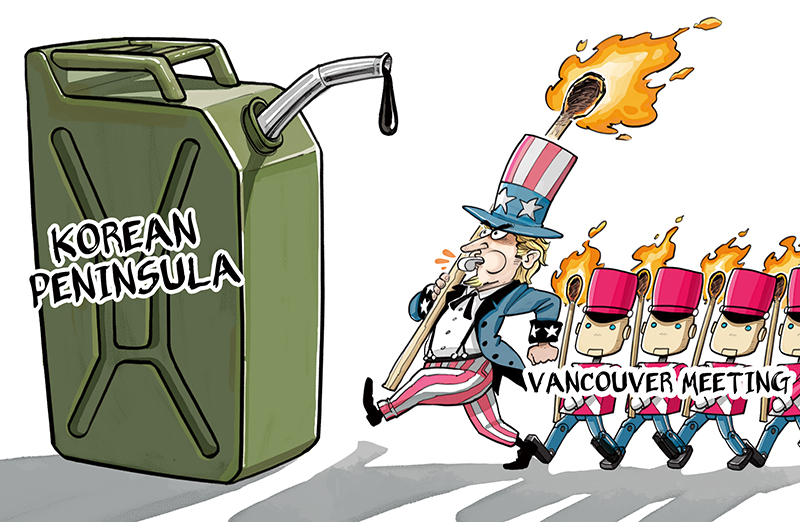
The United States and Canada co-hosted the Vancouver Foreign Ministers' Meeting on Security and Stability on the Korean Peninsula on Jan 15-16. The meeting cast a shadow over the improving relations between the two Koreas.
Why is the possibility of peace always derailed whenever there is the possibility of easing tensions? Over the years, the US' high pressure policy has not paid off. Rather, it has only made the Democratic People's Republic of Korea even more determined to have nuclear weapons.
The crux of the issue lies in the US' ulterior motives, which run counter to resolving the Korean Peninsula issue.
The US' reluctance to talk precedes the DPRK having nuclear weapons. Before the DPRK successfully tested a missile that could reach the US carrying a nuclear warhead, the US hardly showed any interest in meaningful negotiations. After that President Donald Trump declared the US' "patience is over". The reluctance to talk precedes the development of nuclear capabilities.
The Korean Peninsula issue is in essence about a security guarantee. Economic sanctions and military pressure are not solutions to the crisis.
On the contrary, military drills and pressure will make the DPRK feel cornered, making it more likely to cling to its nuclear weapons. This straightforward logic cannot be lost on the US. The only explanation for the US' provocative actions is it has no intention at all of solving the DPRK nuclear issue. It is simply using it as leverage and is keeping the crisis simmering yet within its control.
Its passing the buck compounds the difficulties. The US knows full well that China plays a mediating role in the Korean nuclear issue, but it is in no position to solve it alone. Yet whenever things go awry between the US and the DPRK, the US will play the blame game, accusing China of being excessively accommodating of the DPRK's nuclear program. This serves to obscure its own resistance toward real and substantive steps to solve the issue.
In the meantime, the US is using the DPRK nuclear issue to exert pressure on China and contain its rise. The deployment of its Terminal High Altitude Area Defense anti-missile system in the Republic of Korea is a case in point, as it exceeds the expressed purpose of countering DPRK missile threats to the ROK.
The US also claims a Catch 22 situation as an excuse for not agreeing to talks. It says the DPRK abandoning its nuclear program is a precondition for negotiations, but the DPRK believes talks on peace and security must precede any denuclearization. Thus efforts to promote direct talks never gain traction as neither party is willing to make the first move.
The US alleges that direct talks would be tantamount to recognition of DPRK's nuclear status, which constitutes the fundamental cause of the stalemate. Yet in this context, it is the more powerful country that is in a more advantageous position to break the ice.
Denuclearization is complex in nature and will require many rounds of negotiations to solve, and thus it should not be seen as a precondition for talks to take place. Nor does the US making the first move mean it is recognizing the DPRK's nuclear status. By taking the initiative and demonstrating more diplomatic flexibility it would automatically move things in a positive direction.
Furthermore, normalizing relations and signing a peace treaty are not mere gestures, but rather a sine qua non for the survival of DPRK as a state. It may have been reckless for the DPRK to pursue nuclear weapons, but that is a legacy of the Korean War and military power aligned against it. Therefore, the US should tackle the issue by addressing the long-term causes first, before proceeding to address the more recent developments.
However, it can be predicted that the US will continue to use military deterrence and extended sanctions to keep pressure on the DPRK. In the meantime, there will be no change in its passing-the-buck policy. All this conspires against a viable policy to resolving the crisis.
The author is the vice-president of China Foreign Affairs University. Courtesy: chinausfocus.com