The home cook superstar









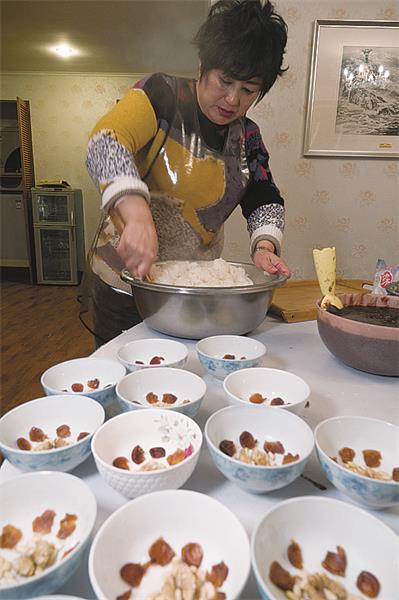
A sweet treat made from glutinous rice, red bean paste and eight types of dried fruits and nuts, eight treasure rice cakes are usually served as the last course of a New Year’s Eve reunion dinner.
While every family used to hand make these cakes before the festival, most people now get them from supermarkets. And this is one of the reasons why Wang’s cakes — they cost 50 yuan ($7.90) each — are so popular despite costing more than five times the average market price.
“I boil my own lard, fry my own red bean paste and peel my own nuts. I can’t say what’s wrong with factory processed food, but we mums just don’t go for that,” she said.
Together with her husband and six staff, Wang is aiming to make 200 rice cakes every day. She does not have a physical store or an online platform to sell these lard-battered cakes.
Most of the orders have been placed by regular customers of her restaurant, some of whom are A-list Chinese celebrities such as Chen Daoming, a famous movie star.
Wang has been a prominent figure in the Chinese culinary scene ever since she was featured in the country’s most watched food documentary, A Bite of China, in 2012. In the documentary, her introduction read: “Whoever hasn’t tasted Wang’s cooking cannot be considered a top foodie in China”.
A former bus conductor who later worked as a corporate assistant before starting her own restaurant, Wang has never received formal culinary training in her life.
Born and bred in a typical Shanghai neighborhood that comprised a lane house with a shared kitchen and bathroom, Wang said she was born with a passion for cooking and an uncanny ability to “steal” cooking skills from the mother of every family in her housing compound.
Such was her talent that she took over the cooking duties in the household when she was just 15.
Wang established her eponymous restaurant in 2008 when she realized that her home-style cooking was well-received by all her friends and acquaintances. It also helped that a friend offered her a handsome investment capital to get started.
Business has been brisk since the very first day. After Wang was featured in the food documentary which was aired during the Spring Festival in 2012, diners needed to make a reservation several weeks in advance before they could get a seat at her restaurant.
There are only four tables in the restaurant. Each fits about 10 people. Wang said she once had to turn down the reservation request by Hong Kong superstar Andy Lau because she was fully booked.
Wang’s little eatery might not have earned a Michelin star, but the price of her creations can be compared to those that have won the accolade — a meal at her restaurant would cost between 600 and 1,000 yuan per person.
There is also no menu — diners simply tell Wang how much they are willing to spend, leaving her to decide what dishes to prepare. A complete meal usually consists of 10 appetizers, 10 hot dishes and two desserts.
However, customers are allowed to request for particular dishes. According to Wang’s assistant, the lion’s share of the restaurant’s most loyal customers are overseas-based Chinese who crave a bite of authentic home cooking when they are back in town.
These customers usually order the most ordinary dishes such as cabbage fried with shredded pork that most Chinese restaurants would not even bother to place on their menus.
Most of her dishes are prepared in the traditional Shanghai way, featuring a heavy use of sugar and soy sauce. Her signature dishes include red braised eel with garlic, cherry-sauced pork and the eight treasure rice cake.
Shen Hongfei, the consultant for the food documentary and China’s most influential food critic, said that the difference between Wang’s cooking style and most catering businesses is akin to the disparity between Chinese traditional medicine and western hospitals.
“Her cooking style is like a TCM doctor who, after taking your pulse, customizes the medicine recipe for the patient. On the other hand, chefs at most Chinese restaurants barely know who they are cooking for,” said Shen.
When asked for her secret to her success, Wang revealed that it was simply down to “staying hungry and happy” while cooking.
“However bad a day I have, I try to be happy the moment I step into the kitchen because I believe that’s the best sauce I can use,” Wang said.
Contact with the author at xujunqian@chinadaily.com.cn.