



Finland touts 'Arctic Corridor' tunnel









Businessman wants to bring China and Europe closer together to boost trade
Each day, more 20,000 people take the two-hour ferry ride across the 80 kilometers of the Baltic Sea that separates Helsinki in Finland from the Estonian capital Tallinn.
Most Estonians who take the trip do so to get to work in the Finnish capital, while Finns do so to visit Tallinn, where shopping is cheaper.
Ten years ago, Helsinki mayor Jussi Pajunen described a subterranean tunnel linking the two cities as a “utopian vision” — an exciting concept that would be next-to-impossible to execute.
Today, a consortium headed by Finnish entrepreneur Peter Vesterbacka, the creator of the popular mobile game Angry Birds, claims to be months away from breaking ground on the project, thanks to unnamed Chinese investors.
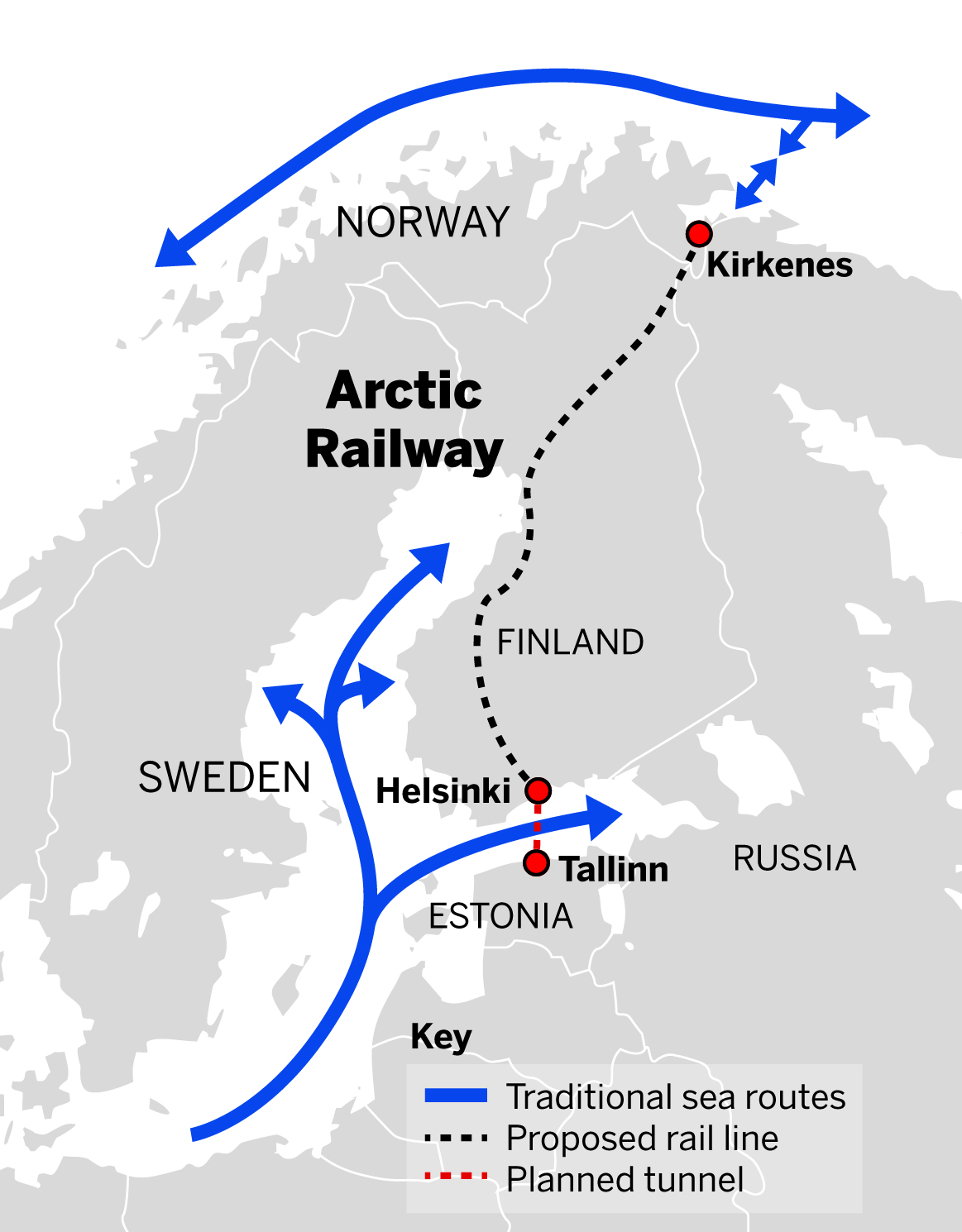
The tunnel would be a vital leg in the “Arctic Corridor”, a plan to link China and Europe via the warming Arctic
Ocean, and through Norway and Finland.
“Planning has been ongoing for a year and a half and we intend to start the first part of physical construction this year,” Vesterbacka said. He did not give details about the Chinese investors. His consortium includes Poyry and AINS Group, two large engineering companies from Finland. The former mobile game developer estimates the increased traffic and connectivity that the tunnel would bring would cause Finland’s GDP to grow by between 1 and 4 percent.
“The target date for completion and having the first trains running is Dec 24, 2024.”
Vesterbacka says the tunnel will cost 15 billion euros ($18.3 billion), and he aims to raise 70 percent of that from Chinese investors. He will look to raise the rest through European pension funds.
At 100 kilometers long, it will be the longest underground rail tunnel in the world. It would mean the travel time between the cities would be 20 minutes.
“This project is perfectly aligned with China’s Belt and Road Initiative,” Vesterbacka said. “It’s obvious that there would be big interest from China to connect with Europe, and we happen to be the closest neighbor of China in Europe.”
Vesterbacka said what makes the tunnel project attractive to Chinese investors is the role it would play in the “Arctic Corridor”, which proposes a rail link between the Norwegian port of Kirkenes and Estonia.
The Finnish Ministry of Transport will soon release a feasibility study for a 3-billion-euro section of the railway that would link Kirkenes to an existing rail network in central Finland. The railway would then continue to Helsinki, and potentially Tallinn, if the tunnel is built.
This new link would mean Chinese cargo could arrive in Central Europe in record time. Chinese ships traveling by the Northern Sea Route in the Arctic can reach Europe 20 days quicker than via the Suez Canal.
The government of Finland is eager to position itself in the heart of trade between Asia and Europe, and the “Arctic Corridor” is central to this endeavor.
The corridor also plays into Chinese plans to utilize previously inaccessible Arctic routes that are now usable because of the effects of global warming.
“China hopes to work with all parties to build a ‘Polar Silk Road’ through developing the Arctic shipping routes,” the Chinese government announced in a policy white paper issued in January.
In terms of expense and technical difficulty, the tunnel is the most ambitious part of the Arctic Corridor, according to Yang Erlin, chairman of the Finnish Chinese Business Council.
“For Finnish politicians, they are concerned the investment is too big,” Yang said. “The first report said it would cost between 9 and 12 billion euros. The new proposal is between 13 and 20 billion euros, depending on how the tunnel is built. The return-on-investment, from a business perspective, is the issue.”
Yang said the tunnel was once a “crazy dream” but is now a potential reality because of the arrival of Chinese investors.
“Private and State investors from China are very interested in this project in terms of investment as well as providing equipment and labor,” Yang said. “They can raise the money. Now, the biggest issue will be concerns about the environmental impact.”
The excavation of the Baltic seabed and the construction of the rail line in Northern Finland and Norway has met with opposition from environmental groups and indigenous communities.
The railway would run through the territory of the Saami people of Lapland. Many Saami make a living from reindeer herding, and leaders from the community are worried the rail line will disrupt reindeer migration routes.
“This is a valid concern,” Vesterbacka said. “The concern comes mainly because of a lack of detail right now of exactly where the line will go. Part of the rail line will go underground to allow for the natural flow of reindeer and other species.”
The World Wildlife Foundation, which is also called the WWF, has raised concerns about the increased use of the Northern Sea Route.
“The Arctic environment is already under massive stress because of climate change. It’s the most rapidly changing environment on the planet,” said Simon Walmsley, senior Arctic sustainability advisor for the WWF. “We would prefer that there wasn’t this level of development. We are not anti-development, but it should be well thought out and well planned before it takes place.”
Walmsley said increased shipping could lead to the introduction of harmful invasive species, as well as pollution caused by leaked fuels and emissions.
The WWF wants trading nations to phase out the use of ships that burn Heavy Fuel Oil in the Arctic. This fuel is particularly damaging to the Arctic environment because it emits black carbon, which creates a dark film on snow and ice, making it melt more quickly.
The WWF is an observer on the Arctic Council, which is an intergovernmental forum that addresses issues faced by the people living in the Arctic region.
“We will be communicating our concerns through the Arctic Council and the International Maritime Organization,” Walmsley said.
“We’ll be communicating particularly with Finland, as Finland is the chair of the Arctic Council. We think a big planning regime has to happen, before this route is even considered.”
After the release of China’s white paper on the Polar Silk Road, Vice-Foreign Minister Kong Xuanyou said China would develop responsibly in the region.
“Some people may have misgivings over our participation in the development of the Arctic, worried we may have other intentions, or that we may plunder resources or damage the environment,” Kong said. “I believe these kinds of concerns are absolutely unnecessary.”
The paper said that China would move forward while “respecting traditions and cultures of the Arctic residents, including indigenous peoples, and conserving the natural environment”.










