



Clearing 'last mile' of poverty alleviation









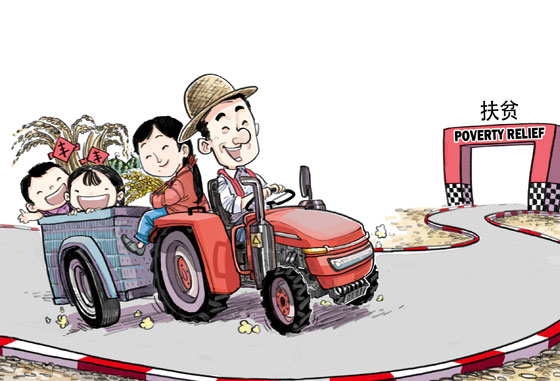
Premier Li Keqiang has said in the Government Work Report that the central government has appropriated more than 280 billion yuan ($44.23 billion) of poverty reduction funds over the past five years.
The government's efforts to eradicate extreme poverty are an apt example of the Communist Party of China's people-centric development philosophy. Targeted poverty alleviation has made great progress in the five years since the 18th National Congress of the CPC in late 2012, with the impoverished population declining from more than 80 million in 2013 to about 30 million in 2017.
In his report to the 19th Party Congress, CPC Central Committee General Secretary Xi Jinping said: "We will intensify poverty alleviation … and continue to promote well-rounded human development and common prosperity for everyone".
And that China has stepped into "a new era" means 2018 will play a vital role in achieving the first of the "Two Centenary Goals"-building a moderately prosperous society by 2020-by eradicating extreme poverty. This means on average China will lift about 10 million people out of extreme poverty every year till 2020.
But poverty alleviation work in China still faces many challenges.
First, in the past some local authorities and departments adopted measures such as fudging or exaggerating their poverty alleviation statistics to enhance their political performance. And some grassroots poverty alleviation officials spent a lot of time filling up forms, attending meetings and writing reports, leaving them little time to visit the impoverished regions in person, make in-depth surveys to know the impoverished residents' real difficulties and provide real support for them. This kind of poverty alleviation work is inefficient and ends up wasting huge amounts of human and material resources.
Eliminating "poverty alleviation work on paper" and reducing the pressure on grassroots poverty alleviation officials to fill up the forms and write summaries will be crucial to the poverty alleviation campaign in the future.
Second, corrupt practices have to be eliminated from poverty alleviation work, by strictly promoting the rule of law and Party regulations. Previous corruption cases show that some village officials in impoverished regions embezzled poverty alleviation funds and/or materials.
Such scandals not only undermine the implementation and results of the central government's poverty alleviation policies and infringe on impoverished residents' interests, but also damage the image of the Party and the government. In addition, they have had a negative impact on the local social order. Therefore, the poverty alleviation policy seems to be failing in the "last mile" in some areas.
To solve the "last mile" problem, the authorities should enhance supervision over poverty alleviation departments and officials. The people's congresses at various levels as well as the public should jointly supervise poverty alleviation work at the corresponding level, and the corrupt officials must be punished according to law to deter other officials from using the poverty alleviation funds and materials for their personal gain.
Fortunately the authorities have already begun to address such problems. Hu Jinglin, vice-minister of finance, said at a news conference on Wednesday, that the financial authorities will strengthen their supervision over the poverty alleviation funds, and evaluate the effect of such aid to truly improve the livelihoods of people in need.
The authorities should also take measures to prevent "fake" poverty alleviation work. Media reports said some local officials abuse their powers to influence poverty alleviation work. For instance, some rural officials listed their relatives and friends as targets of poverty alleviation while ignoring the real impoverished residents.
The need is to make the poverty alleviation process more open and transparent, so that public supervision is realized. And technologies that enable poverty alleviation funds and materials to be given directly to the impoverished households should be adopted, in order to avoid corruption.
With the introduction of the central government's rural revitalization strategy and anti-crime campaign in local areas, the process to build grassroots organizations in China will be further strengthened, which in turn will help remove the obstacles in the "last mile" of poverty alleviation work.
With the strong support of the central authorities, the goal of lifting people out of extreme poverty by 2020 will definitely be achieved.
The author is a professor of public management at the Chinese Academy of Governance.





