Does China's military spending indicate an arms race?









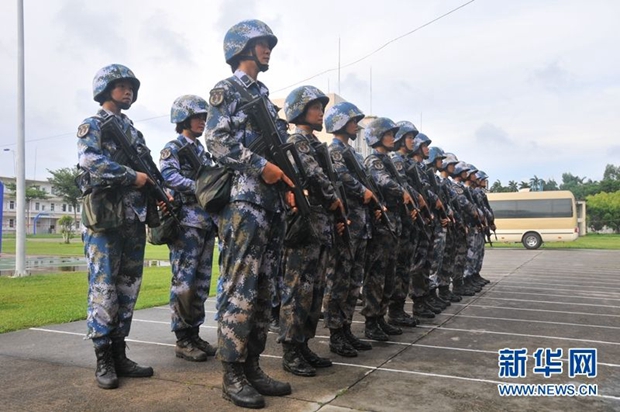
It is hardly surprising when global media outlets react negatively to announcements of Chinese spending figures on issues of regional and international importance. China's uptick in its defense budget for 2018 was no exception.
Following the announcement of an intended military spending increase of 8.1 percent, or up to $175 billion, made by Premier Li Keqiang in his annual government work report, opinion articles and analyses swept the internet warning of China's intention to join an arms race against the US
Indeed, a clearer comparison with Washington may indicate whether or not China is in fact interested in an arms race, or whether it is too premature to determine at this stage.
China claims that it will prioritize turning its army into a "world-class" modernized and mechanized force, investing in high-tech systems and advanced equipment at the expense of size. Troop numbers have recently been reduced by 300,000, putting China's military force at 2 million.
Xu Guangyu, a retired general and senior consultant with the China Arms Control and Disarmament Association in Beijing, was quoted in Sputnik saying that "China would focus on competing against the United States on quality" rather than quantity. In essence, this will mean upgrading the accuracy and strength of its missile, aircraft and aircraft-carrier technologies in order to protect its interests in the Asia-Pacific region and the South China Sea.
China is now at the point of launching its second aircraft carrier and integrating stealth fighters and advanced missiles into its military force.
The increase in China's military budget, up from 7 percent in 2017 and 7.6 percent in 2016, is perhaps predictable given the reduction in its number of troops as well as its reallocation of resources for the modernization of equipment.
On the contrary, the US shows aggressive determination to build a superior unrivaled military power in alignment with its National Security Strategy, National Defense Strategy and Nuclear Posture Review, which cite China as a primary threat.
The US budget proposal for the fiscal year 2019, submitted to the Congress in February, asked for $716 billion for national security, including $686.1 billion in military spending, a double-digit growth up 13 percent from the previous fiscal year. A 2.6 percent increase of US military personnel was also requested.
The US aims at advancing its nuclear arsenal, bolstering its missile defenses and investing in military hardware.
Funding has been requested for countering Russian influence in Europe, Eurasia and the Middle East as well as China's influence in the Indo-Pacific region. Other funds are requested for enhancing space resiliency, overseas contingency operations for war areas like Syria, Iraq and Afghanistan and enhancing programming for North Korea.
In 2017, US military expenditures reached $603 billion, four times higher than China's $151 billion, according to the London-based International Institute for Strategic Studies.
China's military outlay has kept pace with the nation's economic performance, having been holding a steady 2 percent share of China's annual GDP for the past 30 years, according to the Stockholm International Peace Research Institute (SIPRI).
This year, China's budget increase is coordinated with the 6.9 percent economic growth of 2017, the first acceleration of the country's economy since 2010. Zhang Yesui, a spokesman for China's National People's Congress, stated that the budget comes to around 1.3 percent of the nation's 2017 GDP, lower than that of other major nations.
SIPRI figures show that the US defense budget's share of the nation's GDP has been 3.3 percent in recent years.
While an arms race with the US is not on China's strategic agenda, "safeguarding national sovereignty, security and development interests," in the words of Premier Li, are top priorities prompting China's increased military buildup.
Chief among those are securing its strategic interests along the Belt and Road trade routes, including establishing military cooperation with participating countries (its naval base in Djibouti now is an example), warding off threat of terror infiltration, and addressing the increasingly serious possibility of a military conflict between North Korea and the US
China's slight increase in its defense budget is neither alarming nor an overreaction, especially given the clear gap between the military budgets of China and the top spender, the US China's main priorities are to boost regional strength and protect its interests in the Asia-Pacific region. The US's strategy is to establish global dominance, which makes the US defense budget increase the worrying one.
Haifa Said is chief editor of the English Department at the Syrian Arab News Agency.