Smartphones help tame giant forest threat









Rarer than giant pandas
The area inhabited by wild Asian elephants in the province has expanded from seven counties in 2017 to eight this year, according to Chen Mingyong, a life sciences professor at Yunnan University who has been studying the animals for decades.
He said the wild Asian elephant population has grown by two to three animals a year in recent years.
Statistics from the provincial forestry department show the wild elephant population in the province-mostly in Xishuangbanna-has soared from 170 in the 1970s to about 300 now thanks to protection efforts.
That means they are still rarer than giant pandas, but the growing population has resulted in more conflicts between people and elephants.
In 2014, a villager in Basan died after being attacked by a wild elephant searching for food. In 2016, a sexually frustrated bull elephant smashed 19 cars in three days. Five months ago, a 67-year-old tourist from Sichuan suffered broken ribs and a broken right hip bone when he was attacked by a wild elephant in Xishuangbanna.
Statistics from the prefecture's forestry bureau indicate that more than 85 percent of the 153,000 confrontations between humans and wild animals in Xishuangbanna between 1991 and 2010 involved wild Asian elephants. A total of 33 people died and 165 were injured in such confrontations.
A lack of food is the root of the problem. Guo Xianming, deputy director of the research institute at Xishuangbanna Natural Reserve, said an adult Asian elephant usually weighs between 3 and 5 metric tons and consumes 150 to 200 kilograms of food a day. The growing population has been accompanied by a dramatic increase in the herds' demand for food.
The expansion of some invasive plants has made growing conditions more difficult for the elephants' preferred food, and scientists say decades of rainforest protection efforts are another factor.
"Protection of rainforest resulted in rapid growth of plants, especially those big trees that used to be threatened by excessive tree felling," said Wang Lifan, director of Xishuangbanna Natural Reserve's Shangyong section. "The efforts are crucial to the better recovery of rainforest, but might also lead to problems with the wild elephants' natural food supply."
The section, covering 31,300 hectares, is the third largest in the natural reserve. Established in the 1980s, it is now home to 70 to 90 wild elephants.
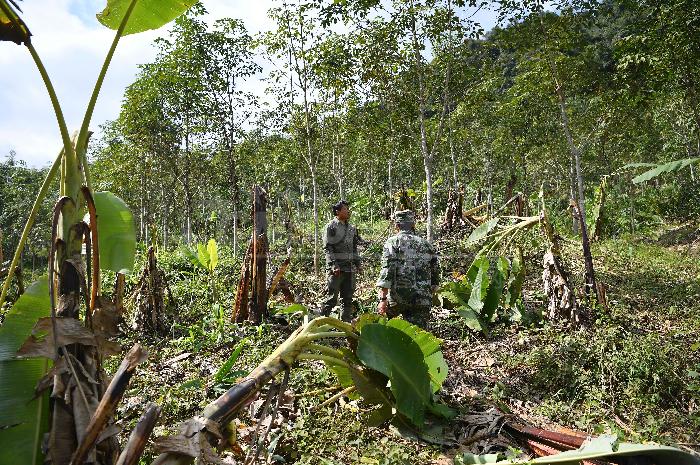
"A number of the elephants' favorite foods, such as bamboo, plume grass and plantain, are declining dramatically," Wang said. "They are much shorter than trees and the protection of the rainforest allows trees to grow rapidly and become a shelter, stopping the sun's rays those shorter plants need."






- Agarwood exhibition steeps Shanghai museum in fragrance
- The Fujian Coast Guard conducts regular law enforcement patrol in the waters near Jinmen
- IP protection for new fields to improve
- Draft rules define premade dishes in consumer interest
- Self-powering pacemaker could last a lifetime
- China intensifies crackdown on misuse of personal data