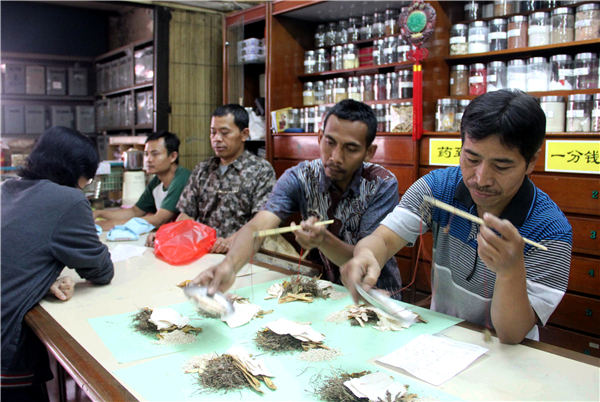
Traditional Chinese medicine is taking off in countries like Thailand and Indonesia, where emigrants are helping to popularize the ancient practice.
In recent years, traditional Chinese medicine has been gaining in popularity around the world, and nowhere more than in Southeast Asia, where many Chinese continue to use these ancient remedies.
Thida Pechsiri, a 25-year-old resident of Bangkok, is not a frequent user of TCM, but she still holds the 2,500 year-old medical practices in high regard like her mother, a descendant of Chinese emigrants.
According to Pechsiri, a tour that brought her to China 8 years ago changed her perspective on traditional Chinese medicine.
Pechsiri, who was then 17, was suffering serious stomach aches during her period, and her mother decided to seek a traditional remedy for her during their visit to China.
Their Chinese tour guide recommended a veteran TCM doctor to them, who took her pulse and diagnosed her before prescribing herbal concoctions. The doctor instructed a course of treatment lasting three months, but Pechsiri found her problem was gone half way through the course, and stopped the treatment to cut costs, which came to 10,000 baht ($320) per month.
"I was satisfied with the results, and became more confident about TCM after that," she says.
While traditional medicine is mostly popular among Chinese emigrants and their descendants in Thailand and most TCM stores in Bangkok are located in its China Town area, a number of cheap patented TCM herbal products have become everyday items used by Thai people in general. Such products include Yunnan Baiyao, which often applied to first-aid injuries, and Xiguashuang, watermelon frost throat lozenges, produced by Guilin Sanjin Pharmaceutical Co Ltd.
"They are not only sold in TCM stores, but can be easily found at regular drugstores," Pechsiri says.
In many cases, TCM is used together with Western and Thai medicines by local people as part of a more comprehensive form of therapy. More expensive herbal medicines like ginseng and caterpillar fungus are also popular with consumers in Thailand, she adds.
Victor Liu, a Singaporean who has been involved in the TCM product business for 9 years in Jakarta, has also observed a stronger presence of TCM in Indonesia in recent years.
According to Liu, a few years ago there were only Tongrentang, a renowned traditional Chinese medicine pharmaceuticals provider from Beijing, and Zhangzhou Pien Tze Huang Pharmaceutical operating as appointed agencies in Indonesia. But recently, more Chinese pharmaceutical producers such as Tasly from Tianjin, Yunnan Baiyao from Yunnan province and Dong'e Ejiao from Shandong province, have started to explore Indonesia's domestic market.
Liu operates a TCM trading company called Sky One Healthcare, and the first product he chose was Huoxiang Zhengqi Liquid, which is produced by the Chongqing-based Taiji Group.
The oral liquid product is one of the handiest medicines used by Chinese people, and it is often used to treat acute abdominal pains, summertime colds, dampness and other problems.
"I knew it was selling very well in China, and believed it would have good market in Indonesia, where the weather is hot all year round," says Liu.
Now his company is also importing other TCM products and their annual sales have grown to $20 million over the course of the past 9 years.
Like Thailand, people of Chinese origin make up the mainstay of consumers of TCM products in Indonesia, according to Liu.
Local people are familiar with a range of typical TCM products, such as Angong Niuhuang pills, which are commonly used to counter heat and toxins, and Pien Tze Huang, a herbal remedy that can be taken to reduce swelling.
"Chinese medicines that have entered the local market more recently still need time to cultivate a wider customer base," Liu explains, adding that the local people's understanding of Chinese medical therapies mostly revolve around acupuncture and manipulation.
As an agent, Liu says the greatest challenge for him is that in Indonesia, unlike in Singapore, Malaysia and Thailand, TCM is still assessed by regulators using the same standards as Western medicine, which results in a protracted registration process and advertising restrictions relating to their healing properties.
Domestically, producers like Taiji Group are also making efforts of their own to further promote their products overseas.
In 2017, the group was designated by the State Administration of Traditional Chinese Medicine as a demonstration base for promoting traditional patented Chinese medicine and services overseas.
According to Bai Lixi, president of Taiji, his company is seeking to further open up markets in Southeast Asia over the next few years.
"Compared with some pure chemical medicines, which may bring adverse reactions, many TCM products have a good curing effect at an affordable price," says Bai.
Bai cited his company's star product Huoxiang Zhengqi Liquid as an example. The product has developed from a traditional prescription, which dates back more than 1,000 years, and has been passed on for generations due to its positive curative effects.
According to Bai, TCM is the gem of ancient Chinese science, and it is also the key to unlocking the treasures of Chinese civilization.
Bai admits that while TCM's international popularity is growing at pace, there are still many challenges, such as the lack of statistical evidence of actual treatment cases due to its different assessment system from Western medicine.
So his company launched a large-scale research program on actual treatment cases of Huoxiang Zhengqi Liquid to prove its effectiveness and safety. The results and sample data will be released online for consumers worldwide in October.
"I am optimistic about TCM's future growth in Indonesia. Suitable TCM products will finally find their way here as long as we promote them in the right way," says Liu of Sky One.