Historic woodcuts presented to Fudan University









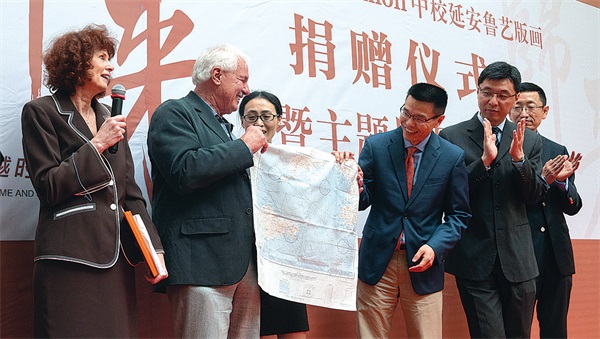
The children of George Hanlon, a former lieutenant colonel in the US Army Air Corps, donated the Yan'an period woodcuts their father received in 1945 to Fudan University Library on April 21.
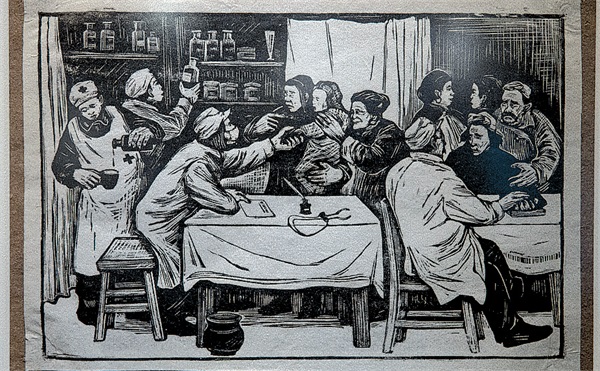
Presented as gifts by Chairman Mao Zedong in Yan'an, the woodcuts were made between 1941 and 1944 by six artists including Gu Yuan and Yan Han from the Lu Xun Academy of Arts and Literature, which was founded by the Communist Party of China (CPC) in 1938. The institution is today known as the Lu Xun Academy of Fine Arts.
The prints cover a wide range of themes concerning the War of Resistance Against Japanese Aggression (1931-45), daily life, farming and political events.
"It is wonderful to send them back to China after all these years," said Deborah Hanlon, the eldest daughter of the late colonel. "I believe our father would have been so proud to do so."
She said the woodcuts have been displayed on the walls of their home in the US since their father framed them up in 1959.
"He described each of the prints to us in great detail, and how these depicted life in China in the 1940s. Because of him, we can use chopsticks since we were 5 years old," she said. Two other children of George Hanlon also attended the ceremony and they donated an original silk American Airforce Cloth Chart in 1944 as a present to Fudan University.
"I have made a photo book for my brother and sister before the donation to remember our dad and the lovely Chinese people."
Chen Sihe, the chief librarian at Fudan University, said these prints reflected the friendship between the Chinese and Americans, and told of other moving stories during the war.
"I know Hanlon wrote a book about his adventures in China, and we hope to preserve these prints and his experience permanently," said Chen. The original prints are exhibited in Fudan University's Science Library till April 28.
Born in Milwaukee, Wisconsin, George Hanlon joined the US Army Air Corps, also know today as the US Air Force, during World War II and was the pilot of a B-29 bomber. He died of a stroke in 1996 at the age of 81.
"When the US military provided aid to the Chinese during the War of Resistance Against Japanese Aggression, the B-29 aircraft, which was called the 'Super Fortress', was used to bomb the Japanese forces," said Jin Guangyao, a history professor at Fudan University.
In September 1944, 108 B-29 bombers took off from Sichuan province's Guanghan city and headed east to attack the Showa Steel Institute in Anshan, Liaoning province. The facility was used by the Japanese military to produce weapons.
While the bombers were returning to base following a successful mission, Hanlon's aircraft was attacked by Japanese fighters and it eventually crashed in Changli county in Hebei province. Of the 11 crew members, only Hanlon and six others survived after parachuting out of the plane. They were later rescued by guerrillas led by the CPC.
"The guerrillas stared at us in curiosity, touched our clothes and looked over our first-aid kits. One of them held my hand. Though embarrassed, I knew this was their way of expressing friendship," George Hanlon wrote in his memoir titled China Walk.
Together with the guerrillas, the US survivors walked more than 1,500 miles across the country for five months before finally arriving in Yan'an in Shaanxi province in January 1945.
One day after their arrival in Yan'an, the heartland of the early revolutionary activities of the CPC, each of the seven crew members received a set of presents, including the woodcuts, from Chairman Mao.
"The woodcuts were given to help them understand the social life in areas liberated from the invaders," said Tang Xiaobing, an expert in woodcuts and a professor at the University of Michigan.
"Because these woodcuts were made from materials that were readily accessible and could be easily reproduced, this distinct form of visual art could be used as a special weapon conveying revolutionary messages to encourage people to fight against the enemy during the war."
Today, Tang added, the woodcuts made in Yan'an are a valuable source of information on how people in places such as Shaanxi and Gansu provinces and the Ningxia Hui autonomous region lived during the war.
Contact the writer at caochen@chinadaily.com.cn