Air pollution is more of a health issue









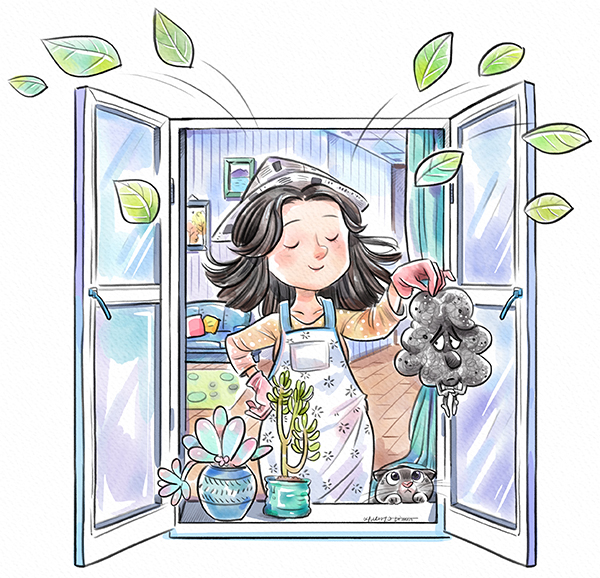
The World Health Organization has released its latest global report assessing ambient air pollution and the resulting disease burden. While some progress has been made around the world since the last WHO report, the fact is that millions of people die prematurely as a direct result of air pollution.
It is no exaggeration to say that air pollution constitutes a public health emergency.
While air pollution is unsightly and demoralizing-witness the sharp contrast between an orange or red-alert day versus a beautiful blue-sky day in Beijing-the ramifications of air pollution, both outdoors and indoors, are of much greater consequence.
PM10 and PM2.5-terms that virtually everyone in China is now familiar with-include particles small enough to wreak havoc on the lungs and the cardiovascular system. The effects of both short and long-term exposure include increased risk of stroke, heart diseases, lung cancer, and chronic and acute respiratory diseases, such as asthma. But the pollution we see and breathe outdoors is not the only killer. Household air pollution, too, has a significant negative impact in two ways.
First, household air pollution has serious implications for people's health in China. Here, the primary source of household air pollution is coal and other unclean fuels used for individual cooking and heating. WHO estimates that reliance on such household energy sources will continue to cause-in addition to the deaths from outdoor air pollution-an additional 1 million premature deaths in China every year unless urgent action is taken.
Second, recent research in China has shown that household air pollution, in fact, is the source of up to 40 percent of ambient air pollution. We simply won't win the war on pollution if we ignore sources of household air pollution.
It is clear to anyone who has spent at least the last few years in China that the country has made remarkable progress since the country's top leadership declared a war on pollution in 2014. Providing better access to cleaner sources of fuel used for indoor heating and cooking, placing and enforcing strict limits on industrial emissions, increasing the use of renewable energy, and promoting greater energy efficiency are some of the strategies the Chinese government has put forth with great success. Indeed, the WHO report shows the annual median exposure to ambient PM2.5 is 48.8 micrograms per cubic meter-a 17 percent reduction from the last WHO report. Still, given that WHO's recommended exposure limit is an annual average of 10 micrograms per cubic meter, there is still a way to go.
But air pollution is not just an environmental problem. It is also a health problem. And as with many other public health issues, it stands in the way of a country's economic and social development.
Think of all resources from the healthcare system that must be diverted to address illnesses caused by air pollution-resources that could otherwise be used to tackle more complicated diseases. Think of the lost wages families will face when loved ones are unable to work due to illness-and potentially being thrown into poverty as a result. Think of the millions of children who can't play in the park with friends-doing what kids otherwise love to do-for days on end due to outdoor pollution.
This is why it is necessary for governments to view air pollution as a health and development problem. And this is why WHO calls on governments around the world, China included, to adopt a health-in-all policies approach when dealing with this issue.
Building on the early wins led by the Ministry of Ecology and Environment and the National Development and Reform Commission, progress can be accelerated by bringing in other stakeholders from the fields of healthcare, finance, and science and technology, allowing broader perspectives to be heard and common solutions to be adopted.
By adopting a holistic approach, and engaging all relevant stakeholders in the solution, I have full confidence that China will make air pollution-both indoor and outdoor-a thing of the past. China can provide a global model for putting ecology and health-as two sides of the same coin-at the center of development.
The author is World Health Organization Representative in China.