Island takes flight after China bird gift









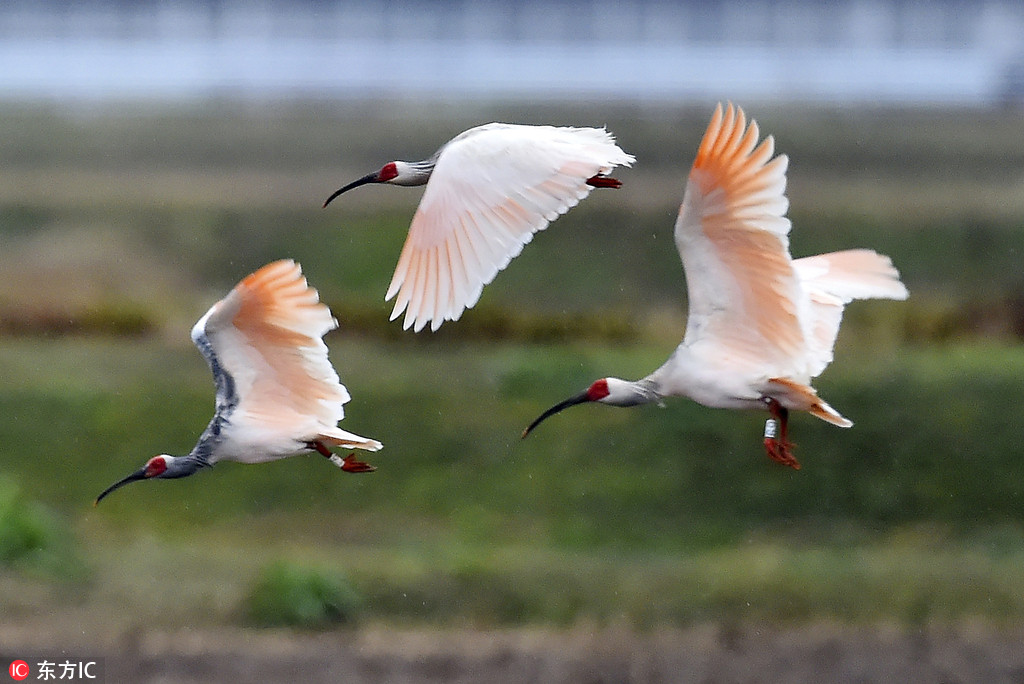
TOKYO - Crested ibises, the iconic birds that were on the verge of extinction in Japan in the 1980s, are now prospering and providing a boost to the local economy on the island of Sado, thanks to China's help.
Since May, the island's farmers have been busy in the fields transplanting rice seedlings. In the morning and evening, white-plumed crested ibises can be seen hunting for food in the paddy fields.
"We can see these birds foraging in the morning and evening all seasons now, as there are crested ibises' nests near our rice fields," said 54-year-old farmer Katsumi Oi.
Sado, covering an area of 855 square kilometers and with a population of 55,000 people, is the sixth largest island in Japan.
The so-called Agriculture in Harmony with Endangered Japanese Crested Ibis is seen as an advantageous resource on the island given its recognition by the United Nations Food and Agriculture Organization as Globally Important Agricultural Heritage.
A crested ibis is an iconic bird deeply rooted in Japanese history and culture. Records of the bird can be traced back to as early as the Chronicles of Japan, a book of history finished in 720 AD.
However, the number of crested ibises in Japan plunged in the 20th century as the birds were hunted for their meat and fine feathers. They also lost their habitats due to deforestation.
"Sado used to be the last habitat of crested ibises in Japan. But with the development of modern agriculture and the abuse of pesticides, food consumed by crested ibises, such as frogs and small fish, disappeared from the paddies, and crested ibises also went to extinct," said Takayuki Nishimaki, an official from the agriculture department of the local government.
To save the endangered species, the Japanese government captured the last five wild crested ibises on the island and relocated them to a conservation center.
But 22 years later, the last Japanese-born crested ibis died at the center at the age of 36, an age equal to 100 in human years.
Today's crested ibises on the island are all descendants of those from northwest China's Shaanxi province.
In 1981, while the world was holding its breath for the endangered species, seven wild crested ibises were discovered in the mountains of Shaanxi.
"The gloom in the conservation center (in Sado) was dispelled by the good news. ... These birds were to save the species from extinction," Hiroyuki Ishi, an environmental journalist and scientist, later wrote in an article.
With the seven ibises, China successfully launched its artificial breeding programs for conserving and protecting the species. In 1999, two crested ibises went to Sado as a gift from China, and three more ibises were sent to Japan by 2007.
Now, around 284 crested ibises are living in Japan.
To boost the local economy, the city of Sado plans to increase the number of foreign tourists from 1,510 in 2011 to 5,000 by 2019, according to Hiroaki Iwasaki, a local government official, who said the target has already been achieved in large part due to the birds.
Moreover, crested ibises have become a brand of their own for local products, especially agricultural products.
"We produce 20,000 tons of rice every year, enough to satisfy the needs of 500,000 people a year, which is ten times of the population of Sado," said Manabu Watabe, an official from a local agricultural cooperative.
To excel in the fiercely competitive Japanese rice market, local farmers stressed that their rice is "produced in harmony with crested ibises".
To produce such rice, farmers must make the rice paddies an effective ecological system, where small creatures coexist in harmony and crested ibises have plenty of food, Nishimaki explained.
"Crested ibises increase demands on protecting the environment, and the birds successfully breeding here shows that the rice here is safe," said Nishimaki.
Xinhua