Satellite launch first step to far side of moon









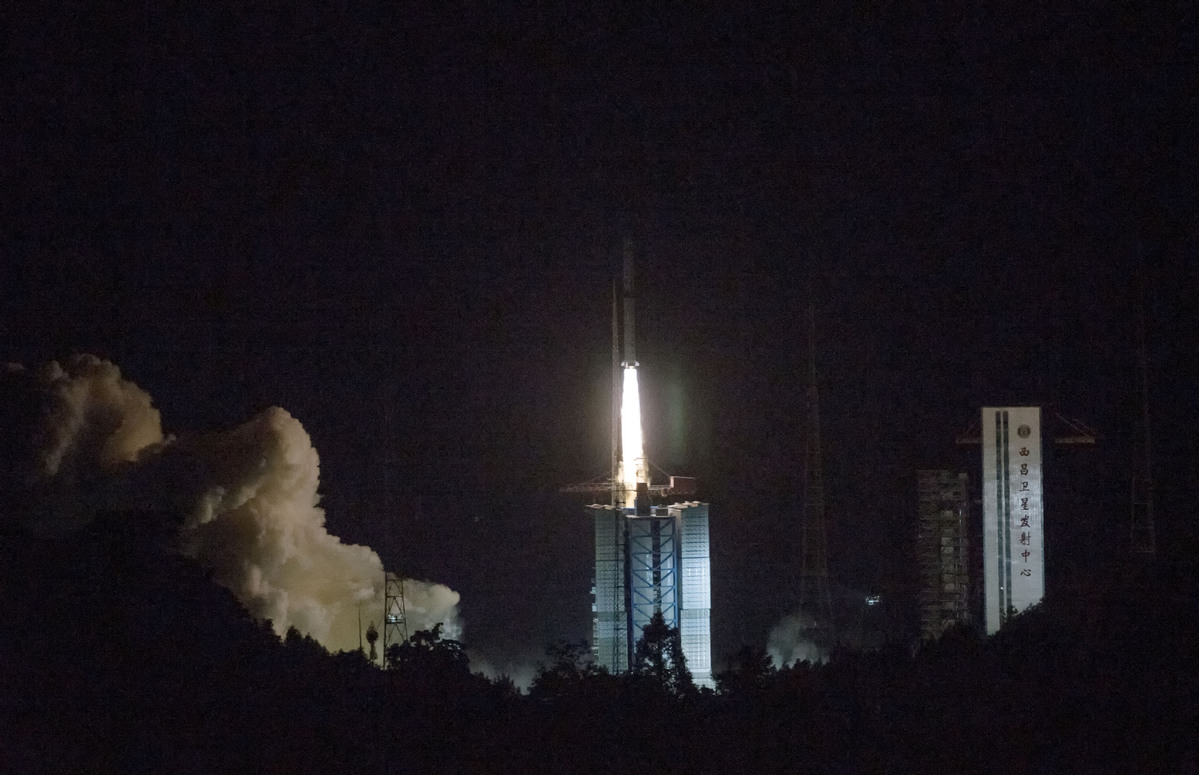
China launched a relay satellite on Monday as the first step in the groundbreaking Chang’e 4 lunar mission.
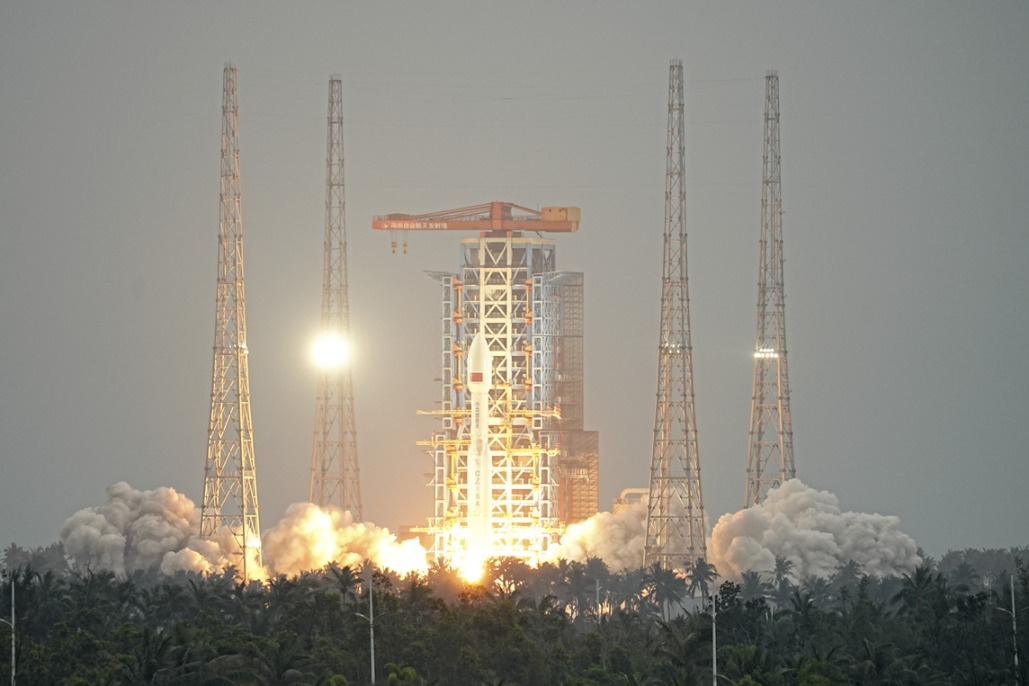
The satellite, named Que-qiao, a legendary bridge in the Milky Way, was lifted into space atop a Long March 4C carrier rocket from the Xichang Satellite Launch Center in Sichuan province, the China National Space Administration said in a statement.
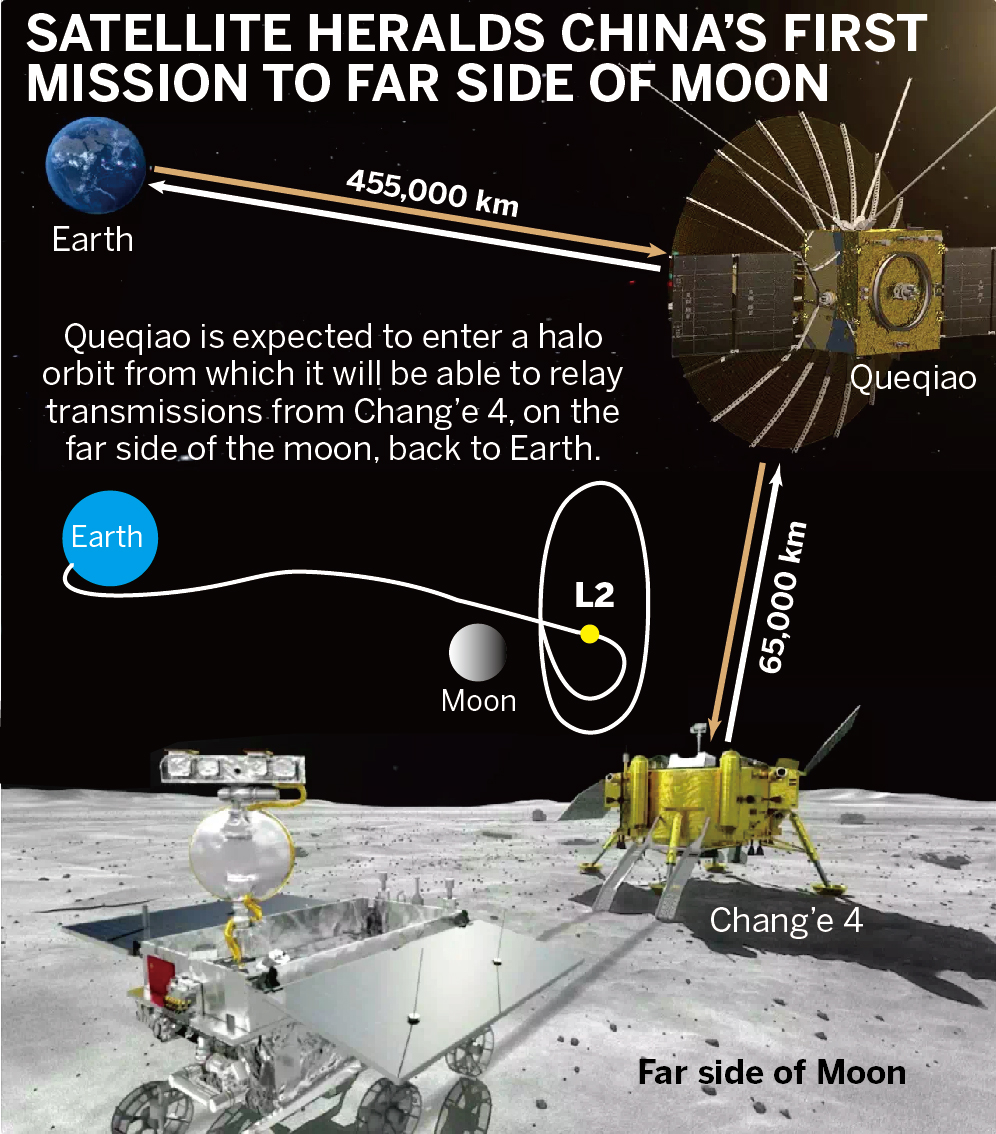
Queqiao has been placed into an Earth-moon transfer orbit and has started a journey toward a halo orbit around the Earth-moon Lagrangian point 2, a gravitationally stable spot located 455,000 kilometers from Earth beyond the far side of the moon. From the orbit, it will relay communication signals between Earth and the Chang’e 4 lunar probe that is scheduled to land on the moon around year’s end, the administration said.
Queqiao will be the world’s first communications satellite operating near the Earth-moon L2 point, the administration said.
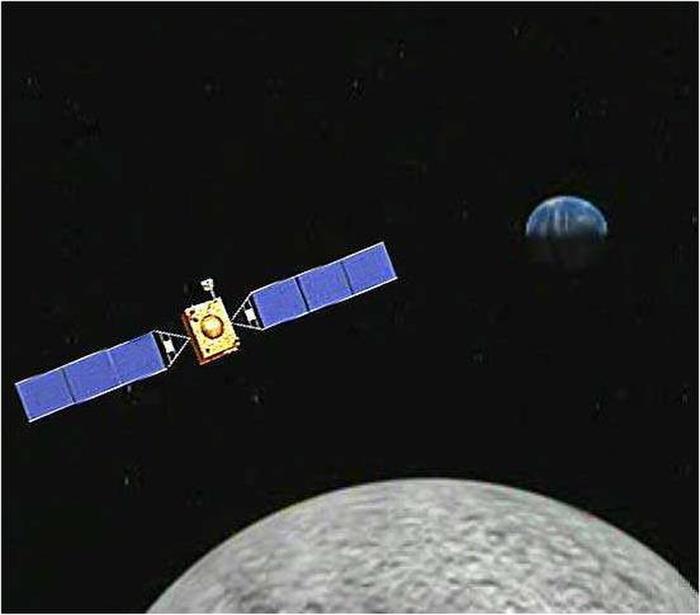
It added that the launch, which marked the 275th flight of the Long March rocket family, also sent up two mini satellites made by Harbin Institute of Technology in Heilongjiang province. The satellites will orbit together to conduct astronomical observation.
Queqiao, developed by the China Academy of Space Technology under China Aero-space Science and Technology Corp, weighs more than 400 kilograms and has a design life of three years. The satellite has an umbrella antenna with a diameter of nearly 5 meters, enabling it to transfer data from Chang’e 4 to ground control in real time.
Wu Weiren, chief engineer of China’s lunar exploration program, said the Chang’e 4 probe will be unable to directly communicate with ground controllers on Earth due to its position on the far side of the moon, so it must have a relay satellite to transmit signals.
China Academy of Space Technology said the development of Queqiao means Chinese scientists have become the first to have reliable technology for relaying signals between Earth and far side of the moon.
The relay satellite is also equipped with a low-frequency radio spectrometer developed by Dutch scientists to help scientists “listen” to the deeper reaches of the cosmos as well as a small lunar optical imaging detector developed by Saudi Arabia.
China plans to launch the Chang’e 4 probe before the end of 2018 and land it on the far side of the moon, where no probe has successfully landed and explored. The far side has been extensively photographed, starting with a Soviet probe in 1959. In 1962, a NASA probe crashed into the far side of the moon, but sent back no data.
Tidal forces on Earth slow the moon’s rotation to the point where the same side always faces Earth. The other side, most of which is never visible from Earth, is the far side of the moon.
The Chang’e 4 mission will enable scientists to discover what they haven’t known about the moon. They also can take advantage of the far side’s shield against Earth’s interference to make clearer observations into deep space, according to Bao Weimin, head of science and technology at China Aerospace Science and Technology Corp.
In addition to Chinese equipment, Chang’e 4 also will carry scientific equipment developed by the Netherlands, Sweden, Germany and Saudi Arabia.
China started sending robotic probes to the moon in 2007 and has carried out several lunar missions since then. It landed the Chang’e 3 probe, which carried the first Chinese lunar rover, on the moon in December 2013. The Chang’e 3 mission made the first soft landing — the opposite of a hard impact — on the moon by a man-made spacecraft in nearly four decades.
The next step in China’s lunar exploration program, the Chang’e 5 mission, is set to take place in 2019 and will put a rover on the lunar surface to take samples and then bring them back to Earth.
Contact the writer at zhaolei@chinadaily.com.cn

- CPC leadership meeting urges steadfast implementation of eight-point decision on improving conduct
- Ethiopian coffee trading center unveiled in Zhuzhou
- Mouse births pups after space mission, paving way for future research
- Autumn grain purchases exceed 200m tons in China
- Public chooses names for China's space-traveled mice
- Xinjiang's outside investment hits 1t yuan mark