Financial opening-up - a risk well taken









BEIJING - Once considered a risk, forty years on, reform and opening-up in the financial sector has proven to be a risk well taken.
Critical to opening-up, a fresh push in the financial sector is providing opportunities for both domestic and global businesses.
A honorable profession
In 1984, Shanghai Feilo Acoustics Co issued 10,000 shares at 50 yuan (about $7.8) per share. It was the first listed firm on the Chinese mainland.
Feilo remained largely unknown outside China until two years later, when a stock certificate of the company was given by Deng Xiaoping, architect of reform and opening-up, as a gift to visiting John Phelan (now deceased), then chairman of the New York Stock Exchange.
Phelan then made a trip to Shanghai, home to China's first stock exchange, especially to transfer ownership of the certificate. China's first stock exchange counter, measuring about 10 square meters, had been open to the public for just two months.
The formative years of China's equity market accompanied the transformation from a planned economy to a market economy, a journey of many twists and turns.
Perhaps no one knows the early days better than Yang Huaiding, known to many as "Millionaire Yang" for his legendary success back in the 1990s in the fledgling equity market.
Yang, 68, one of New China's first private investors, was just an ordinary worker with a monthly salary of 51 yuan. He started to invest in stocks after his "first bucket of gold" of 800 yuan through treasury-bond trades.
Yang recalls how he worried that he might be labeled as a "speculator" or a "profiteer." At that time, laboring with one's hands was considered one of the few honorable ways to make a living.
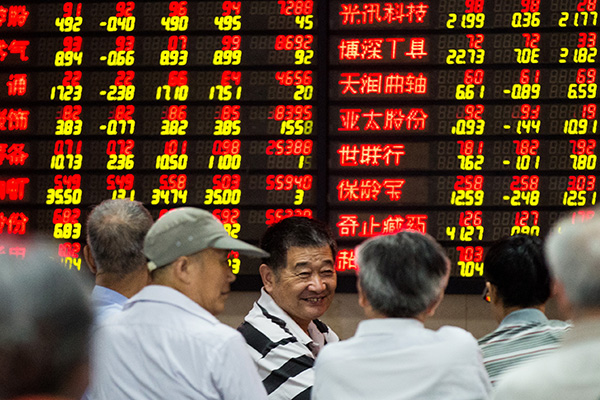
Opening-up was not just about borders and trade, it was also about opening up people's minds. Following the early successes of people like Yang, more people began to invest in the equity market. Today the number of stock-trading accounts in China has exceeded 130 million. That means about one in 10 people have an account.
Of course, the primary function of a stock-exchange is not to generate personal wealth. The equity market has opened up new channels for companies to raise funds. More than 3,500 companies are traded on the Shanghai and Shenzhen bourses with a total market value of more than 56 trillion yuan. Likewise, as the market has grown, the regulatory framework has grown along with it.
In building an economy reliant on domestic demand and technological innovation, new rules and mechanisms are emerging all the time.
In the latest move, the country announced a pilot program in March to support domestic listing and issue of China Depositary Receipts (CDRs). New draft rules on CDRs were put out for public opinion.
Changes to financial markets will bring ample benefits, and are a necessary step for economic transition, said Zhu Min, former deputy managing director of the International Monetary Fund.
Good things coming
With few multinationals willing to miss out on the opportunities the country affords, many are establishing a new presence or expanding their current positions.
JP Morgan Chase & Co is the latest to apply to set up a securities firm under rules put in place last month. The New York-based banking giant will hold 51 percent of the new firm and expects to raise its ownership to 100 percent over the next few years.
UBS has applied to raise its portion of UBS Securities from 24.99 percent to 51 percent, while Japan's Nomura plans to set up a holding company.
Foreign ownership caps on securities firms, fund managers, futures dealers and life insurance companies will be fully lifted within three years.
In expansion of the commodities market, overseas investors began to trade in domestic iron ore futures at the Dalian Commodity Exchange this month.
Following the launch of the Shanghai- and Shenzhen-Hong Kong stock links, which makes it easier for foreign investors to buy A-shares, a similar program between Shanghai and London is expected this year.
Financial opening-up has the added advantage of mitigating domestic risk by importing expertise, said Zhou Yu, an economist at Shanghai Academy of Social Sciences.
Global index provider MSCI has taken gradual steps to include A-shares in its indexes. As a first step, 234 companies will be added to the MSCI China Index and others from June.
"The direction has been very consistent towards opening up, towards liberalizing the market, towards expanding international presence in China, and towards expanding Chinese presence internationally," according to Nicolas Aguzin, JP Morgan Asia-Pacific chairman and CEO.
"There are even more good things to come, for China, for its companies, for its people and for JP Morgan," he said.