Most advanced labs at USTC's festival









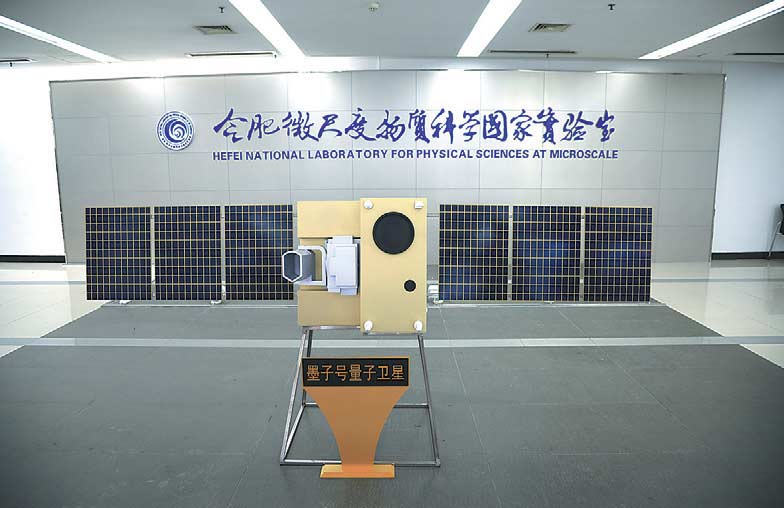
At this year's science festival, USTC had 22 spots and among them were five from the university's most advanced laboratories.
National Synchrotron Radiation Laboratory
The National Synchrotron Radiation Laboratory is the first dedicated synchrotron radiation facility in China. Construction of the first phase of the lab began in 1984 and finished in 1991, to become one of the country's large-scale scientific facilities.
Phase two of the laboratory was completed between 1999 and 2004 and a further upgrade was carried out from 2012 to 2014.
NSRL is now home to a fully upgraded soft X-ray synchrotron radiation facility.
The synchrotron is close to the third generation level, and the facility now has five ready-to-use end stations, which can be used for combustion and flame, soft X-ray microscopy, catalysis and surface science, angle resolved photo-emission spectroscopy, atomic and molecular physics.
It has six other beamlines now open for future end stations.
The superior radiation, together with the well-designed beamlines and end stations, allow scientists nationwide to perform cutting-edge scientific experiments, which are otherwise impossible in their own laboratories.
The research covers the areas of physics, chemistry, the life sciences, material sciences, surface sciences, metrology, medicine, microscopy and instrumentation.
As a user-oriented large-scale scientific facility, NSRL welcomes researchers from various fields to carry out state-of-the-art research at its facilities.
Hefei National Laboratory for Physical Sciences at the icroscale
The Hefei National Laboratory for Physical Sciences at the Microscale was founded in 2003. Supported by the Ministry of Science and Technology and the Chinese Academy of Sciences, the national laboratory's major focus is placed on areas of nano-science, information technology, biological science and cognitive science.
HFNL is currently composed of seven divisions, including the Division of Atomic and Molecular Science, the Division of Nano-materials and Nano-chemistry, the Division of Low-dimensional Physics and Chemistry, the Division of Quantum Physics and Quantum Information, the Division of Structure and Function of Biomacromolecules, the Division of Bio-X interdisciplinary Science, the Division of Theoretical and Computational Science and the Division of Public Technical Service.
The operation of the divisions is to encourage interdisciplinary interaction and cooperation. Each division is home to several research teams.
HFNL wishes to attract world-class scientists to work at the laboratory. With 11 academicians from the CAS, the laboratory is also a training ground for young talents. Positions for research personnel and project leaders of HFNL are accessible for world-wide application and recruitment.
CAS Innovation Institute of Quantum Information and Quantum Echnology
The CAS Innovation Institute of Quantum Information and Quantum Technology is set to become a new national laboratory.
As part of its "Pioneer Initiative" plans, the Chinese Academy of Sciences has aggregated all related scientific resources from universities, institutions and technology companies all over the country, and founded the innovation institute.
The institute adheres to national laboratory standards and is dedicated to solving a variety of frontier scientific problems, ranging from quantum communication and quantum computing, to quantum measurement and quantum material development.
The institute is trying to make major breakthroughs in developing key technologies and core devices.
State Key Laboratory of Fire Science
State Key Laboratories are a list of university-based laboratories receiving funding and administrative support from the central government. Nearly 300 laboratories have been set up since the 1990s, and the State Key Laboratory of Fire Science is the country's only national research institution in the field of fire science.
The SKLFS conducts frontier basic and interdisciplinary research that combines state-of-the-art knowledge and approaches to chemistry, physics, mechanics, thermo-physics (featuring heat transfer and combustion), information science, computer science, electronics, automation and material science to investigate fire dynamics and basic principles of fire safety technologies.
The mission of the SKLFS is to study fire dynamics and key technologies in fire safety, train qualified personnel and endeavor to cater for the growing national demand in fire science research and make fundamental, strategic and forward-looking contributions to the national fire safety.
The lab has three major research directions: fire dynamics, key technology of fire prevention, and theory & methodology of fire safety engineering.
In recent years, SKLFS has extended its remit to cover fire safety relevant public safety topics such as emergency planning, emergency decision-making and human evacuation.
The State Key Laboratory of Particle Detection and Lectronics
Leading the country's academic development in the field of particle detection and electronics, the State Key Laboratory of Particle Detection and Electronics carries out top-level research on both basic and application science.
The lab also serves as an essential platform for scientific personnel training and academic communications.
It has always set a goal in following the demand of the state, and of the academy, targeting three major fields of advanced particle detection techniques, frontier electronics, and massive-scale data collection and processing.
The lab has also established cooperation with many scientific institutes across the world, making significant contributions to several essential projects, including the ATLAS Experiment of the European Organization for Nuclear Research and China's first dark matter particle exploration satellite, Wukong.






- 'Beijing Rocket Street': A launchpad for accelerated development
- Capital city targets 5% GDP growth for 2026
- 17 rescued Filipino sailors handed over
- Tech used to increase farm yields in Gansu province
- Restored wetlands welcome new flocks of migratory birds
- Sustained efforts supercharge flyway routes