


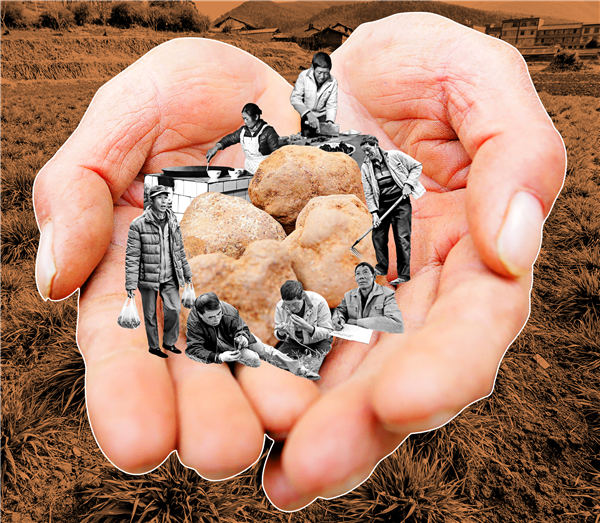
An initiative started by a leading fast food chain has transformed the way farmers in Yunnan source, manage and harvest truffles, Zhang Lei reports
Sixty-year-old Duan Chaowen, a forest ranger and head of Duanjia village in remote area of Yunnan province, spends his days patrolling the mountains near his home in Yongbei town, Yongsheng county. In one valley, which he knows so well that he can practically retrace from memory, lies a rare kind of black truffle.
Like many local villagers, Duan is a veteran wild truffle hunter. Despite his best efforts over the past two decades of harvesting the valuable fungus, he has been unable to maintain a constant crop of this rare delicacy, which is dwindling rapidly by the year.
For decades, the destructive methods used by truffle hunters have continued to damage their natural habitat, leading to an incremental decline in their yields. A decade ago, the annual output of truffles from Yongsheng county was somewhere between 500 and 800 tons - or around 20 percent of the province's total output. After more than 10 years of destructive hunting and picking practices, the current output has dropped by as much as 80 to 90 percent of that figure.
"Seven or eight years ago, I could pick more than 30 kilograms of truffles around one pond, and the largest single truffle would weigh around 350 grams. Now, it is more normal to find just a few hundred grams of truffles around one pond," says Duan, shaking his head woefully. "Although truffle prices have increased, there's just not as much for us to harvest since the damage we have caused is too severe."
Duan's concern about the dwindling numbers of black truffles in Yunnan is very real. While many local farmers want to address the situation, they lack the knowledge and means to do so.
However, things started to turn around in February. Professor Liu Peigui, a researcher at the Kunming Institute of Botany of the Chinese Academy of Sciences and the president of the Wild Fungus Conservation and Development Association of Yunnan Province, traveled to Yongsheng to host three training sessions for more than 300 people, including Duan Chaowen, about the science of sourcing truffles.
Initiated by Yum China, the training sessions were part of the fast food chains' recent Yum China Pizza Hut Grow Local Initiative, which placed Yongsheng's truffles at the top of its list of priorities.
For Duan, the two-day training course was similar to the timely arrival of rain after a long drought. He not only learned about how to source truffles in a scientific and environmentally friendly manner, but also acquired a deeper understanding of how to better protect this precious treasure in his hometown.
The type of truffle that accounts for the highest percentage of total output in Yongsheng is called Tuber indicum. Its maturity season usually ranges from mid-November to late February, or later. However, due to a lack of understanding of the truffles' growth patterns, local farmers used to start harvesting them as early as July. Immature truffles are typically small in shape and poor in quality, and their sale tends to weaken their competitiveness and lower their prices in the international market. However, most importantly, using the wrong harvesting methods can "kill the goose that laid the golden egg," resulting in a chronic waste of resources and ever-dwindling numbers of truffles found growing in the wild. This can eventually lead to a sharp decline in truffle yields and have an adverse effect on the income levels of local famers.
To address this problem, Yum China partnered with the local government and invited agricultural experts to invest money and resources into providing local farmers with long-term and multifaceted guidance in the form of training sessions, both online and offline. These sessions were designed to help farmers transform the way they harvest and source truffles.
The training session that took place in February was part of this initiative and Duan Chaowen was the first beneficiary of the project. It has given him the hope that he will be able to continue to drive the sustainable sourcing of truffles in his hometown.
"It is very important to complete this scientific training and education. The production of truffles not only has enormous scientific and economic value, but also, and perhaps more importantly, ecological value," says Professor Liu Peigui. "The farmers who attended the training sessions were more passionate than I expected. I could see the desire to learn in their eyes. They were really interested in learning more about it."
Accompanying Professor Liu on this course was police officer and a search dog from Kunming Police Dog Base. The course also included truffle-hunting training for dogs and on-the-ground demonstrations of how to source truffles. In the past, pigs were typically used to locate truffles. However, the use of dogs to search for truffles can actually be more efficient and scientifically viable. Dogs are less likely to damage the truffles as they generally have a more stable temperament and a better ability to understand instructions more clearly.
In the meantime, Yum China has created a number of new products that include truffles and has helped local companies to improve their standards to meet Yum China's procurement requirements. The procurement of truffles from Yunnan not only delivers economic benefits to the local area, but also helps food outlets like Yum China create more innovative menus. Starting in April, more than 2,200 Pizza Hut restaurants nationwide featured pizza products that contained high-end truffles from Yunnan.
As part of it's commitment to corporate social responsibility, the company has set up a number of initiatives in China aimed at tackling poverty through food innovation.
Joey Wat, CEO of Yum China, says, "By enhancing local farmers' expertise and knowledge, and connecting them with our national customer base, we hope the Grow Local Initiative will improve local economic and living conditions, and support the sustainable expansion of the truffle industry in Yunnan."
President Xi Jinping has noted that poverty alleviation initiatives need to be implemented in different ways and that they should be designed to encourage society to play an active role in reducing poverty. Alice Wang, chief public affairs officer at Yum China, says that the success of CSR projects lies in perseverance. "The power of companies is not infinite. Only by combining the core advantages of companies and the strength of industries and society can we successfully drive sustainable development."
The Grow Local Initiative will gradually be rolled out in other parts of Yunnan and other regions, to encompass more agricultural products while promoting ecological, healthy and sustainable development in areas affected by poverty.








