Remains of small ape, now extinct, found in ancient tomb









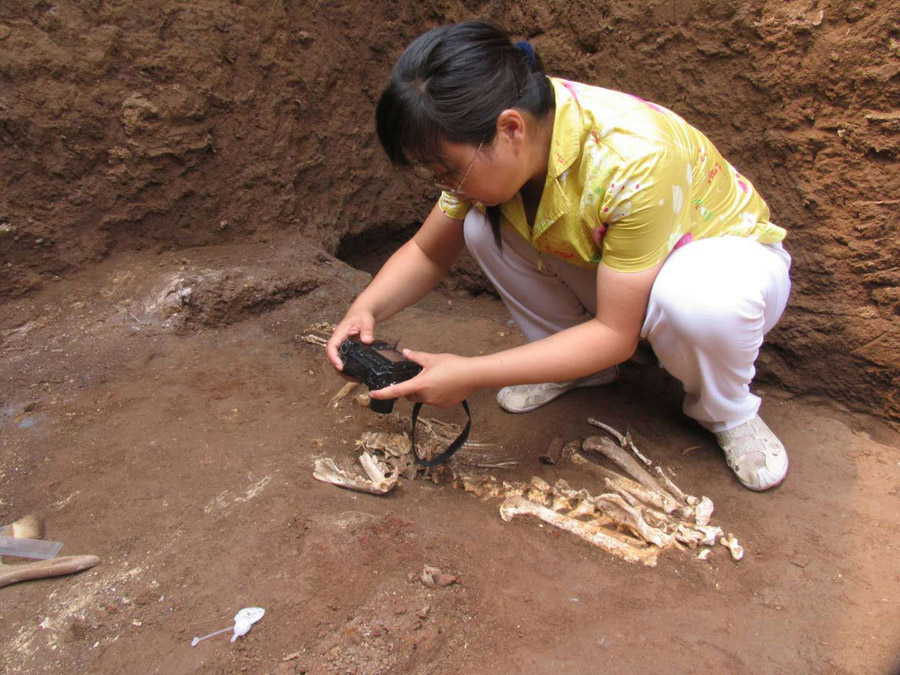
An international team of scientists has discovered the skull of a new species of gibbon in the tomb of an ancient Chinese aristocrat, perhaps the grandmother of China's first emperor, according to a study published in the journal Science.
The gibbon, described in Thursday's edition of the journal, may be a species that went extinct after the last ice age because of human influence.
The remains of the gibbon were discovered in a tomb approximately 2,200 or 2,300 years old in the ancient capital of Chang'an, modern-day Xi'an, Shaanxi province.
The tomb in which the remains were found - and perhaps the gibbon itself - may have belonged to Lady Xia, the grandmother of China's first emperor, Qin Shihuang (259-210 BC).
The emperor was buried near Xi'an with his famous terracotta army.
Researchers found that the ape specimen was so different that it probably belonged to its own species and genus.
They named it Junzi imperialis. Junzi is a Chinese word for scholar-officials, who were often associated with gibbons because the animals were considered wiser and nobler than mischievous monkeys. At the time, gibbons were kept as pets by people of high social status.
Zhang Tian'en, an archaeologist at the Shaanxi Institute of Archaeology in Xi'an, said the discovery suggests that past human activities had much more influence on the loss of primate diversity than previously thought, and is a sobering lesson on the devastating effects humans can have on the natural world.
Human exploitation of nature, including habitat destruction, has led to an escalating extinction rates for the gibbon, Zhang was quoted as saying by the local newspaper, Huashang Daily.
The discovery may also shed light on the threat to the survival of the gibbon today, he said, adding that researchers will continue to study monkeys in the wild and historically via important museum collections and archives to prevent another human-induced ape extinction.
Hu Songmei, another archaeologist at the institute, said researchers will sample DNA from the bones of the gibbon to determine its relation to existing species.
Xinhua contributed to this story.






- 6.6-magnitude quake hits waters off Taiwan: CENC
- China seeks public feedback on draft rules for anthropomorphic AI services
- China's top legislature concludes standing committee session
- China adopts revised Civil Aviation Law
- China launches satellite to aid in early extreme weather detection
- Report on mining accident that killed 6 suggests accountability for 42 individuals