Govt gives young people more assistance









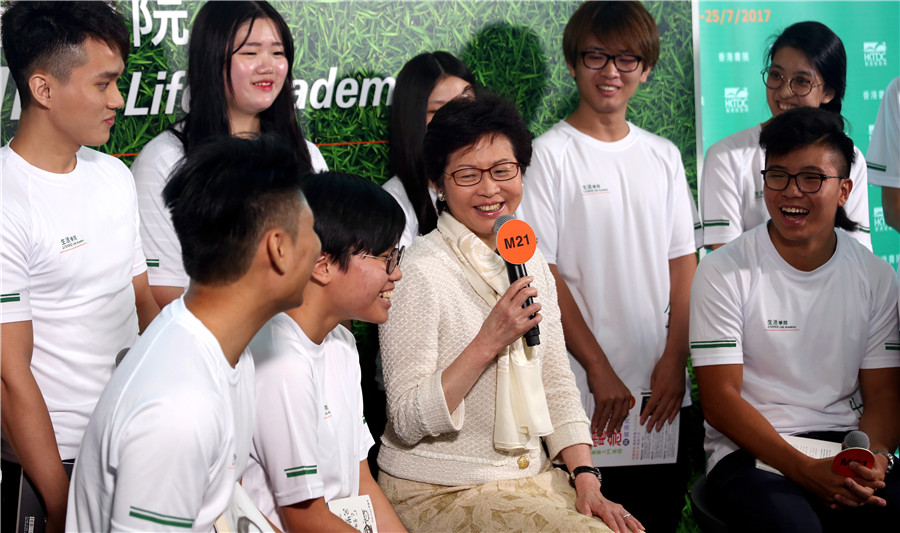
Youth development has been one of the strongest elements of the first year of Chief Executive Carrie Lam Cheng Yuet-ngor's administration.
As the mother of two sons, she has vowed to connect with young people, address their concerns and help them climb the social ladder.
Upon assuming office, the new government immediately went to work on education.
With cross-spectrum support from the Legislative Council, Lam delivered on her election manifesto pledge to increase recurrent education expenditure by HK$5 billion ($637 million) a year from HK$75 billion to HK$80 billion, while the official budget shows that a further HK$2 billion will be provided for the 2018/19 period.
Immediate change
The education sector welcomed the funding increase. Wong Kwan-yu, president of the Hong Kong Federation of Education Workers, said the rise in recurrent education expenditure is one of the most praiseworthy measures taken by the government to improve the education system.
"A recurrent HK$5 billion hike is inspiring and is also a crucial change for Hong Kong's education sector," he said. He added that the rise will not only help to solve a number of long-term problems - such as a shortage of permanent teaching posts for young graduates in local primary and secondary schools, and the heavy pressure on students from excessive schoolwork - but will also encourage stakeholders, including teachers and schools.
Speaking about the next step, he noted that demand is rising for more quotas for the publicly funded local higher education program.
The government has also emphasized postsecondary education. A task force to examine the role of self-financing postsecondary institutions and the way forward for sub-degree programs - two widely discussed education problems faced by the city - was established in November. The task force will complete its work by the end of the year.
Frankie Ngan Man-yu, chairman of the Young Democratic Alliance for the Betterment and Progress of Hong Kong, praised the policy and said reviews of the quota system and the role of sub-degree education will improve the education system.
The move could further diversify the options for aspiring young people in Hong Kong and distinguish the functions of higher diploma, sub-degree and bachelor's degree programs, he said.
The government will inject HK$3 billion into the Research Endowment Fund to provide scholarships for local students, according to this year's budget.
Vincent Lo Lun-chi, vice-president of the Hong Kong Jiangsu Youth Exchange Association, described the rise in funds to promote innovation and technology development in Hong Kong as "great news" for professionals and graduates.
He suggested that undergraduates should be offered more opportunities to participate in entry-level scientific research and related projects.
Broader path
Ngan said the overall measures are comprehensive. In addition to education, the program also includes career development and participation in policy discussion and politics.
To broaden the horizons of the younger generation, improve their career choices and offer opportunities for upward mobility, the government is providing a number of themed internships and exchange opportunities in the mainland and overseas.
In March, a pilot corporate summer internship in collaboration with major enterprises was launched that provides about 250 internships in the mainland and abroad for students in higher education.
Another themed summer internship scheme offers almost 70 shortlisted young candidates the opportunity to undertake work related to cultural conservation, nature conservancy and scientific research at leading national institutions in the mainland.
The Palace Museum in Beijing, the Dunhuang Research Academy in Gansu province, the Wolong National Nature Reserve in Sichuan province and the Chinese Academy of Sciences are all involved with the program.
In addition, last year, the Hong Kong government signed bilateral agreements with the Netherlands and Sweden for the Working Holiday Scheme, enabling more than 6,200 young people to obtain visas to stay in the host economy for an extended period and undertake short-term work, according to data provided by the Hong Kong Labour Department.
So far, the government has signed similar cooperation agreements with 13 countries and regions.
The program provides students with a growing number of chances and platforms to prepare their career paths before they leave campus, Ngan said, adding that more government-funded internship programs are expected in countries participating in the Belt and Road Initiative.






- New China-Vietnam air route boosts links with ASEAN
- Beijing's Daxing airport sets a new record in passenger trips
- China and France hold joint forum on higher education
- Dinosaur footprints from about 200m years ago found in China
- Free shuttles provided for residents affected by Tai Po fire to vote
- Global influencers unlock scenic and cultural charms of Hechi