Japan-EU deal shows US is not becoming great, but vulnerable









Before sitting down with the United States for trade talks later this month, Japan is holding some good cards.
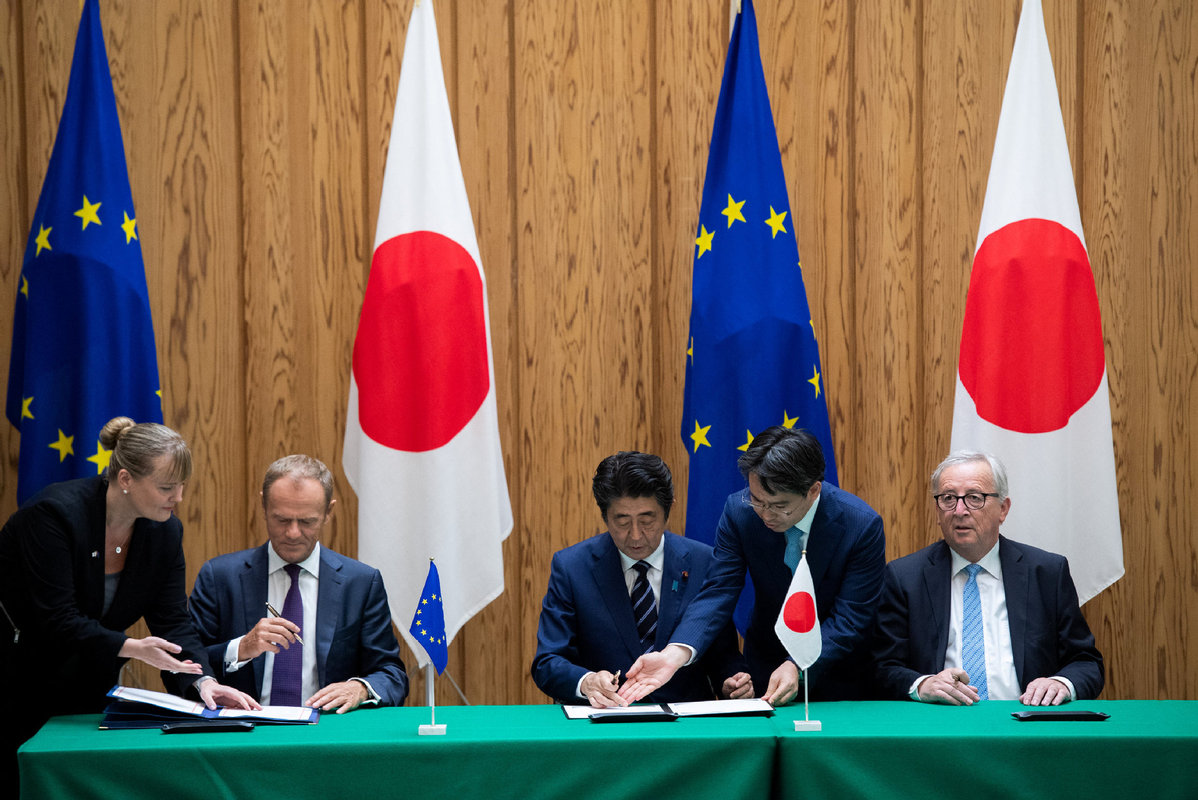
On Tuesday, Japan and the European Union signed the world's largest reciprocal trade deal that will eliminate nearly all tariffs. The agreement came in stark contrast with the new duties the United States has slapped and will slap on its trading partners.
The EU-Japan economic partnership agreement will create a free trade zone with a total population of about 600 million, accounting for nearly 30 percent of the world's gross domestic product and 40 percent of global trade.
European Council President Donald Tusk said the deal showed the two sides' united front against protectionism.
The EU and Japan became the targets of recent US import tariffs of 25 percent on steel and 10 percent on aluminum products. Among others, their carmakers have reasons to worry because the US Commerce Department, under the orders of US President Donald Trump, has launched a national security investigation to check if automobiles and auto parts imports are threats to national security, so the US may heap hefty tariffs on cars and parts from Japan and EU countries.
During his recent visit to Europe, Trump rattled European leaders by labelling the EU one of the greatest trade "foes" of the US. To address the US trade deficit with Japan, Washington has pressured Tokyo to have bilateral trade talks to extract concessions advantageous to the US.
Japan needs the massive trade deal with the EU as a shot in the arm for its economy and as a tool to counter the US' protectionism.
In the International Monetary Fund's latest World Economic Outlook report released on July 16, the Japanese economy is forecast to cool to 1 percent this year-a downgrade of 0.2 percent-following weak private consumption and investment in the first quarter of the year. Japan will have the slowest growth rate among all the developed nations.
The Japanese economy shrank 0.6 percent at an annual rate in January-March, marking the end to eight consecutive quarters of growth.
Depopulation in Japan has led to a decrease in manpower and consumers. Domestic consumption constitutes 60 percent of Japan's GDP.
Japan has been actively pushing for bilateral and multilateral free trade agreements to shore up its own alliances in Europe and the Pacific Rim and find cheap products and large markets.
Following Mexico, Japan became the second country to ratify the revised Trans-Pacific Partnership trade deal or the TPP-11 on July 6. The TPP-11 agreement will come into effect 60 days after it is ratified by six member countries. The agreement, which Trump pulled the US out of, covers 490 million people, or about 6.8 percent of the world's population, 15 percent of world trade and 13.4 percent of the global economy.
Japan and 15 other East as well as Southeast Asian countries have confirmed that they will seek to reach a broad agreement on the Regional Comprehensive Economic Partnership by the end of the year. The RCEP countries-the members of the Association of Southeast Asian Nations, as well as Australia, China, India, Japan, New Zealand and South Korea-account for about half the world's population as well as 30 percent of the world's economy and trade.
The bilateral and multilateral trade deals such as the Japan-EU economic partnership agreement and the TPP-11 will push domestic reforms in Japan and create investment opportunities abroad for Japanese companies. They may also increase Tokyo's bargaining leverage in other trade negotiations.
After signing the trade deal with Japan, European CommissionPresident Jean-Claude Juncker tweeted that it made a statement about the future of free and fair trade. "The agreement puts fairness and values at its core. There is no protection in protectionism-and there is no unity where there is unilateralism," he said.
The US is being isolated in the international community. Which means Trump's protectionism will make the US vulnerable rather than great.
The author is China Daily Tokyo bureau chief.
caihong@chinadaily.com.cn