



Toyota to expand scale, shrink cost of hydrogen vehicles









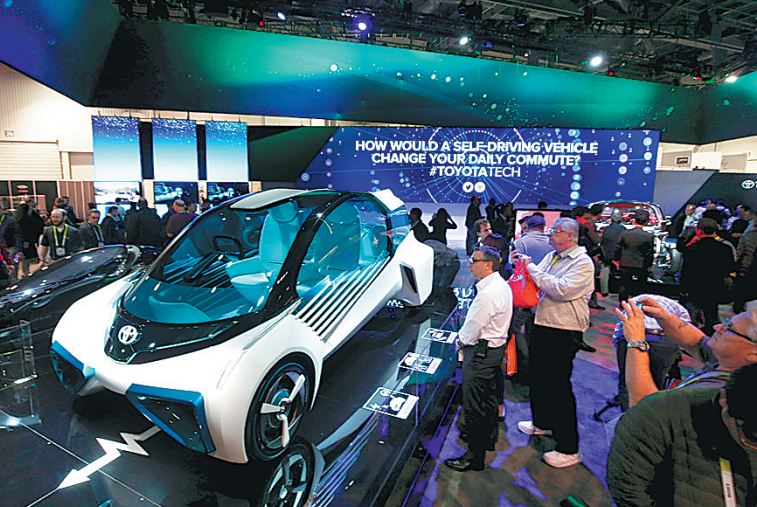
Toyota Motor Corp is doubling down on its investment in hydrogen fuel cell vehicles, designing lower-cost, mass-market passenger cars and SUVs and pushing the technology into buses and trucks to build economies of scale.
As Toyota cranks up improvements for the next generation of its Mirai hydrogen fuel cell vehicles, or FCV, expected in the early 2020s, it is hoping to prove critics wrong; most rival automakers and industry experts have dismissed such plans as commercially unviable.
The maker of the Prius, the world's first mass-produced "eco-friendly" gasoline-hybrid car in the 1990s, says it can popularize FCVs, in part by making them cheaper.
"We're going to shift from limited production to mass production, reduce the amount of expensive materials like platinum used in FCV components, and make the system more compact and powerful," said Yoshikazu Tanaka, chief engineer of the Mirai.
The company is planning a phased introduction of other FCV models, including a range of SUVs, pickup trucks and commercial trucks, beginning around 2025, a source with knowledge of the automaker's plans said.
The automaker declined to comment on specific future product plans. But it has developed FCV prototypes of small delivery vehicles and large transport trucks based on models already being driven, as Tesla Inc develops a battery-operated commercial semitruck from the ground up.
"We're going to use as many parts from existing passenger cars and other models as possible in fuel cell trucks," said Ikuo Ota, manager of new business planning for fuel cell projects at Toyota. "Otherwise, we won't see the benefits of mass production."
The company is also betting on improved performance. Toyota wants to push the driving range of the next Mirai to 700-750 kilometers from around 500 kilometers, and to hit 1,000 kilometers by 2025, a separate source said.
Driven by the belief that hydrogen will become a key source of clean energy in the next 100 years, Toyota has been developing FCVs since the early 1990s.
Hydrogen is the most abundant element in the universe and stores more energy than a battery of equivalent weight.
The Mirai was the world's first production FCV when it was launched in 2014. But its high cost, around $60,000 before government incentives, and lack of refueling infrastructure have limited its appeal. Fewer than 6,000 have been sold globally.
LMC Automotive forecasts FCVs will make up only 0.2 percent of global passenger car sales in 2027, compared with 11.7 percent for battery EVs. The International Energy Agency predicts fewer FCVs than battery-powered and plug-in hybrid electric vehicles through 2040.
Many automakers, including Nissan Motor Co and Tesla, see battery-powered cars as a better, zero-emission solution to gasoline engines. Only a handful, including Honda Motor Co and Hyundai Motor Co, produce FCVs.
But people familiar with Toyota's plans said the automaker thinks demand will perk up as more countries, including China, warm to fuel cell technology. The company also sees FCVs as a hedge against a scarcity of key EV battery materials such as cobalt.
Hand built
For now, Mirais are assembled by hand at a plant in Toyota City, where 13 technicians push partially constructed units into assembly bays for detailed inspections. This process yields just 6.5 cars a day, a sliver of Toyota's average domestic daily production of about 13,400 vehicles.
Strategic Analysis Inc, which has analyzed the cost of FCVs including the Mirai, estimates that it costs Toyota about $11,000 to produce each of its fuel cell stacks, by far the vehicles' most expensive part.
Toyota has been building up production capacity to change that, as it expects global FCV sales climb to 30,000 units annually after 2020 from about 3,000. Strategic Analysis estimates that would allow Toyota to reduce costs to about $8,000 per stack.
It has already begun to use parts developed for the Mirai in other models, such as the fuel cell stack, which is used in Kenworth freight trucks being tested in California, the Sora FC bus it released in Japan in March and the delivery trucks it will test with 7-Eleven stores in Japan next year. "It will be difficult for Toyota to lower FCV production costs if it only produces the Mirai," the first source told Reuters on condition of anonymity as he was not authorized to speak publicly about the issue.
Xinhua - Reuters




















