



Education reform facilitating innovation









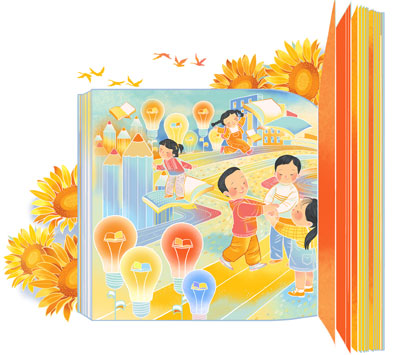
Over the past 40 years, countless photographs have captured the milestones of China's reform and opening-up. Some are regarded today as national treasures, others are on display in old family photo albums. After late Chinese leader Deng Xiaoping resumed the national college entrance exam in 1977 and led the economic reform, leaders of the Communist Party of China realized education is the foundation of the "Four Modernizations"-the goal set by Deng to upgrade agriculture, industry, science and technology, and national defense.
Deng advanced the "Four Modernizations" to better position China's future, putting emphasis on profitable achievements. Four decades ago, academic degrees were awarded in only limited subjects because China was basically an agrarian economy. But the economic reform aimed at building an industrial society dynamically influenced occupations across the board. It enriched and diversified Chinese culture, fueling social desire for change and laying the base for China's rise on the global stage.
In their quest to build a flawless education system, both Eastern and Western economies have struggled to find the right direction. Successive US administrations have tried to fix their education system for decades to ensure all the schools turn into elite academic institutions, but achieved only limited success.
In China, May 1985 was a watershed year, as it heralded a new era of education reform, characterized by unswerving commitment from the country's leadership. The CPC Central Committee unveiled a plan to overhaul the educational structure, by introducing compulsory education for all children till the age of 15 and establishing the State Education Commission, the forerunner of the Ministry of Education. The commission was tasked with raising the education standards to meet the goals of a China undergoing continuous modernization.
China's education reform has made remarkable progress, but more work needs to be done. As we celebrate the 40th anniversary of the reform and opening-up, it is necessary to reflect on why students today are seen as lacking a creative edge. The four great inventions of ancient China-compass, gunpowder, papermaking and printing-h(huán)ave played a most significant role in human development around the world. But in modern times, China has not offered the world any such formidable invention.
China trails behind neighboring Asian countries in the 2018 Global Innovation Index, ranking 17th for innovation capacity. Perhaps the Ministry of Education should consider setting up school clubs and organizations for all high school students.
In the US, teachers begin creative pedagogy in preschools. Early learners gather experience from a variety of organizations or government-supported projects. Youngsters who start early tend to perform better in interpersonal relationships and can better imagine ideas and be more creative in the fields of science and technology. By the time they enter a university, many of them are bubbling with creative ideas. Which makes them adapt more easily to university life.
The shortage of young creative talents in China is not the central dilemma. Yet maintaining a perfect balance between traditional and new learning methods is a great challenge for China's schools and colleges. With time, some problems will be solved, others will persist and new ones will emerge. So in today's fast-paced life, it's good to pause and reflect on our problems-maybe in a moment of clarity, we'd realize that we're close to solving whatever is puzzling us.
It's time therefore that all Chinese people did so, because China's education system is on way to becoming a leading example of quality for the world.
The author is an academic specializing in the methodology of spoken language teaching at Shenyang Normal University and author of Spokenology: You and Me, published by Tsinghua University Press.





