Kidney surgeon, 67, shows no sign of slowing down









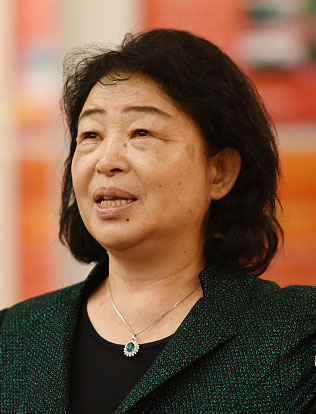
Chen Xiangmei, a leading specialist, has dedicated decades to seeking breakthroughs in diagnosis, treatment. Cheng Si reports.
While some people around her age are settling into retirement, Chen Xiangmei, one of China's top kidney disease specialists, is working harder than ever to find breakthroughs in diagnosis and treatment.
The surgeon, 67, is renowned for spending decades studying life-threatening conditions such as uremia, which is caused when the kidneys fail to filter toxins in the blood.
"I've been running all my lifetime, I've never stopped," said Chen, who was awarded a first-class National Prize for Progress in Science and Technology last year for her achievements in kidney disease research. "I do feel tired sometimes, but I want to do more for my peers with rest of my life."
Chen was born in 1951 in the Democratic People's Republic of Korea. Her mother was Korean and her father was from eastern China's Shandong province. She moved to China with her family when she was 16 years old.
She studied at Norman Bethune University of Medical Sciences, where she earned a bachelor's degree in 1977 and a master's in 1982. The college was incorporated into Jilin University in 2000.
"People in the 1970s and '80s had to survive with rather backward medical supplies," she said. "Even minor illnesses were claiming lives due to a lack of medicines and quality medical workers."
Chen recalled that patients could barely afford the cost of a health checkup, especially those with kidney disease, which at the time could only be diagnosed by a few hospitals in large cities.
Determined to help ease their pain, in 1983, she went to study for a PhD at Japan's Kitasato University, focusing her research on kidney disease.
She said she was shocked at the gap in healthcare services between "an advanced Japan and backward China" and recalled thinking to herself, "If patients with kidney disease can be cured in Japan, why not in China?"
"While I was in Japan, I went to bed very late, about 2 am, and got up an hour before my peers," she said. "About six of us were sent to Japan by the government, and most of them chose to stay there after they had finished the doctoral program."
Chen, however, said she felt obliged to return to China.
"I love my country deeply. It was my responsibility to use the knowledge I'd learned to serve the people in my homeland," she said.
She still remembers her first day at the Chinese PLA General Hospital in 1987. The urology department had only five doctors and 12 beds, she said.
Initially, she was given a 30-square-meter laboratory to carry out research on her own. Yet over the years, as her studies yielded valuable results, the lab was expanded and is now a State key laboratory with more than 200 personnel. Its chief focus now is training a new generation of kidney specialists.
Chen, who said she sees herself more as a soldier than a doctor, played a big part in helping victims of the 2008 Wenchuan earthquake in Sichuan province. She spent 50 days and nights providing emergency care to those trapped in the rubble as well as operating on survivors who had suffered kidney damage.
Her greatest concern, however, has always been how to save the lives of those affected by uremia, especially young people.
She recalled a case in 1992 involving a 16-year-old girl that had a major impact on her. "It was seven days after I had given birth to my daughter. I was still in hospital recuperating when I was told the girl had been rushed to the emergency room with suspected kidney failure," she said. "My colleagues and I stayed with her for 10 days, but she died."
The girl's death touched Chen, and she said it inspired her to work harder.
"People with uremia used to have no access to dialysis because we didn't have modern technologies or equipment. We had the advanced medics but patients could still barely afford the costs of treatment," she said, sighing. "It costs about 100,000 yuan ($14,500) a year for dialysis, which is a lot of money, particularly for rural families."
To ease the burden, she lobbied the government to include the cost of treating uremia in China's medical insurance program. Her efforts paid off in 2012 when authorities agreed to include uremia along with seven other major diseases.y 10/03/2018 page5)


- Foreigners check-in to China for hospital expertise
- Forum underlines cross-Strait exchanges
- China, Uruguay vow to deepen ties
- Hunan achieves record grain output in 2025
- Thai students to train in China as universities expand high-speed rail cooperation
- China unveils world's fastest full-size humanoid robot