Beijing vows to stick to neutrality in dealing with State-owned enterprises









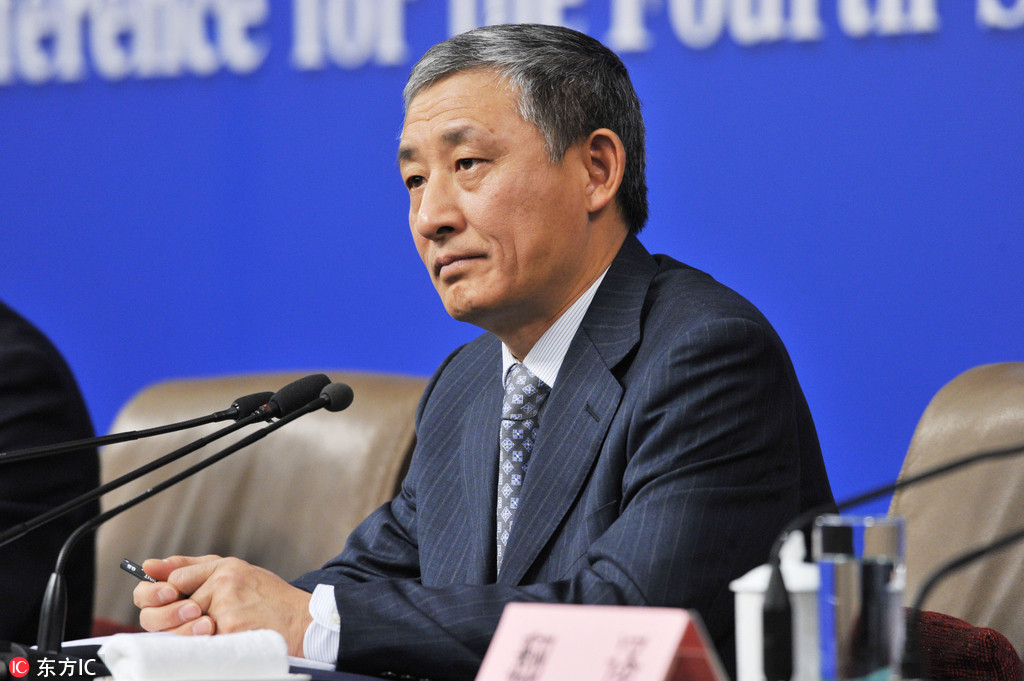
Level-playing ground the rule for firms of all kinds, regulator says
China will maintain its neutral stance for market competition and offer companies of all categories of ownership a level playing ground, the regulator of China’s State-owned assets and enterprises said on Monday.
Peng Huagang, spokesman for the State-owned Assets Supervision and Administration Commission, said the target of the country’s State-owned enterprises reform and reshuffling is to turn SOEs into independent entities that are truly self-managed, self-disciplined and able to assume full responsibility for their own profits and losses.
Peng was responding to recent media speculation that some giant SOEs are taking advantage of difficulties experienced by some listed private companies by acquiring or merging with them at bargain prices.
Some media have claimed that SOEs are expanding while private firms are shrinking.
“SOEs have no intention to acquire or merge with listed private companies in a fair market environment regardless of the circumstances,” Peng said at a Beijing news conference.
“Instead, a total of 2,618 SOEs such as Shanghai Baosteel Gases Co, have transferred the majority ownership to private companies under the policy guide in recent years,” Peng added.
He said that the government will also remain neutral toward companies of all categories of ownership, standing against the practice of applying different rules for companies of different ownership.
China also is against the idea of discriminatory restrictions on SOEs and supports the principle of competitive neutrality, Peng said.
According to the Organization for Economic Cooperation and Development, competitive neutrality means that state-owned and private businesses compete on a level playing field.
This is essential for the effective use of resources within the economy and therefore the achievement of growth and development.
While the principle of competitive neutrality is gaining wide support around the world, obtaining it in practice is a much more difficult question, said analysts.
Xiang Anbo, a researcher of enterprise development at the Development Research Center of the State Council, noted China’s economic policy transformation from emphasizing industrial policy to focusing on competitive policy.
During this process, the government has already begun to push forward substantive reform in its SOEs to adapt to the new policy environment and take the initiative to become compatible with the regulation of competition policy, Xiang said.
Also, the competition policy should take into account that China has a large number of State capital investment and operating companies, and the country should hold the principle of competitive neutrality, provide adequate room for the performance of SOEs and enable them to play a positive role, Xiang added.
Yi Gang, governor of the People’s Bank of China, the central bank, said the country is considering promoting SOE reform based on the competitive neutrality principle. He made the comment at the annual International Banking Seminar of the Group of Thirty on Sunday in Bali, Indonesia. The group is an international body of leading financiers and academics.
For the next step, China will accelerate reforms and opening-up to solve the structural issues in its economy, as well as enhance intellectual property protection, Yi said, adding that the country will further promote the opening of the service industry, including that of the financial sector.
The State-owned Assets Supervision and Administration Commision said profit growth in China’s centrally administered SOEs accelerated in this year’s first three quarters.
Combined profits reached 1.35 trillion yuan ($195 billion) between January and September, up 21.5 percent year-on-year, while their cumulative business revenue rose 11 percent year-on-year to about 21.1 trillion yuan, about 0.9 percentage point higher than the growth rate of the first half of 2018.
The growth figures show that China’s central SOEs have moved to meet the requirements of the competition policy to optimize overall economic efficiency and maximize social welfare, said Li Jin, chief researcher at the China Enterprise Research Institute. “In the long term, they will continue to focus on capital management and mixed-ownership reform to further improve their earning ability.”
Among financial indicators for central SOEs also released on Monday were a further drop in debt-asset ratios, vigorous fixed-asset investments and an upsurge in cash flow.
Chen Jia contributed to this story.
Contact the writers at zhongnan@chinadaily.com.cn