



Xi sends important signals from Guangdong









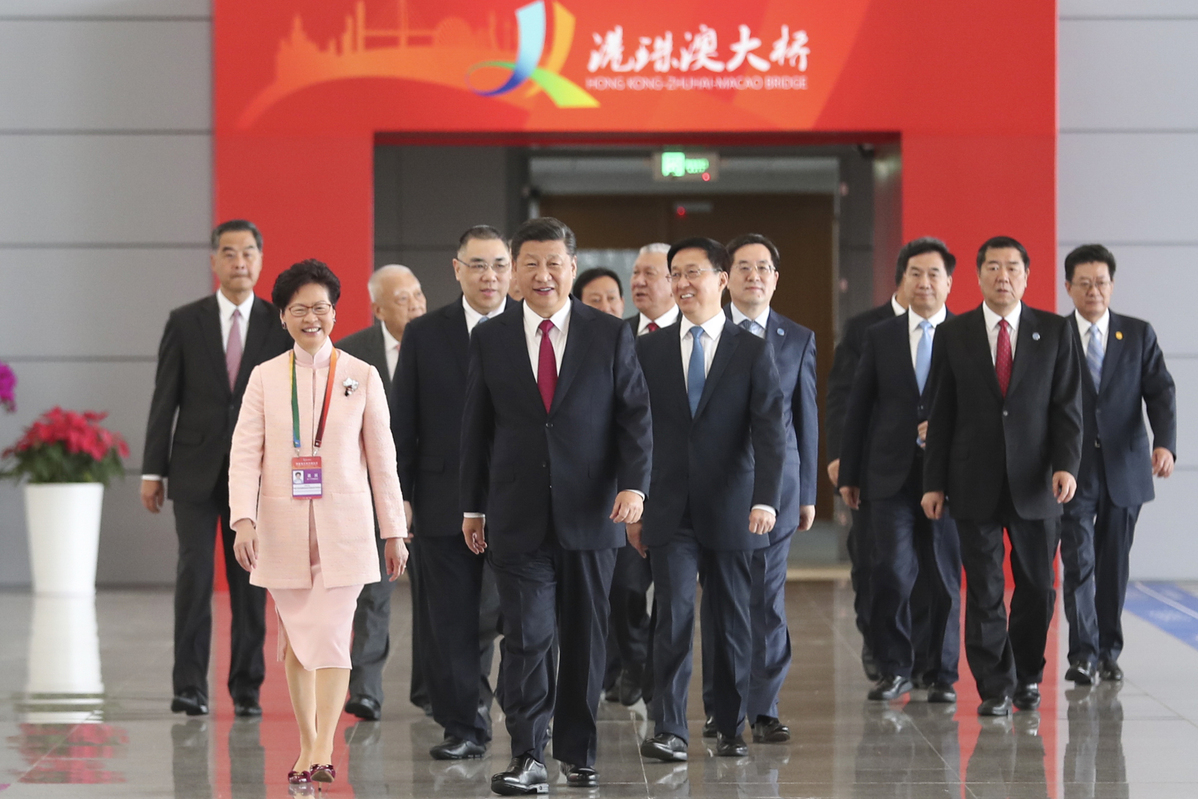
Editor's note: President Xi Jinping conducted an inspection tour of South China's Guangdong province on Oct 22-25, during which he talked about the importance of further reform and opening-up to stimulate independent innovation and give a boost to the private sector. Two experts shared their views with China Daily's Zhang Zhouxiang:
Encouraging independent innovation
Of all the remarks President Xi Jinping made during his inspection tour of Guangdong, one word he stressed repeatedly was "innovation". He emphasized the importance of independent innovation and called for all researchers and workers to strive toward that.
Having "advanced technology" means a nation can manufacture key products that other countries cannot. "Innovation" means a nation gains the ability to manufacture key products that it could not produce before. The developed countries produce unique key products and obtain huge profits by selling them in the international market. Part of the profits they obtain is then invested in further research to sharpen the technology, which is a virtuous circle.
During the whole process, innovation is the most important part because it makes the circle sustainable by improving the technology.
The countries that are without advanced technologies have two choices: Either to innovate and develop their own core technologies or develop inferior technologies by co-working with developed countries and applying their advanced technology. The latter is the easier way, but its positive effects lessen over time. If a country cannot develop its own core technologies, it will meet a bottleneck on its development path.
That is why, as President Xi stressed, China needs independent innovation to develop its own core technologies. And after 40 years of fast development, China has accumulated ample capabilities for endogenous innovation. Take natural sciences, for example, in 2017, only the United States had more research papers published in first-tier academic journals. In terms of the research influence of countries, China ranks second in the world. Its number of highly-cited researchers is 249, ranking third in the world. These indexes do not equal innovation capability, but they at least lay a solid foundation for independent technological innovation.
So to sum up, China both needs technological innovation and has the potential to realize it.
Yuan Lanfeng, a researcher on chemical physics at the University of Science and Technology of China, as well as a popular micro blogger on China's science and technology policies.
Firmly supporting private enterprises
During his inspection tour, President Xi visited several private enterprises and stressed the central leadership's firm support for the nonpublic sector.
This is the third time within a month that President Xi has talked about this issue. During his inspection tour to Liaoning on Sept 27, and in a letter to private entrepreneurs on Oct 20, he clearly expressed the central leadership's strong support for the private sector.
In both the Constitution and relevant laws, China has long confirmed the key role the private sector plays in the national economy. Therefore, there is no possibility of private enterprises being "marginalized" as rumored. On the contrary, as China's economy has entered a new normal of higher efficiency and better quality, but relatively slower growth, the market needs private enterprises to inject new vitality. Xi's remarks, with more detailed policies to follow, should strengthen the confidence of private enterprises.
The annual growth rate of the private sector has remained between 20 to 30 percent since 1980, much higher than the 5 to 10 percent of State-owned enterprises. Private companies also account for more than 60 percent of GDP, as well as over 80 percent of urban jobs.
However, private enterprises face difficulties just as their public counterparts do. Under the pressure of the economic slowdown, some private enterprises face higher difficulties as well as higher financing costs, because many financial institutions tend to issue loans to State-owned Enterprises, regarding them as less risky. The more difficulties private enterprises face in financing, the more possible it is there will be a break in their funding chain. That in turn requires further reform of the financial system so as to help private enterprises raise funds more easily.
President Xi's inspection tour will boost the confidence of private enterprises, and we expect deeper reform of the financial system to help them further flourish.
Pan Helin, an economist at the Chinese Academy of Fiscal Sciences





