Fungus and factories forge stable incomes and raise living standards









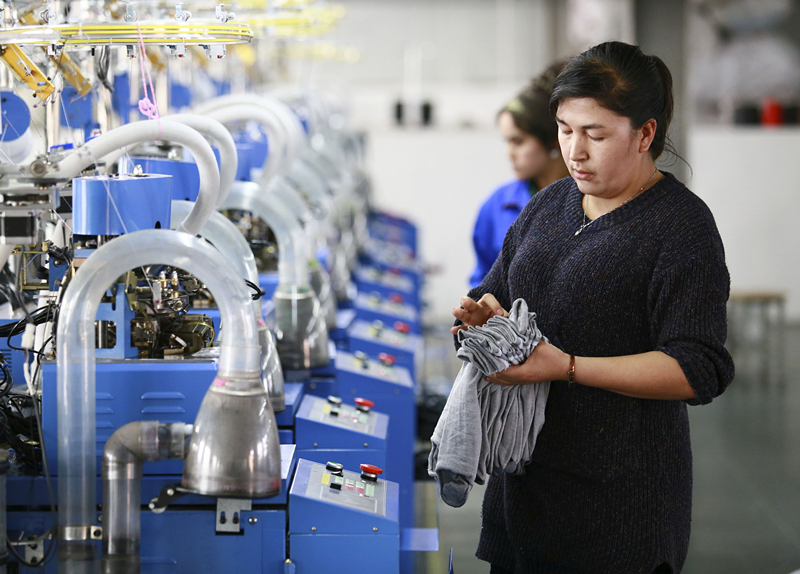
Most people living in deep poverty in the four prefectures are rural residents, and many are members of ethnic groups with limited education. Many also have chronic illnesses associated with their lifestyles (such as tuberculosis and iodine deficiency), the statement said.
This year, the regional government initiated a three-year poverty-relief plan targeting the four prefectures, with the aim of lifting 400,000 people out of poverty by the end of December.
Growing riches
"I thought black fungus came from the sea, and it was impossible to grow, but after being encouraged by the team, I decided to try," said Tunisakhan, who earned 11,000 yuan last year from cultivating the fungus.
When they grew walnuts for a living, the villagers had to prune the trees to help them grow. They stored the severed branches in their yards.
When the poverty alleviation team arrived, they noticed the fungus growing on the branches, and realized that cuts in the bark provided the perfect breeding ground, Tunisakhan said.
In response, the team provided machines to pulp the tree branches. The pulp is made into logs and wrapped in damp plastic sheeting to create an environment where the fungus can multiply. The "bacteria sticks", as the villagers call them, are then stored in the grow tunnels to prevent rapid evaporation.
"Instead of growing walnuts, we now break tree branches to make the bacteria sticks. It's natural, and means the fungus can be produced at a reasonable cost," Tunisakhan said.
Liu Guorong, deputy director of the poverty alleviation office in Aksu, said growing fungus is a way of creating value out of waste in Wushi, which was designated a national-level poverty-stricken county in 1994.
The northwestern part of the county, which is surrounded by mountains, shares a 137-kilometer border with Kyrgyzstan. The total area of cultivated land is 30 million hectares and the per capita area of cultivated land is 1,553 square meters.
"The soil is very thin and contains many small rocks, so the area of cultivated land per family is very low," Liu said. "Before, walnuts were the main cash crop and the only source of income for many farmers."
Poverty is also responsible for the low level of education and poor health care provision in Wushi, and families can easily fall into poverty if a member becomes ill or is injured in an accident, according to Liu.





- China's Global Governance Initiative receives positive feedback at forum
- China's Xizang sees steady tourism growth in 2025
- First-of-its-kind pearl auction held utilizing Hainan FTP
- Agarwood exhibition steeps Shanghai museum in fragrance
- The Fujian Coast Guard conducts regular law enforcement patrol in the waters near Jinmen
- IP protection for new fields to improve