



Why are Sino-US ties 'the most consequential'?









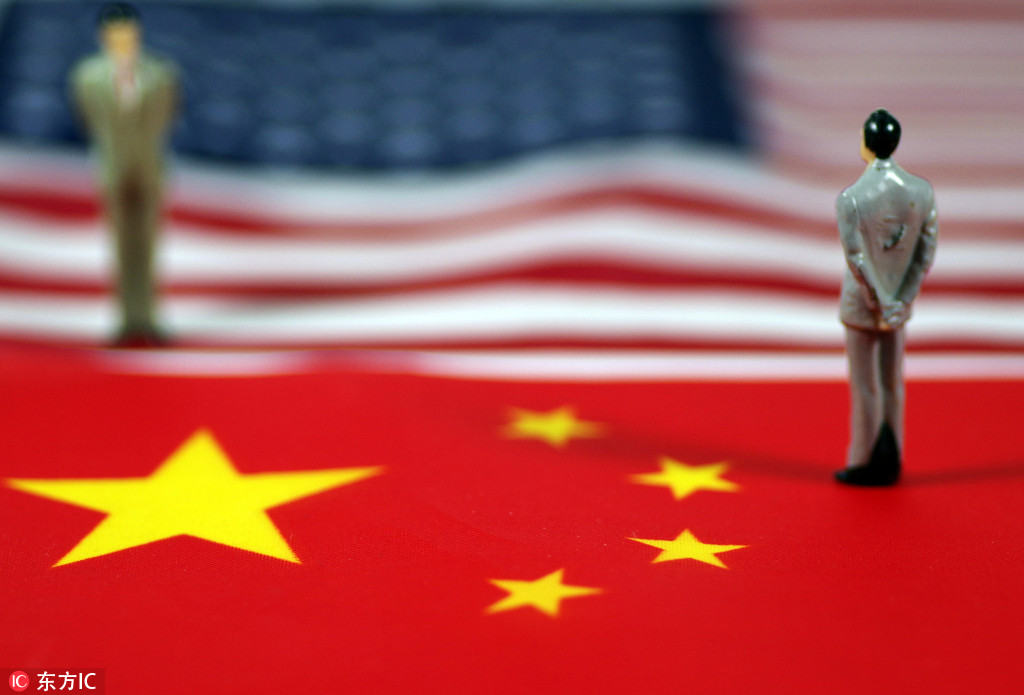
When John Allen, president of the Brookings Institution, said the US-China relationship is "the most consequential" bilateral relationship of the 21st century in Washington on Tuesday, I realized he had said the same thing a few weeks before.
Allen didn't elaborate even this time, and he didn't need to. At least three public discussions were held on Tuesday in different venues blocks apart, and they all focused on China-US relations, from trade conflicts to long-term interests to myths the two peoples hold about each other. It's not surprising that so many events on a single day were devoted to reviewing the status quo and trends in the relations between the world's top two economies because they are locked in an escalating trade conflict and facing rising tensions on many other fronts.
But the takeaways from the discussions were interesting, which mostly favor de-escalation of the trade conflict, prefer cooperation to rivalry and seek to bridge the gaps that separate the two countries.
At a seminar organized by the Institute for China-America Studies on Tuesday morning, senior economists from the International Monetary Fund and the Asian Development Bank reviewed how the tit-for-tat trade measures by the two countries are already wreaking havoc on their economies, as well as the rest of the world.
The trade conflict the US administration triggered is going to cost at least 8.6 million jobs in China and 329,000 jobs in the United States in the worst-case scenario, Valerie Mercer-Blackman of the ADB said at the seminar.
Shanaka Jayanath Peiris from the IMF argued that the aggregate labor displacement would be limited, but some sectors such as textiles in China and agriculture in the US, could be hit hard. The East and Southeast Asia regions, whose supply chains are centered on China, are the most dynamic growth centers in the world today. A prolonged China-US trade conflict would undermine the confidence of investors and deter investment much beyond the regions, the Institute for China-America Studies said in a statement.
One of Tuesday's most important think tank events was the "China Debate: Are US and Chinese long-term interests fundamentally incompatible?" held at the Brookings in the afternoon. The team supporting the motion, led by Evan Medeiros, Penner Family Chair in Asian Studies at Georgetown University, argued that US-China interests are substantially and increasingly incompatible, with more divergence than convergence. Medeiros warned that "continuing to deny that our interests are diverging more than converging is dangerous" because he said that would "embolden" China to be more assertive in pursuing its multiple interests.
But Susan A. Thornton, former US acting assistant secretary of state for East Asian and Pacific Affairs, on the opposing team, said the trade conflict is manageable and that the two countries have many interests in common - either in countering instability and conflict in regional hotspots; fighting terrorism and extremism; or in promoting prosperity for both as well as other countries.
"Maybe the most fundamental interest we have in common is the mutual desire to avoid conflict," said Thornton, now senior fellow at Paul Tsai China Center of Yale Law School. "I would also argue that China is not a revisionist, that China sees itself as wanting to prolong and continue the existing international order, albeit with some changes."
Before the nearly 90-minute debate, 35 percent of the audience voted that American and Chinese long-term interests are incompatible, while 50 percent disagreed, and 15 percent were undecided. "After the debate, 53 percent disagreed," announced Evan Osnos, a nonresident fellow with the John L. Thornton China Center at Brookings.
The event on Tuesday evening - a panel discussion followed by the screening of the latest documentary on China-US relations - was a light one but shed light on serious issues, including whether Americans really understand China.
Five years in the making, the 90-minute film, Better Angels, directed by two-time Academy Award winner Malcolm Clarke, is an ode to ordinary men and women in the two countries who have put the relationship on a firm footing. In the words of co-producer William Mundell, the documentary highlights the wider benefits of US-China cooperation, the dark side of globalization for the Chinese, and the common humanity that drives China and the US together.
After watching the film, I agree with Mundell that by using the lens of ordinary Americans and Chinese to bridge the gaps separating them, the film will help shatter the myths that Americans have about China, and Chinese have about the US. And I understand all the more what Allen meant when he said Beijing and Washington comprise "the most consequential bilateral relations of the 21st century".
The author is deputy editor-in-chief of China Daily USA.





