


Peking Man site at Zhoukoudian









Category of site: Cultural Site
Brief introduction
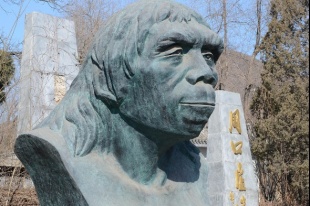
The Peking Man site 42 kilometers south-west of Beijing was first excavated in 1927, in a cave on the Dragon Bone Hill at Zhoukoudian, southwest of Beijing. In 1929, skull fossils of the Peking Man were discovered, and provided concrete evidence for the existence of the primitive man in the Beijing area and marking a milestone in the history of paleoanthropology. So far, a total of six skulls, 15 pieces of lower jawbones, 157 teeth and numerous other bone segments from the bodies of about 40 humans have been excavated, providing concrete data for the study of the evolution of pre-historic biology and the development of pre-historic culture.
Fossils of primitive men living 20,000 years ago were excavated in 1930 near the top of Dragon Bone Hill, and were named Upper Cave Man fossils. In 1973, fossils of New Cave Man were discovered. New Cave Man is believed to have lived in the period between Peking Man and Upper cave Man, suggesting a continuity of development.
The Peking Man Site at Zhoukoudian was added to the list in December 1987.
Peking Man
This is the remains of Sinanthropus pekinensis, who lived in the Middle Pleistocene, along with various objects, and remains of Homo sapiens sapiens dating as far back as 18,000-11,000 BC. The average brain volume of these people was 1,088 milliliter (the average for modern people is 1,400 ml). And it is estimated that their average height reached 156 cm for males and 150 cm for females. They chose to stay here for adequate water supplies and natural limestone caves, which provided an optimal survival environment.
Peking Man was among the first human beings to learn how to use fire, and could hunt large animals. Their average life expectancy was short; it is estimated that 68.2 percent of them died by the age of 14, and only 4.5 percent lived up to 50 years.
Cultural heritage
As primitive men evolved from ape men to intelligent men, Peking Man learned how to make tools in the early Paleolithic period, marking them as humans, different from apes.
Ancient human fossils, cultural remains and animal fossils from 23 localities within the property dating from 5 million years ago to 10,000 years ago discovered by scientists include the remains of Homo erectus pekinensis living in the Middle Pleistocene (700,000 to 200,000 years ago), archaic Homo sapiens who lived about 200,000-100,000 years ago and Homo sapiens sapiens of about 30,000 years ago. Meanwhile, scientists have also discovered fossils of hundreds of animal species, over 100,000 pieces of stone tools and evidence (including hearths, ash deposits and burnt bones) of Peking Man using fire.
Though scientific work at the site is still under way, the discovery and study of Peking Man and his culture solved the 50-year-long controversy over whether ape-men were apes or men, which resulted from the excavation of Java Man in the 19th century. Evidence indicates that at the dawn of human civilization, ape-men did exist and they were descendants of southern apes and ancestors of intelligent men, judging from their physique, culture and social organization. Peking Man still serves as the benchmark for judging whether an ancient creature was an ape or homo sapiens. The Zhoukoudian Site is invaluable for paleoanthropological research. It is not only an outstanding reminder of the pre-historical human societies of the Asian continent, but also describes the process of evolution.
Fossils
In December 1929, under the leadership of Chinese anthropologist Pei Wenzhong, a team from the Peking Institute of Geology excavated the first skull fossil of Peking Man. It was identified as being at least 690,000 years old. In the following large-scale excavation, a large number of skulls, bones, teeth and bone segments were discovered. The finding of these ape-man fossils was of great significance for the study of human evolution.
Evolution from Ape to Man
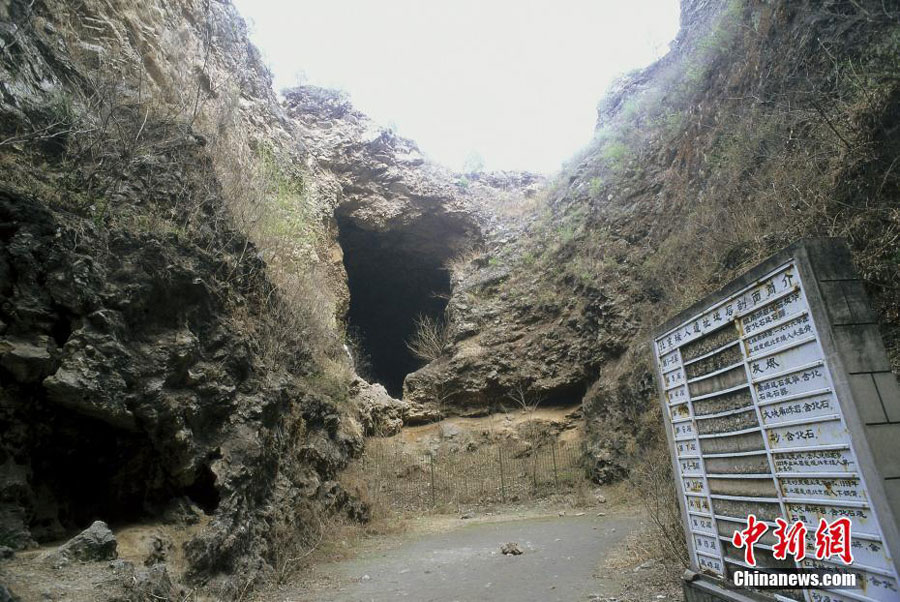
The site of Peking Man is a large natural cave. Some 700,000 years ago, a species of homo sapiens lived here for about 300,000 years, leaving several layers of ash as evidence of the use of fire. In addition, a number of stone tools were excavated here.
In 1933, fossils of New Cave Man, who lived about 50,000 to 20,000 years ago, were discovered here. He was a descendant of Peking Man, but much more evolved. He resembled modern human beings in appearance, with fairly well developed intelligence and superior physique to Peking Man.